QZS-7
Shape built from published dimensions and pictures; details simplified.
Turn it in 3D
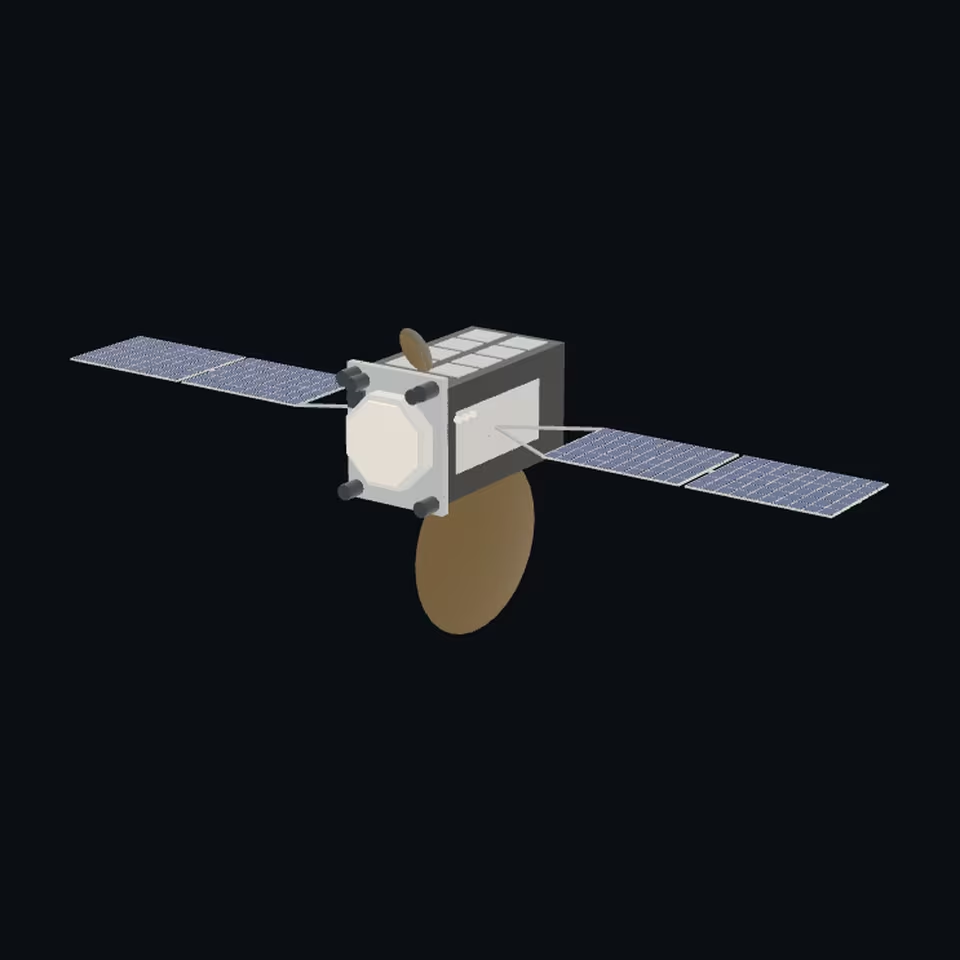
Open the 3D viewer (www.spaceradar.ai).
The viewer loads when you ask: about 700 kB the first time (three.js and the model), much less after.
Pictures 4
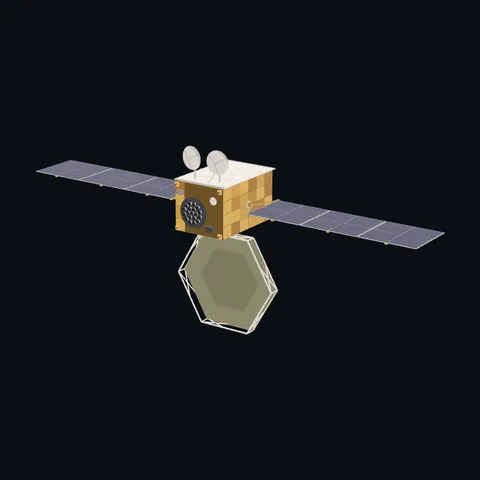
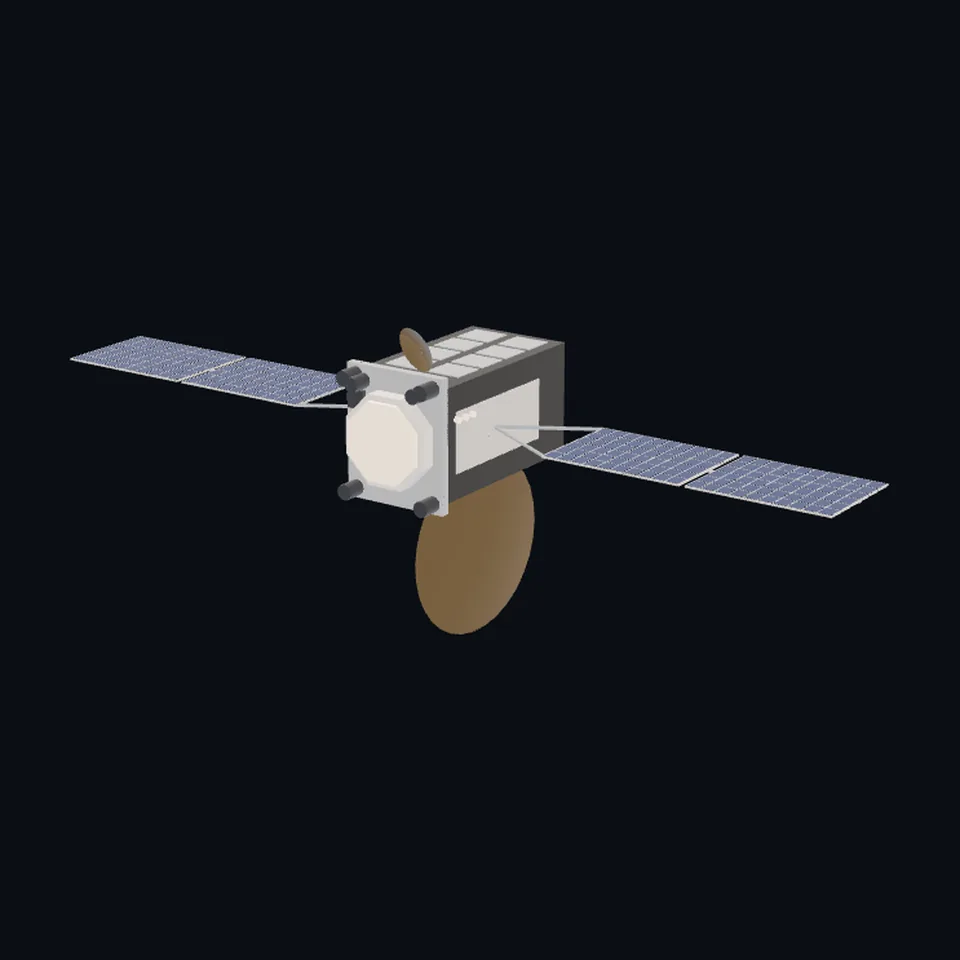 Three-quarter view
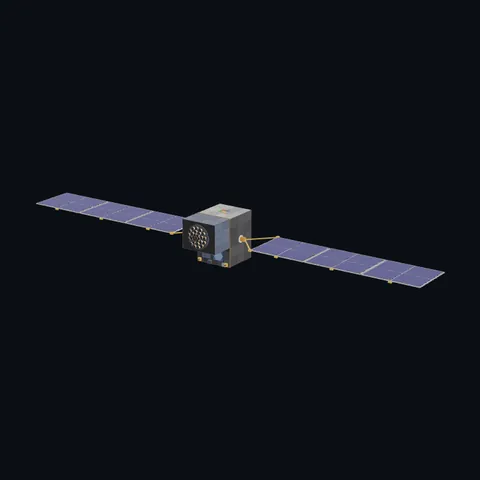
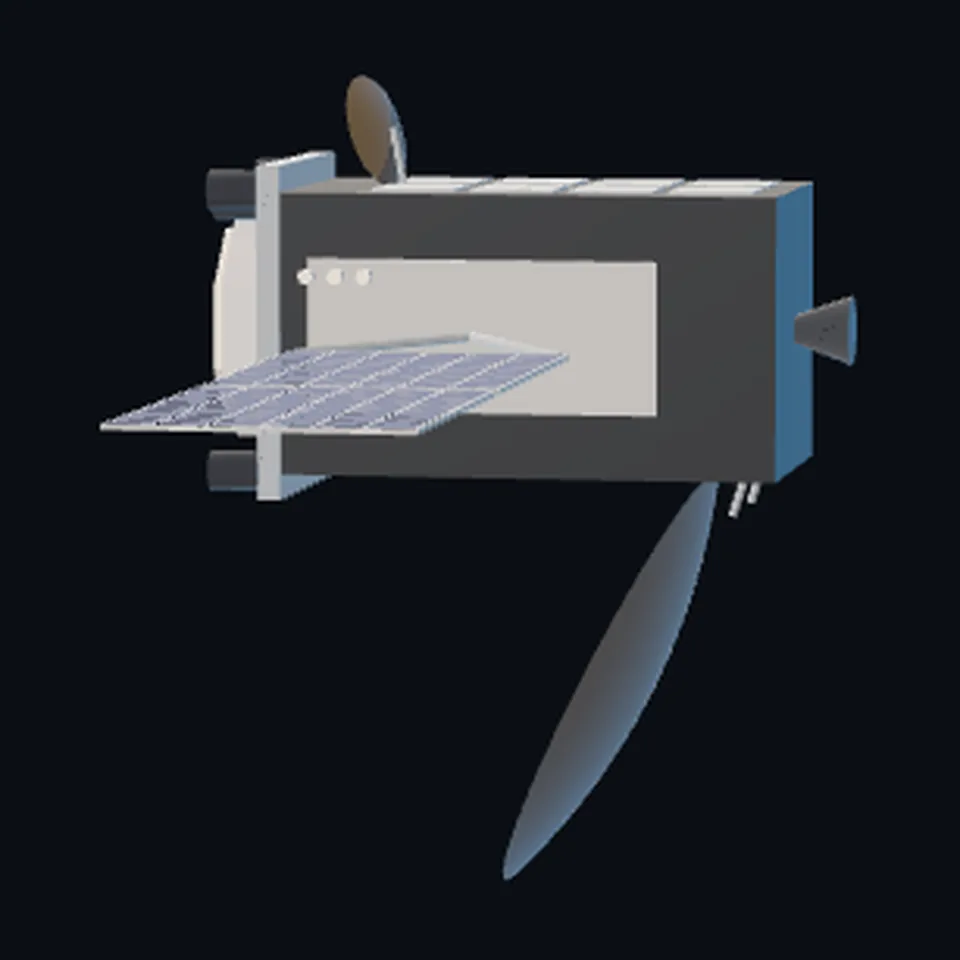 From the side
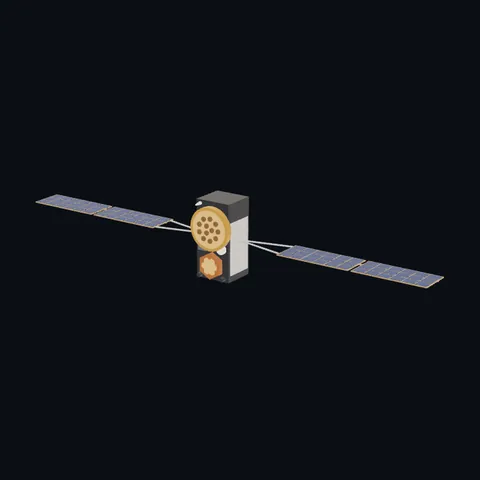
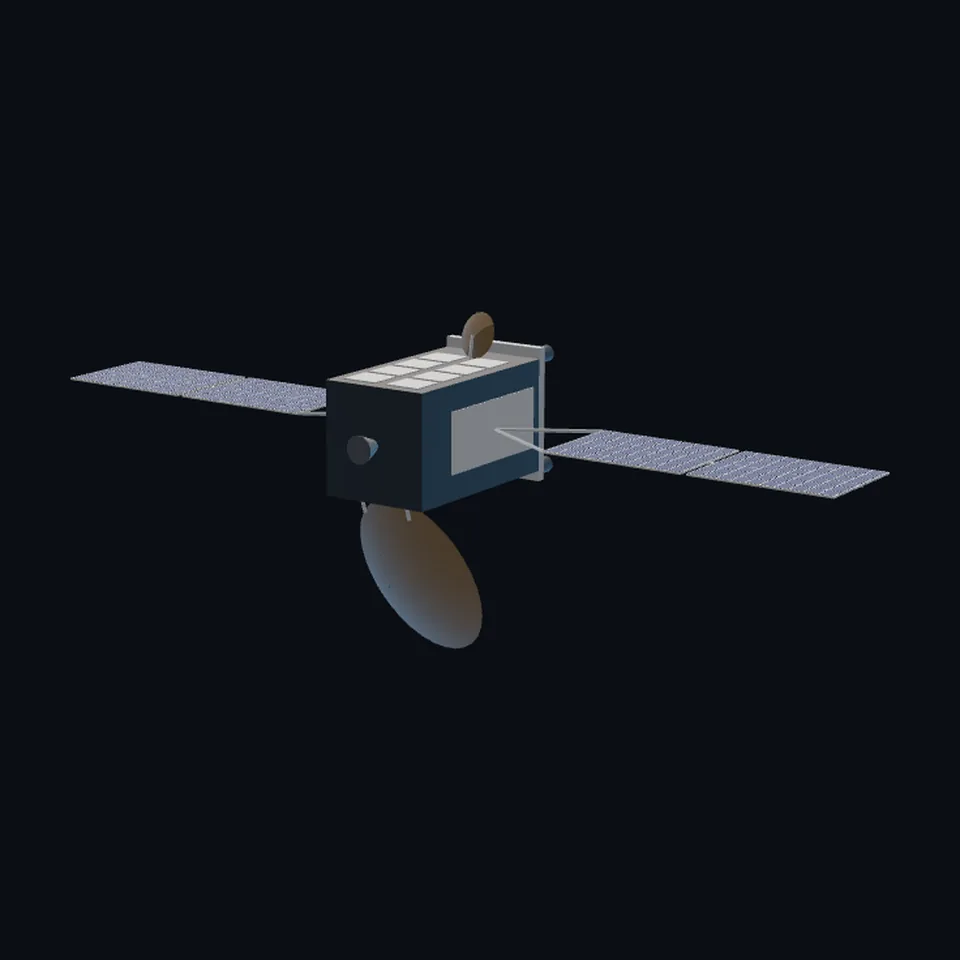 From behind
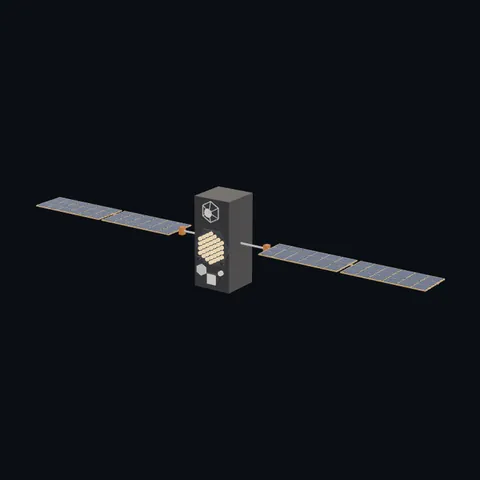
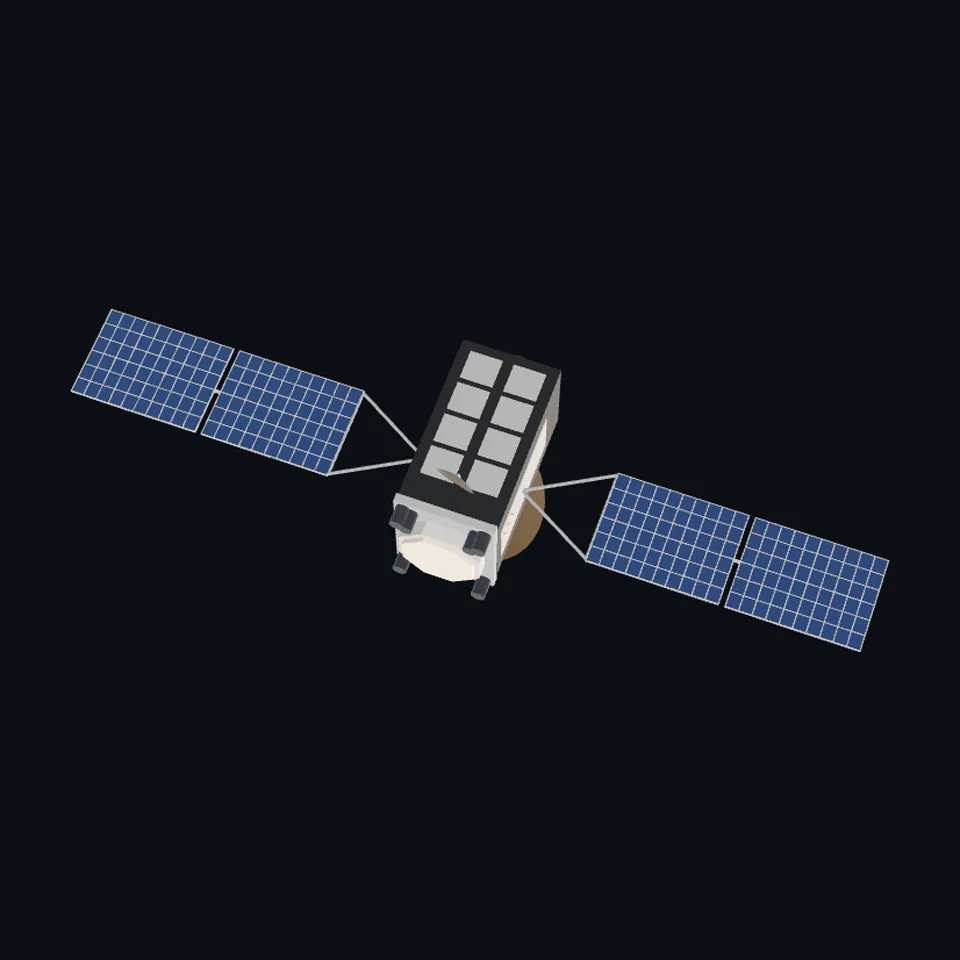 From above
About this model
QZS-7 is one of the 203 3D models Space Radar made itself: a satellite, built in code from published dimensions and photographs, with no image-to-3D generator and no one else’s mesh.
Shape built from published dimensions and pictures; details simplified. It has 17,390 triangles in a 78 kB glTF file, and is 19 m across at full scale.
On Space Radar’s live map it is drawn for the object with NORAD catalogue number 100270, where its published orbit puts it now. Open it on the map.
Dimensions and their sources
| Measure | Value |
|---|---|
| Body 1 | 2.359 m |
| Body 2 | 2.4 m |
| Wing | 8.271 m |
| Span | 18.901 m |
| Solar array area | 14.9 m² |
| L ant cover | 2.3 m² |
Cabinet Office, Government of Japan, 'QZS-7 Satellite Information', SPI-QZS7 (Oct 19, 2026), qzss.go.jp/en/technical/qzssinfo/khp0mf0000000wuf-att/spi-qzs7.p…, OPENED 2026-11-04 (the list it hangs from: qzss.go.jp/en/technical/qzssinfo/index.html), section 6 'Geometry', 'Figure 4 Satellite dimensions' '(Unit: mm)', whose dimension lines read 8271, 2359, 8271 (each wing, the body, the other wing) and 18901 (tip to tip), the figure drawing two reflectors; Table 4 'Optical properties': 'SAP 14.9' m2 on each Y face, '+X MLI 10.0', '+Z MLI 3.2', 'L-ANT Cover 2.3', 'LXR/ISR-ANT Covers 0.5', '-Z MLI 5.6', 'Reflector-1' and 'Reflector-2' with the notes 'Reflector-1 orients so that the normal vector of the front surface is (-0.443, -0.062, 0.895). Reflector-2 orients so that the normal vector of the front surface is (0.294, -0.254, 0.922).'; section 2: 'The +Z-axis is oriented to the bore sight direction of the L-ANT antenna. The +Y-axis is parallel to the rotation axis of the solar panels'; section 3 'Attitude Law': 'Yaw steering mode: The +z-axis is pointing to the Earth. The y-axis is oriented perpendicular to the plane made up by the Sun, Earth and satellite.' DERIVED: the same bus as QZS-2 and QZS-1R (a box 2.359 x 2.4 x 4.25 m, wings of two 3.2 x 2.33 m panels on 1.9 m yokes); the cover read as a regular octagon 1.67 m across; the reflectors' sizes (an oval about 3 m by 4 m and a dish 1 m across) read off the figure's scale. READ OFF THE FIGURE AND THE PICTURES (CC BY 4.0): Reflector-1 a large dish hung from the bottom of the +X face and standing out to the side and up, drawn as a yellow mesh; Reflector-2 a small dark dish on the -X face near the top; the black blanket with its silver tiles; the octagonal patch. OURS: the dishes' depth, exact size and holders, the tiles, the deck's corner units. The reflectors are drawn solid; the real ones are a mesh. (read 2026-11-04)
How it was made
Built in code from published dimensions and photographs, with no image-to-3D generator and no one else’s mesh. 3D model: built by Space Radar from the dimensions in the Cabinet Office of Japan's satellite information; compared with renders from the Quasi-Zenith Satellite System website (CC BY 4.0).
The full record
built by this project in code (the private tool model-from-images: assemble.py, from a yaml of primitives), from the cited dimensions and the pictures under `references`; no image-to-3D model was used, and no published mesh (NASA's 3D Resources on GitHub, 1 583 paths read 2026-10-13, has none of this craft; the survey of 2026-10-13 found no agency model of it under usable terms)
Where the map uses it. any record of klass satellite named QZS-7 (1 record in the live saved data of 2026-11-04: QZS-7 (MICHIBIKI-7), NORAD 100270): the seventh Michibiki, the QZSS bus with a flat octagonal L-band antenna and two reflectors (the Cabinet Office's SPI-QZS7 of 19 October 2026 gives their normals). It was, and while this file is on its way still is, the family navigation box at Galileo's size; internal #751
Licence note. The shape is this project's, under this repository's licence, built from published numbers (facts). The Cabinet Office's renders compared with are CC BY 4.0 and are not in the file. The Cabinet Office's dimension drawing was READ FOR ITS NUMBERS AND LAYOUT and is not reproduced. NO LOGO AND NO LETTERING is on the mesh.
References 2
What the shape was compared with. None of these pictures is in the file.


Use it
The model is under the MIT licence: use it, change it and share it, in any project, also a paid one. Keep the credit:
QZS-7 3D model by Space Radar (spaceradar.ai), MIT LicenseAny glTF 2.0 loader that reads meshopt compression (EXT_meshopt_compression) opens the file: three.js with its MeshoptDecoder, Babylon.js, model-viewer. Tools such as glTF-Transform can write an uncompressed copy.
Or embed the viewer in your page:
<iframe src="https://www.spaceradar.ai/model/?id=qzs-7" title="QZS-7, 3D model by Space Radar" width="600" height="450" loading="lazy" style="border:0;max-width:100%"></iframe>Related models