BeiDou-3 MEO
Shape built from published dimensions and pictures; details simplified.
Turn it in 3D
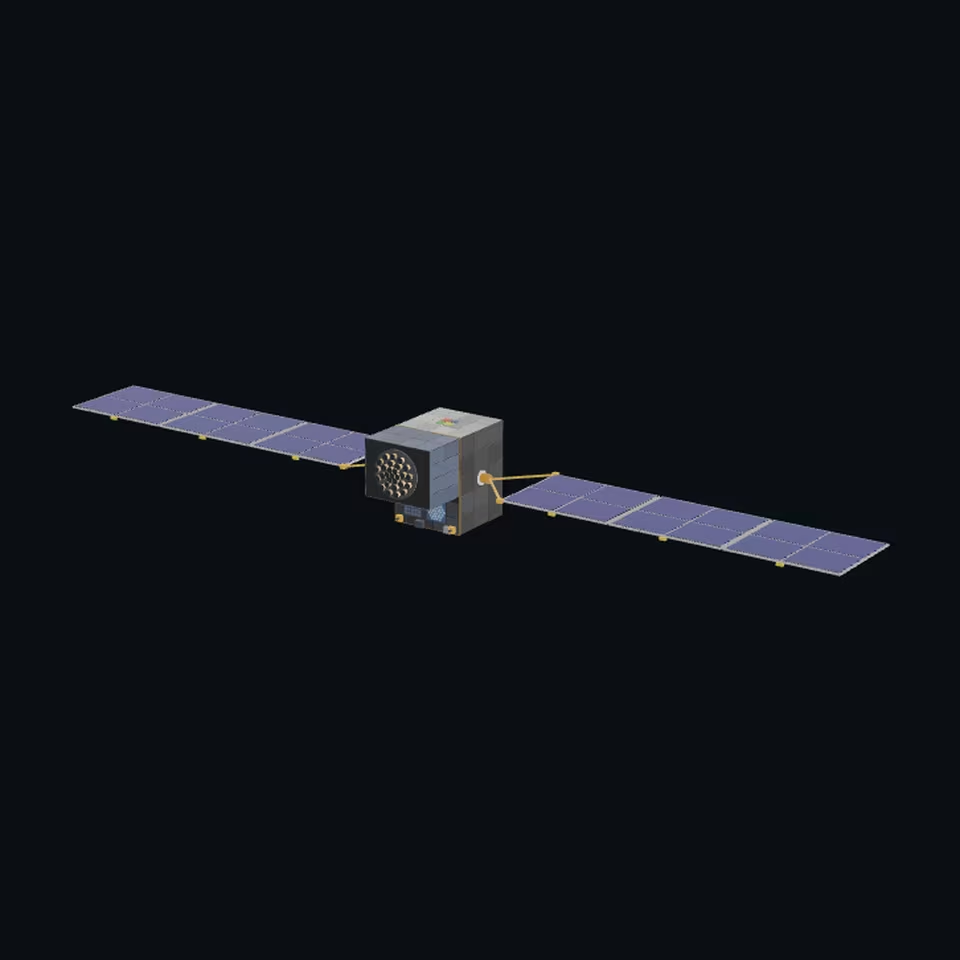
Open the 3D viewer (www.spaceradar.ai).
The viewer loads when you ask: about 700 kB the first time (three.js and the model), much less after.
Pictures 4
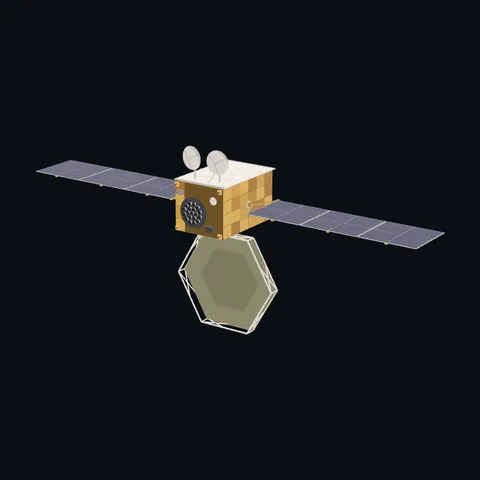
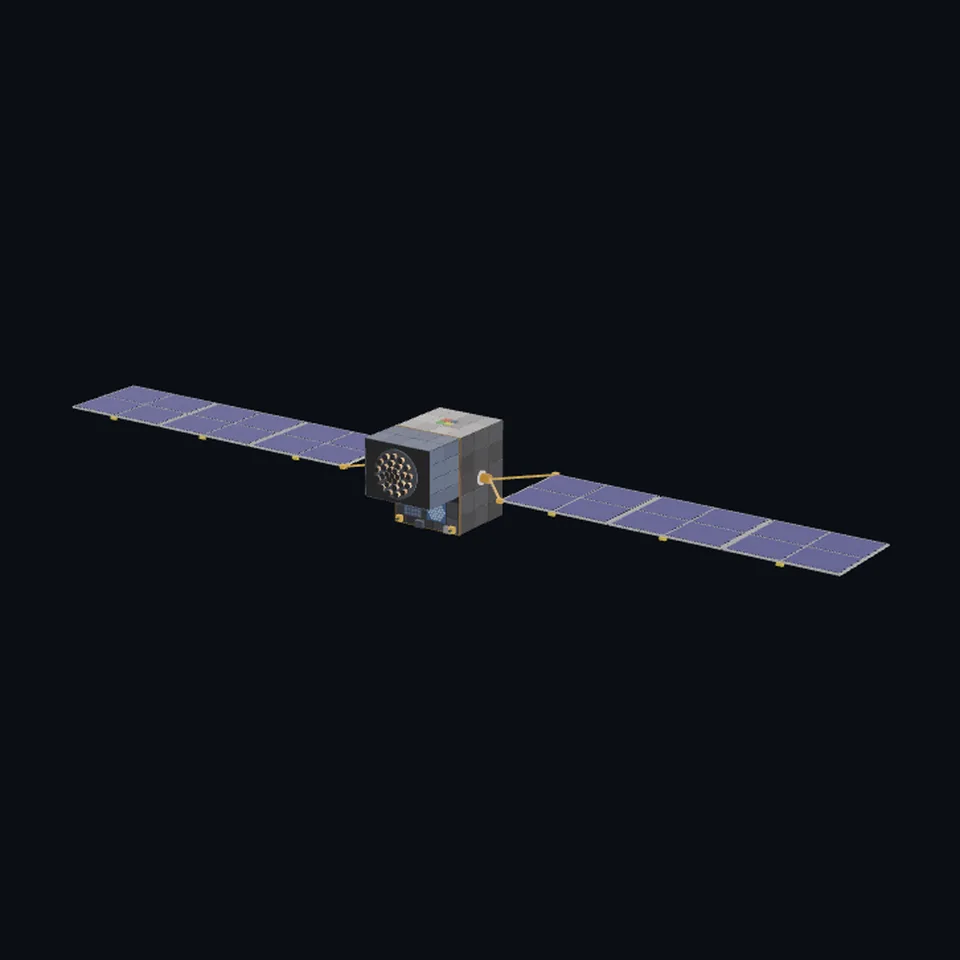 Three-quarter view
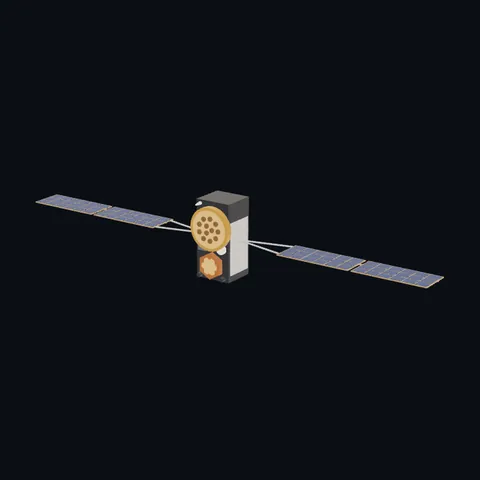
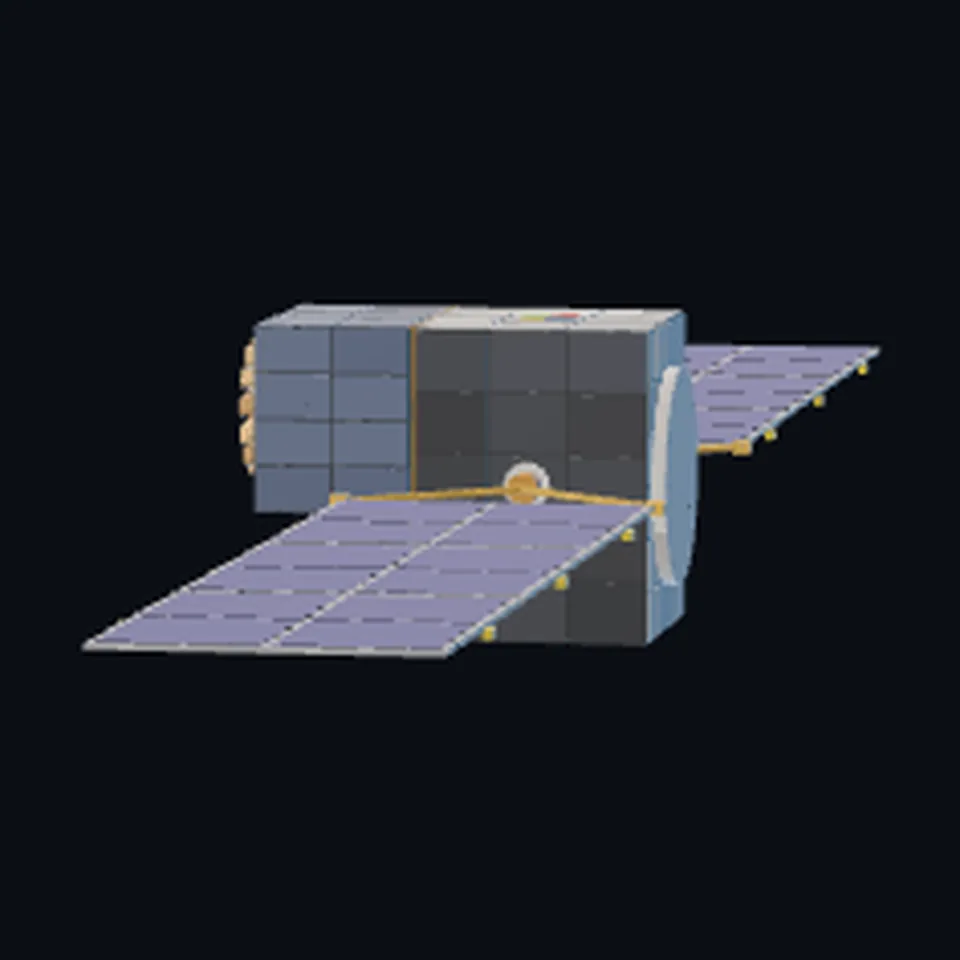 From the side
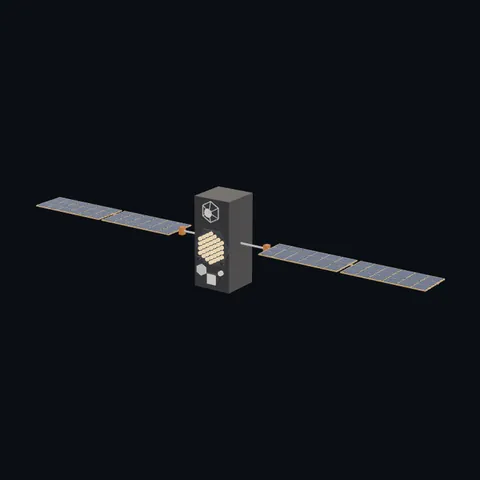
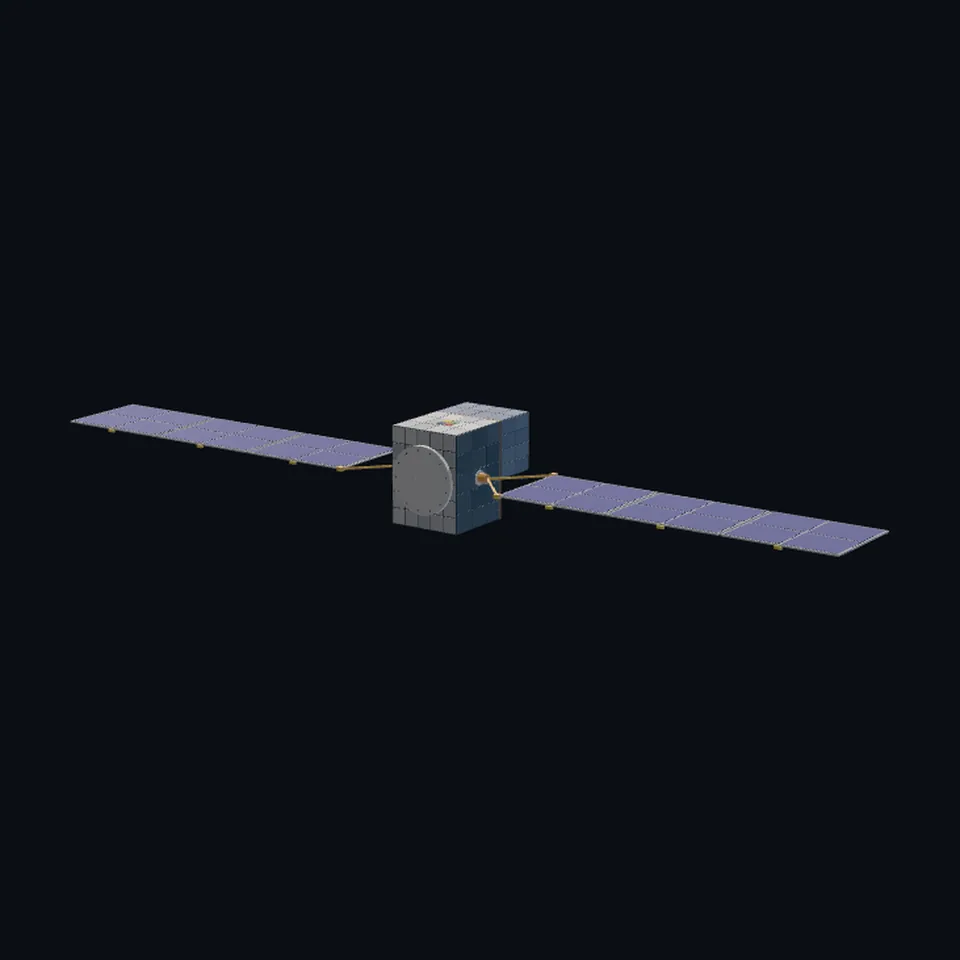 From behind
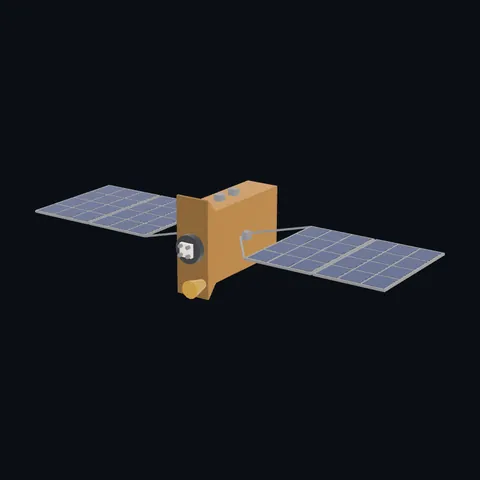
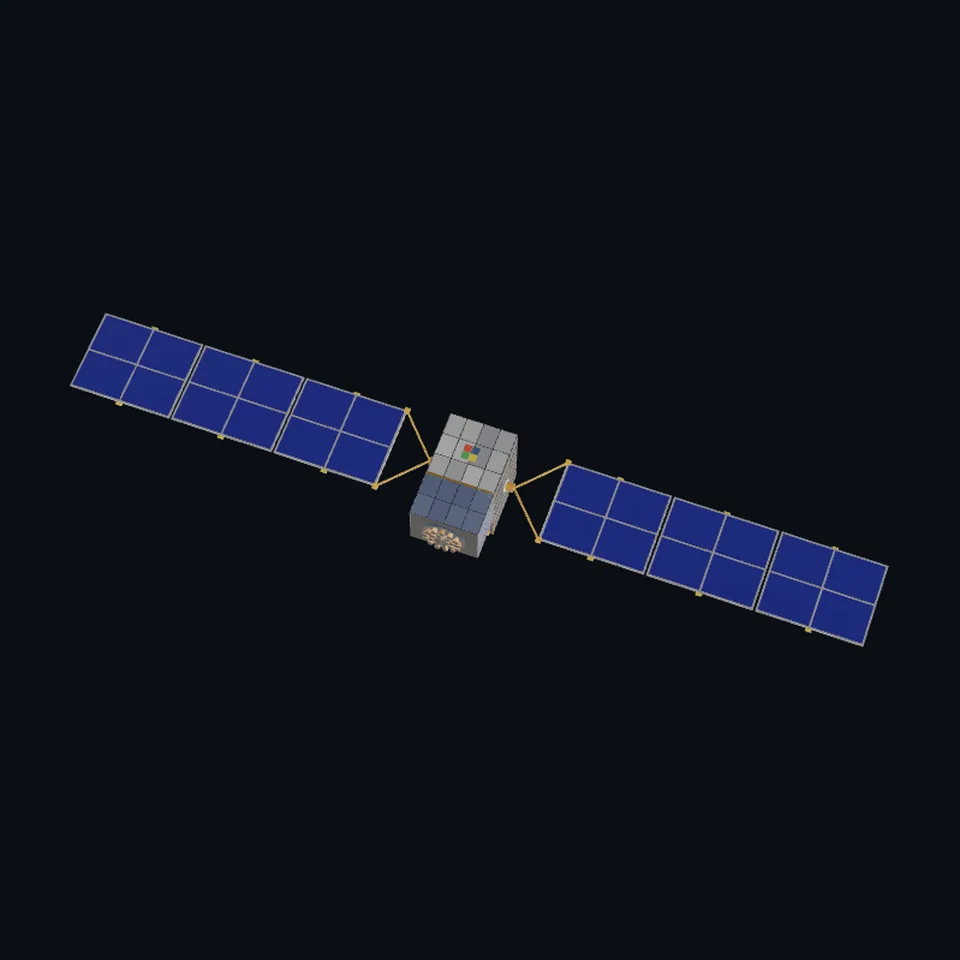 From above
About this model
BeiDou-3 MEO is one of the 203 3D models Space Radar made itself: a satellite, built in code from published dimensions and photographs, with no image-to-3D generator and no one else’s mesh.
Shape built from published dimensions and pictures; details simplified. It has 9,710 triangles in a 91 kB glTF file, and is 16 m across at full scale.
On Space Radar’s live map it is drawn for 28 catalogued objects, each where its published orbit puts it now. Open it on the map.
Dimensions and their sources
| Measure | Value |
|---|---|
| Mass | 1014 kg |
| T1 | 1.68 × 1.3 × 1.3 m |
| T2 | 1 × 1.3 × 0.85 m |
| Solar area | 20.44 m² |
| Wing span | 15.5 m |
| Panel | 1.68 × 2.03 m |
BUS METRES FROM A SOURCE THE WIKIPEDIA 'BeiDou' ARTICLE DOES NOT GIVE: that article (OPENED 2026-11-03) names no body size, only 'All BeiDou satellites are equipped with laser retroreflector arrays' and the three orbit types; the metres are from the papers below. (1) 'Precise orbit determination for BDS satellites', Satellite Navigation 2, 2021, Table 2 'Geometry dimensions of BDS satellite bus and mass', satellite-navigation.springeropen.com/articles/10.1186/s43020-02…, OPENED 2026-11-03: MEO 'T-shaped (T1) ~ 1000 kg, 1.68, 1.30, 1.30 m, solar panels 20.44 m2'; 'T-shaped (T2) 1.00 1.30 0.85'; 'SECM-A ~ 1050, 2.55, 1.02, 1.51, 10.8'; 'SECM-B ~ 1050, 2.80, 0.92, 1.35, 10.8'. (2) 'Study of the SRP model for BDS-3 satellites SVN C223 and C222', Satellite Navigation 2025, Table 2, satellite-navigation.springeropen.com/articles/10.1186/s43020-02…, OPENED 2026-11-03: CAST '+X 2.86, +Z 2.18, -Z 2.18 m2, solar panel 20.44 m2'; SECM-A '+X 1.25, +Z 2.59'; SECM-B '+X 1.24, +Z 2.57', 10.80 m2. 2.18 = 1.68 x 1.30 and 2.86 = 1.30 x (1.30 + 0.85) (this arithmetic is ours): the two tables agree about CAST's body. (3) Dilssner et al., ESA/ESOC, IGS Workshop 2018, files.igs.org/pub/resource/pubs/workshop/2018/IGSWS-2018-PY02-03…, slide 4, OPENED 2026-11-03: 'BDS-3M CAST 1.22 [x-panel m2] 2.25 [z-panel m2] 1014 [kg]'; 'BDS-3M SECM 1.24 2.58 1030'; 'Rectangular shape with a ratio of about 2:1 for main body axes'; slide 12: 'Indicates approximately factor two larger solar array on CAST satellite (~ 27 m2)'. (4) Gunter's Space Page, 'BD-3 M (Type 1)', space.skyrocket.de/doc_sdat/bd-3m.htm, OPENED 2026-11-03: 'They feature a phased array antenna for navigation signals and a laser retroreflector.'; 1014 kg (marked uncertain); the list of the CAST craft M1 to M6, M13, M14, M17, M18, M23, M24. THE PAGES DISAGREE and this was built: the bus of table (1) (T1 and T2), which table (2)'s face areas confirm and which gives the 2.2 m height and 1.7 m width that keeptrack.space (a catalogue site, read through a search extract and NOT OPENED; scene/models.js cites its satellite/43707 page) gives for this craft; the CAST solar area of 20.44 m2 of tables (1) and (2), NOT ESA's ~27 m2 and NOT that site's 'span of approximately 10 meters' (which does not fit 20.44 m2 on panels as wide as the body). NOT BUILT: SECM-A and SECM-B (2.55 to 2.80 m long, 10.8 m2). A second sanity check, not a source for the build: a Shanghai Observatory ILRS talk (ilrs.gsfc.nasa.gov/lw16/docs/presentations/tar_7_Wanzhen.pdf, read through a search extract, NOT OPENED) gives the COMPASS-M1 test craft's retroreflector array as 42 cubes of 33 mm on 31.6 x 28 cm. NOT CITED, READ OFF THE PICTURES AND ESTIMATED: how T2 sits on T1 (at one end, flush with its edge, on the Earth face), the round array's size (0.82 m) and its 28 cups, the retroreflector plate (0.38 m, 37 round cubes of 50 mm), the inter-satellite-link plate (0.36 m, 5 x 5 elements), the ring antenna, the boxes and corner units, the 1.19 m ring and its thirteen bolts on the far deck, the four-coloured square, the yokes (0.95 m) and hinge blocks, the panels' shape (three of 1.68 x 2.03 m a wing: the width from the drawing, the length from the cited area), the colours. NO PAGE OPENED GIVES THE PANELS' SIZE, so the wing's 15.5 m span is the area of the cited table spread on the drawing's panel width. (read 2026-11-03)
How it was made
Built in code from published dimensions and photographs, with no image-to-3D generator and no one else’s mesh. 3D model: built by Space Radar from the dimensions published for BeiDou-3's CAST-built medium-orbit satellites and from pictures of them by ESA/ESOC, CAST and SECM (looked at, not used).
The full record
built by this project in code (the private tool model-from-images: assemble.py, from a yaml of primitives, object `satellite-beidou-3-meo`), from the cited numbers and the pictures under `references`; no image-to-3D model was used, and no published mesh (CAST, SECM and the China Satellite Navigation Office publish none; NASA's 3D Resources on GitHub carry none of this craft). The pictures of the CAST type are agency slides and are not free to derive from, so they were looked at only
Where the map uses it. NORAD 43001, 43002, 43107, 43108, 43207, 43208, 43245, 43246, 43581, 43582, 43602, 43603, 43622, 43623, 43647, 43648, 43706, 43707, 44542, 44543, 44793, 44794, 44864, 44865, 58654, 58655, 61186, 61187 (CelesTrak's BEIDOU-3 M1 to M28, the medium-orbit craft of BeiDou-3; table of public #987; earlier notes #429, #513): it replaces, for these 28 numbers, the generic navigation box of the name key `beidou` (build 'navigation-beidou-meo', a 1.02 x 2.2 x 1.19 m box with 10 m wings). The file is the CAST-built type: twelve of the 28 (M1 to M6, M13, M14, M17, M18, M23, M24: Gunter's Space Page) are CAST's; M7 to M12, M15, M16 are SECM's, a smaller craft, and M19 to M22 and M25 to M28 are not confirmed either way, so those wear it as the kind of thing (`generic: true`). BeiDou's geostationary and inclined craft are another shape and are not routed
Licence note. None of the pictures is in the file and none was fetched into it. LOOKED AT ONLY: the renders of the SECM and the CAST type (slide 4) and CAST's mechanical drawing (slide 13) in ESA/ESOC's slides for the IGS Workshop 2018 (credited 'Courtesy: SECM' and 'Courtesy: CAST', no licence stated); a news rendering of a BeiDou satellite (CC BY 4.0, China News Service, Commons); four museum mockups of the IGSO or GEO type on Commons (CC BY-SA 4.0 and CC BY 4.0), looked at to tell that type (a lattice hexagon and two white dishes) from this one. The shape is this project's, under this repository's licence, built from published numbers (facts). NO LOGO AND NO LETTERING is on the mesh.
References 4
What the shape was compared with. None of these pictures is in the file.
- Dilssner et al. (ESA/ESOC), BeiDou-3 MEO orbits, IGS Workshop 2018, slides 4 and 13ESA/ESOC; SECM; CASTno licence stated (ESA/ESOC; pictures credited 'Courtesy: SECM (top) & CAST (bottom)' and 'Courtesy: CAST'): looked at only
- Chinese news rendering of Beidou satelliteChina News ServiceCC BY 4.0 (China News Service; Commons' LicenseShortName, read 2026-11-03)
- Beidou satellite mockup at FING UNLP 01 to 03Wikimedia Commons contributor (name on the file page)CC BY-SA 4.0 (the third picture CC BY 4.0; Commons, read 2026-11-03): looked at only
- Beidou-3 Satellite MockupWikimedia Commons contributor (name on the file page)CC BY-SA 4.0 (Commons, read 2026-11-03): looked at only


Use it
The model is under the MIT licence: use it, change it and share it, in any project, also a paid one. Keep the credit:
BeiDou-3 MEO 3D model by Space Radar (spaceradar.ai), MIT LicenseAny glTF 2.0 loader that reads meshopt compression (EXT_meshopt_compression) opens the file: three.js with its MeshoptDecoder, Babylon.js, model-viewer. Tools such as glTF-Transform can write an uncompressed copy.
Or embed the viewer in your page:
<iframe src="https://www.spaceradar.ai/model/?id=beidou-3-meo" title="BeiDou-3 MEO, 3D model by Space Radar" width="600" height="450" loading="lazy" style="border:0;max-width:100%"></iframe>Related models