Galileo FOC
Shape built from published dimensions and pictures; details simplified.
Turn it in 3D
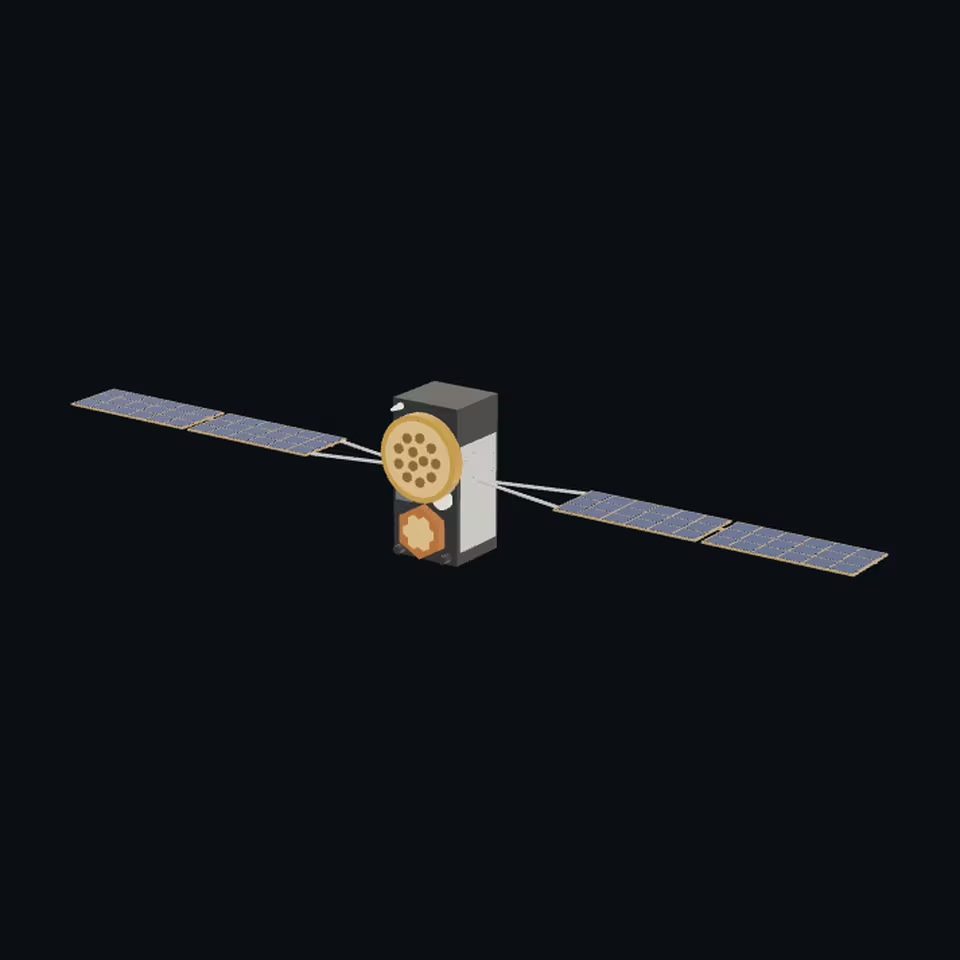
Open the 3D viewer (www.spaceradar.ai).
The viewer loads when you ask: about 700 kB the first time (three.js and the model), much less after.
Pictures 4
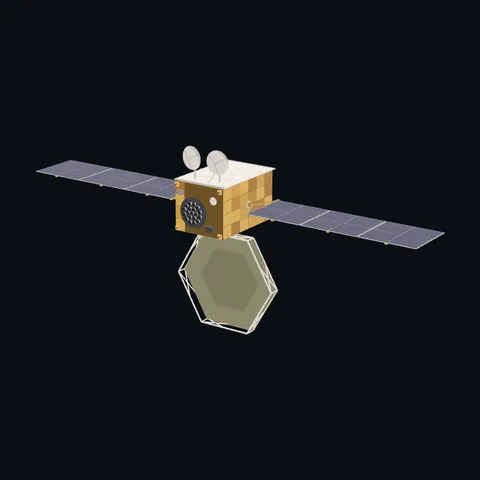
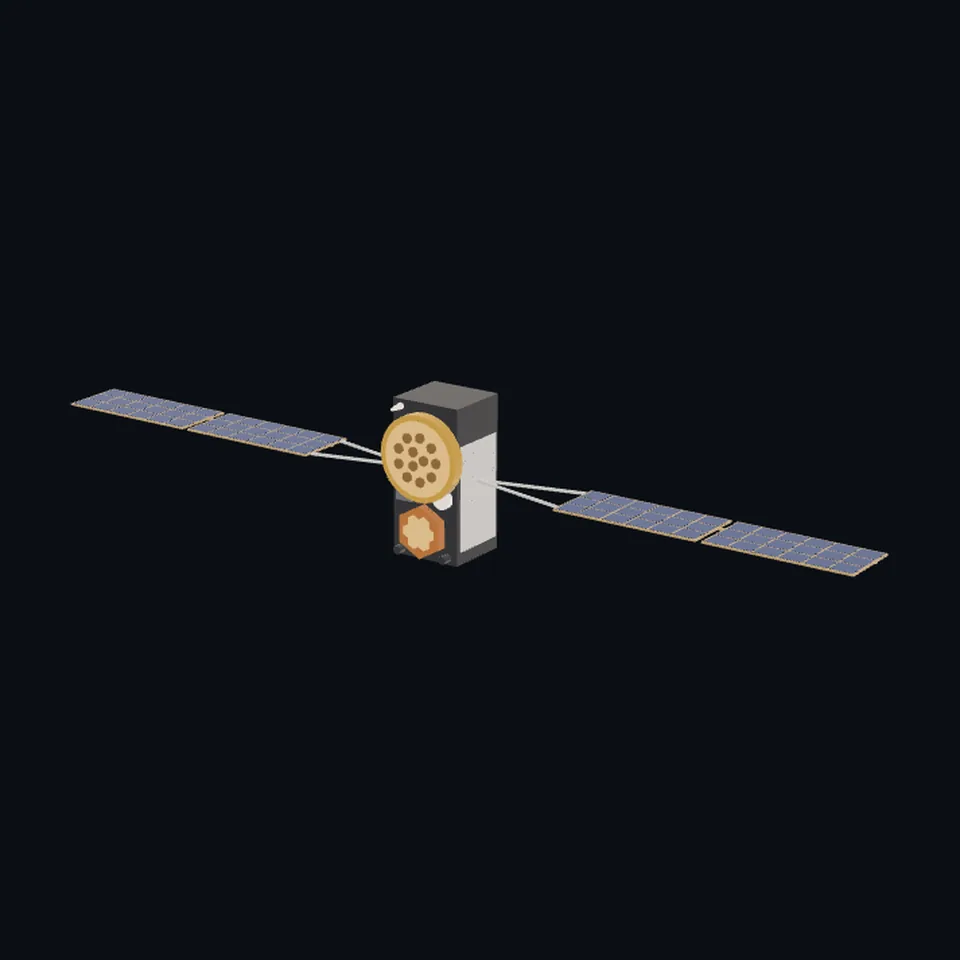 Three-quarter view
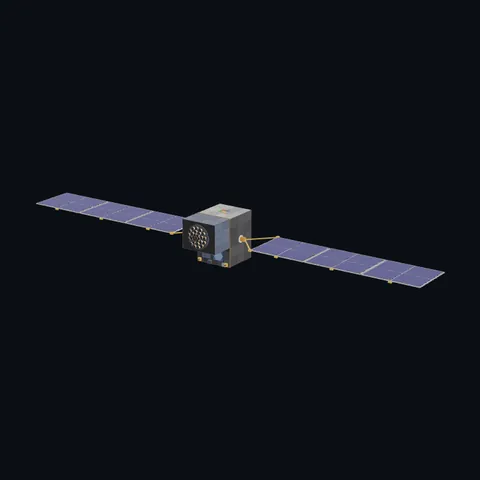
 From the side
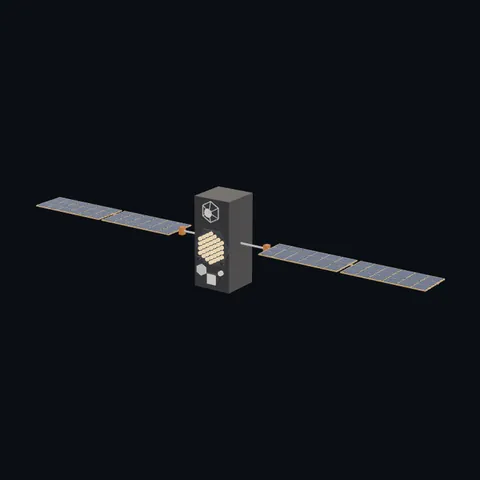
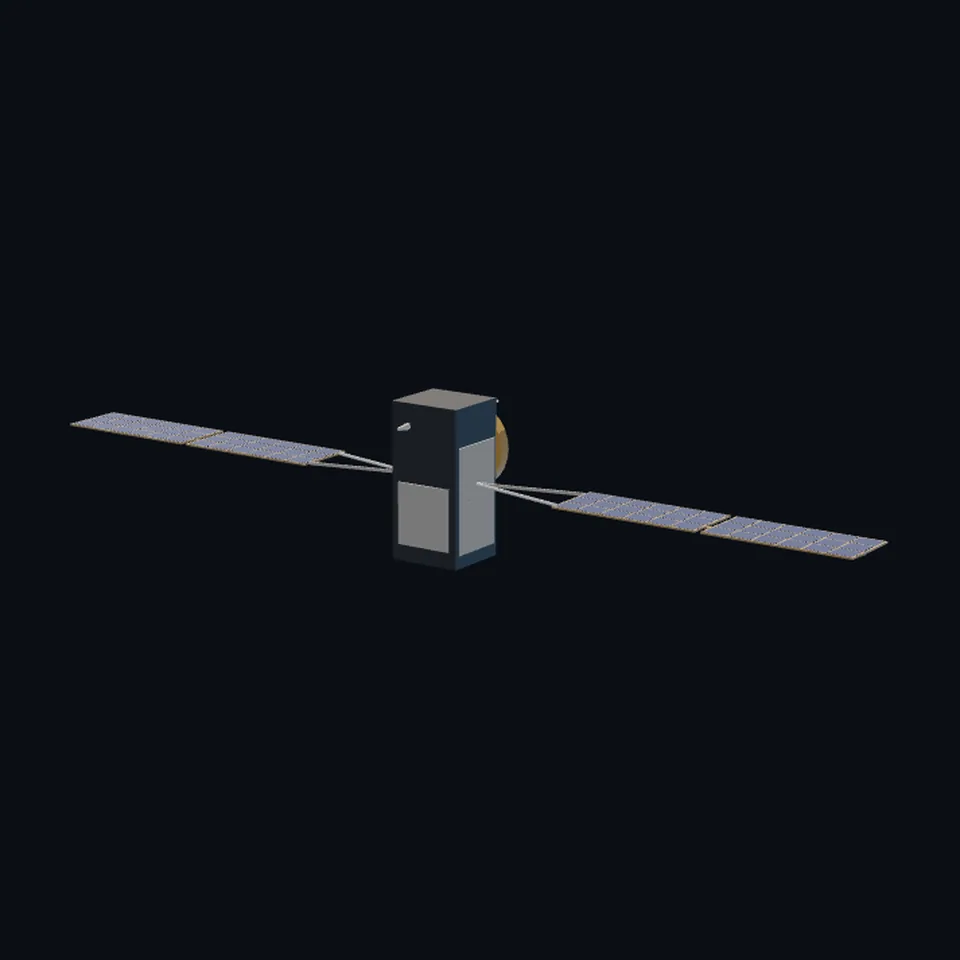 From behind
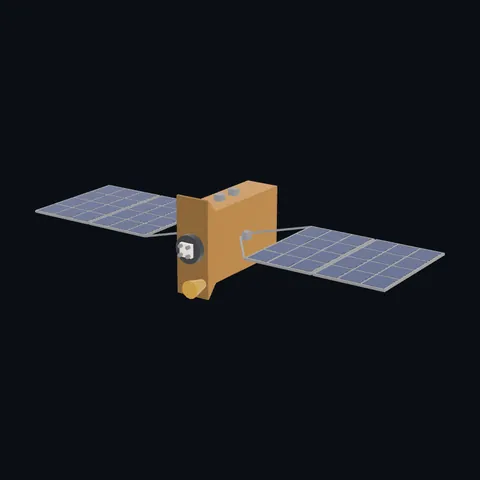
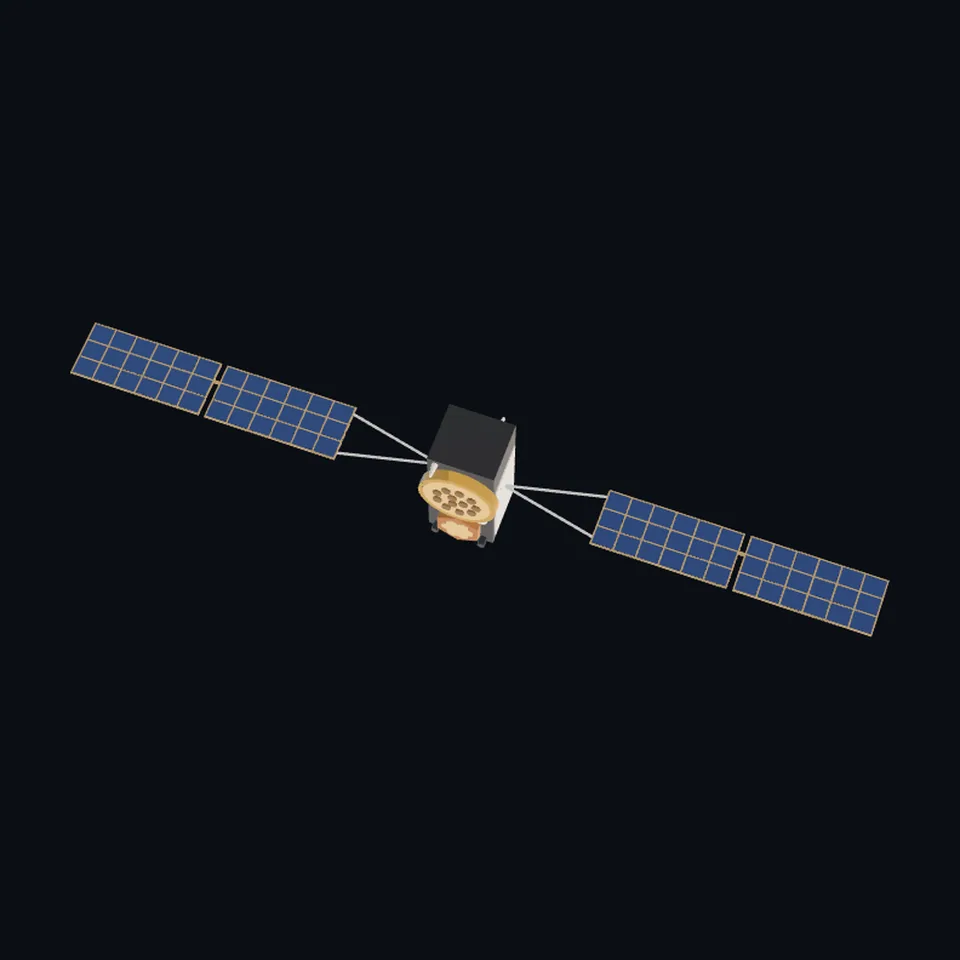 From above
About this model
Galileo FOC is one of the 203 3D models Space Radar made itself: a satellite, built in code from published dimensions and photographs, with no image-to-3D generator and no one else’s mesh.
Shape built from published dimensions and pictures; details simplified. It has 7,360 triangles in a 43 kB glTF file, and is 15 m across at full scale.
It is part of the map’s library; no object on the live map is drawn with it today.
Dimensions and their sources
| Measure | Value |
|---|---|
| Box 1 | 2.53 m |
| Box 2 | 1.2 m |
| Box 3 | 1.1 m |
| Solar array 1 | 5 m |
| Solar array 2 | 1.082 m |
| Span | 14.67 m |
| L band antenna diameter | 1.4 m |
European GNSS Service Centre (EUSPA), 'Galileo Satellite Metadata', gsc-europa.eu/support-to-developers/galileo-satellite-metadata…, OPENED 2026-10-13, section 6.2 'FOC Satellites', 'Dimensions of the Box with respect to the mechanical RF': 'ΔX = 2.530 m', 'ΔY = 1.200 m', 'ΔZ = 1.100 m', '±Z − panel = 3.036 m2'; section 6: 'The Galileo spacecraft is a typical box-wing type satellite, consisting of a central cube (the box) and two rectangular solar panels (the wings) attached to it'; 'The surface area of each solar array amounts to 5.41 m2 (= 5.000 m x 1.082 m)'; section 2.2: 'The +Zs-axis is normal to the separation plane and points towards the L-Band Navigation Antenna. The +Xs-axis is normal to the clock panel and points towards the clock panel'; section 3.1: 'the body is fixed in a way it keeps the Z axis towards the Earth Centre (in order to illuminate the Earth with its Navigation Antenna), the Y axis is perpendicular to the Sun and the X axis points towards deep space'; its table of surfaces: the -X face all 'A' (absorption 0.93: a black blanket), the +X and both Y faces mostly 'C' (specular 0.73: radiators). eoPortal, eoportal.org/satellite-missions/galileo-foc, OPENED 2026-10-13: 'Spacecraft body size, span' '2.5 m x 1.2 m x 1.1 m'; 'Spacecraft span' '14.67 m'; '2 wings, 2 panels each'; and under a picture of ESA's: 'the 2.5 m by 1.2 m by 1.1 m satellite's main 1.4-m diameter antenna transmits L-band navigation signals down to Earth. To its left is the hexagonal search and rescue antenna'; 'To the bottom right of the navigation antenna are a pair of infrared Earth sensors'; 'Above them is the laser retro-reflector'; 'Above that is the circular C-band antenna'. ESA, esa.int/Applications/Satellite_navigation/Galileo/Satellite_anat…, OPENED 2026-10-13: 'Two S-band antennas'; 'The satellite rotates twice per orbit to allow the solar wings to face the Sun's rays'. DERIVED: each wing's yoke is 1.735 m, what is left of the 14.67 m span after a 1.2 m body and two 5.0 m arrays. NOT CITED: exactly where on the Earth face each antenna sits (placed from eoPortal's words and the model photograph looked at), the search-and-rescue antenna's size (0.75 m), the C-band antenna's (0.3 m), every small part's size. (read 2026-10-13)
How it was made
Built in code from published dimensions and photographs, with no image-to-3D generator and no one else’s mesh. 3D model: built by Space Radar from the dimensions in EUSPA's Galileo satellite metadata.
The full record
built by this project in code (the private tool model-from-images: assemble.py, from a yaml of primitives), from the cited dimensions and the pictures under `references`; no image-to-3D model was used, and no published mesh (NASA's 3D Resources on GitHub, 1 583 paths read 2026-10-13, has none of this craft; the survey of 2026-10-13 found no agency model of it under usable terms)
Where the map uses it. any record of klass satellite whose name has the word GALILEO and a GSAT02nn number (29 records in the live saved data of 2026-10-12, GSAT0201 to GSAT0234): the Galileo Full Operational Capability craft, OHB's. They were, and while this file is on its way still are, the family navigation box (scene/models.js `navigation`), which stood the body on end with its small face to the Earth. The three In-Orbit Validation craft (GSAT0101 to GSAT0103) wear galileo-iov.glb since release 1.8.0 (internal #751); public #986
Licence note. The shape is this project's, under this repository's licence, built from published numbers (facts). ESA's pictures are not free to reproduce and NONE WAS USED OR COPIED. The one picture looked at is a visitor's photograph of a model, CC BY-SA 3.0, and NOTHING OF IT IS REPRODUCED OR TRACED. NO LOGO AND NO LETTERING is on the mesh.
References 1
What the shape was compared with. None of these pictures is in the file.
- GalileoSatModelPouyana, Wikimedia CommonsCC BY-SA 3.0 (a visitor's photograph of a model; share-alike: looked at only)

Use it
The model is under the MIT licence: use it, change it and share it, in any project, also a paid one. Keep the credit:
Galileo FOC 3D model by Space Radar (spaceradar.ai), MIT LicenseAny glTF 2.0 loader that reads meshopt compression (EXT_meshopt_compression) opens the file: three.js with its MeshoptDecoder, Babylon.js, model-viewer. Tools such as glTF-Transform can write an uncompressed copy.
Or embed the viewer in your page:
<iframe src="https://www.spaceradar.ai/model/?id=galileo-foc" title="Galileo FOC, 3D model by Space Radar" width="600" height="450" loading="lazy" style="border:0;max-width:100%"></iframe>Related models