Lucy
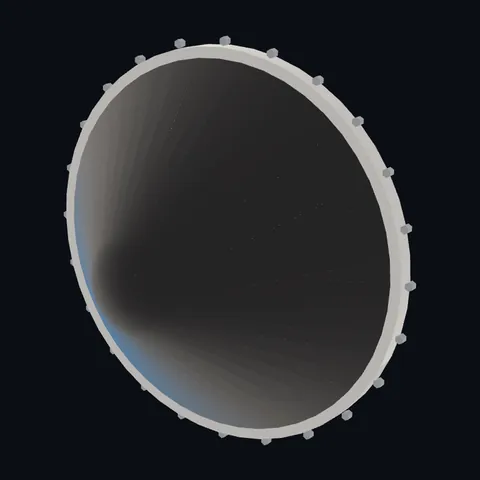
Shape built from published dimensions and pictures; details simplified.
Turn it in 3D
Open the 3D viewer (www.spaceradar.ai).
The viewer loads when you ask: about 700 kB the first time (three.js and the model), much less after.
Pictures 4
 Three-quarter view
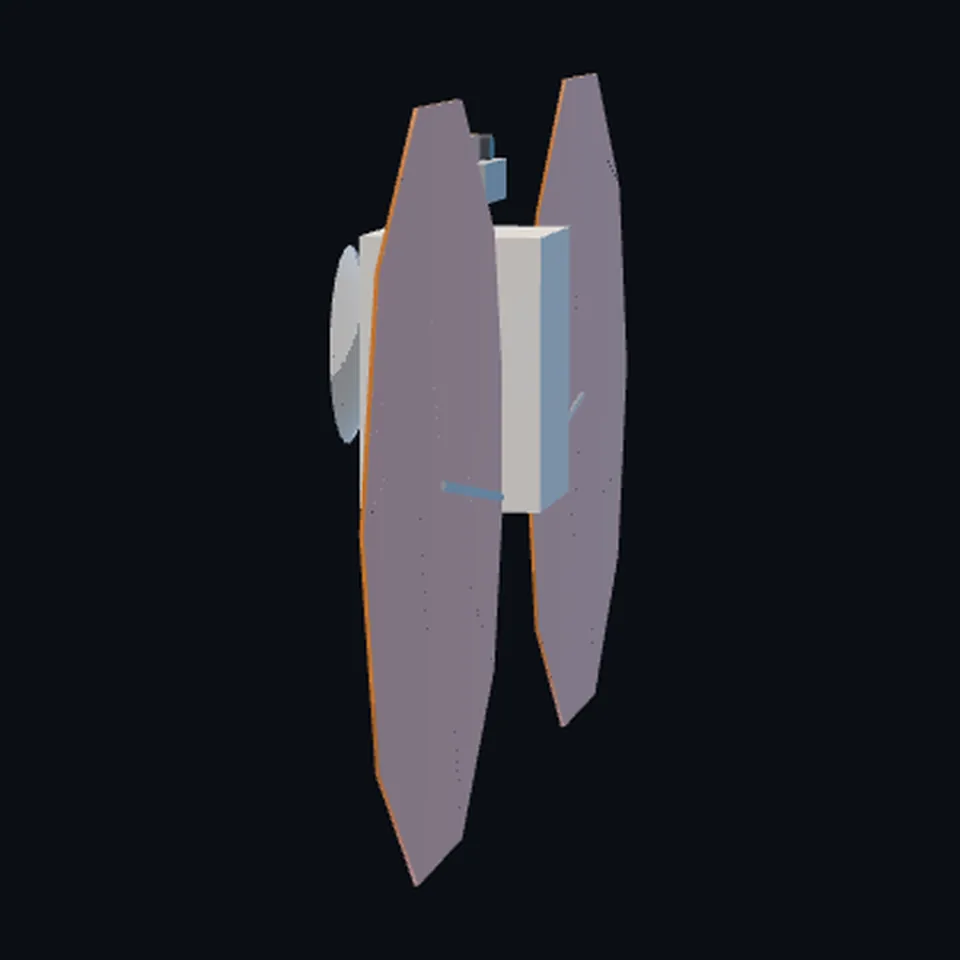 From the side
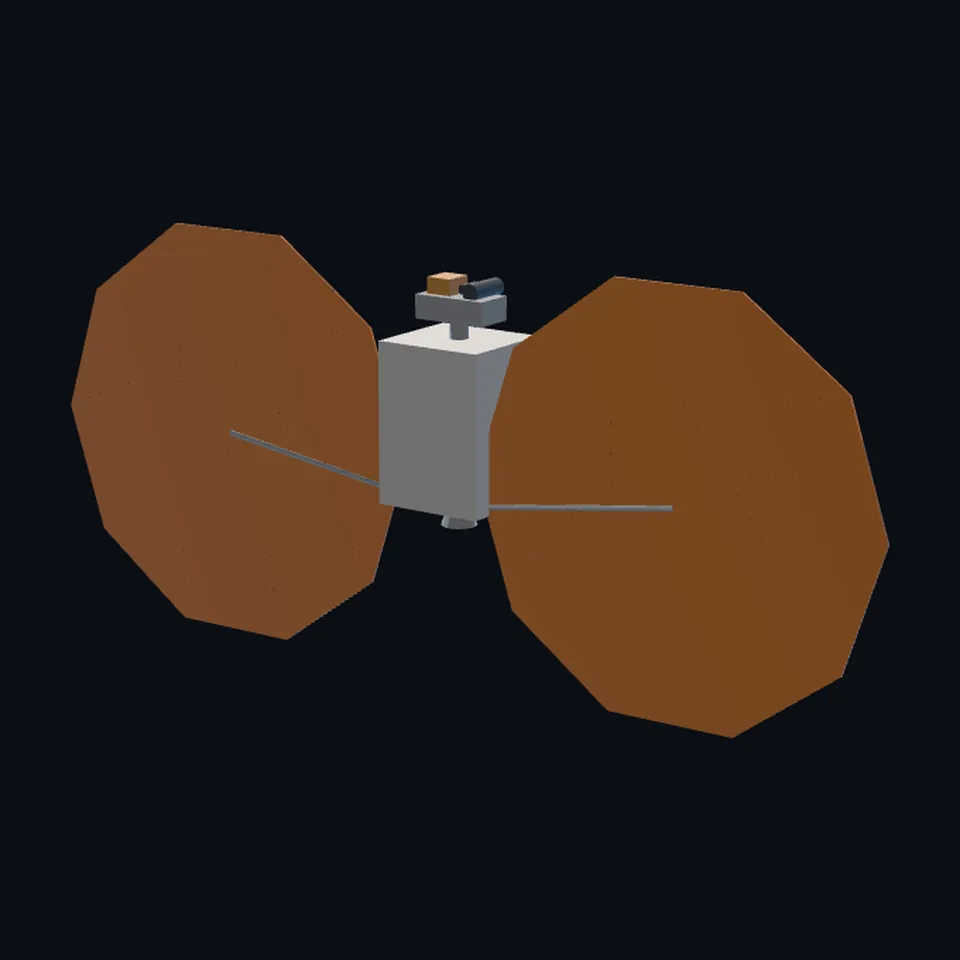 From behind
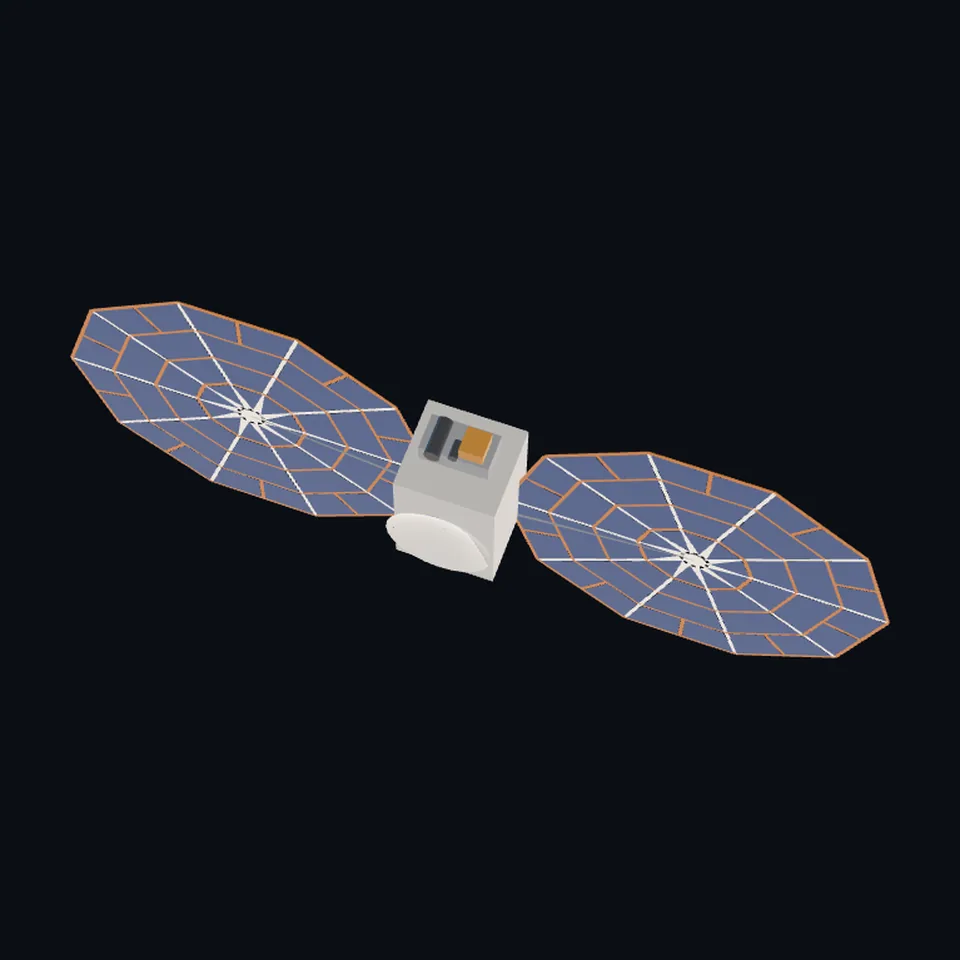 From above
About this model
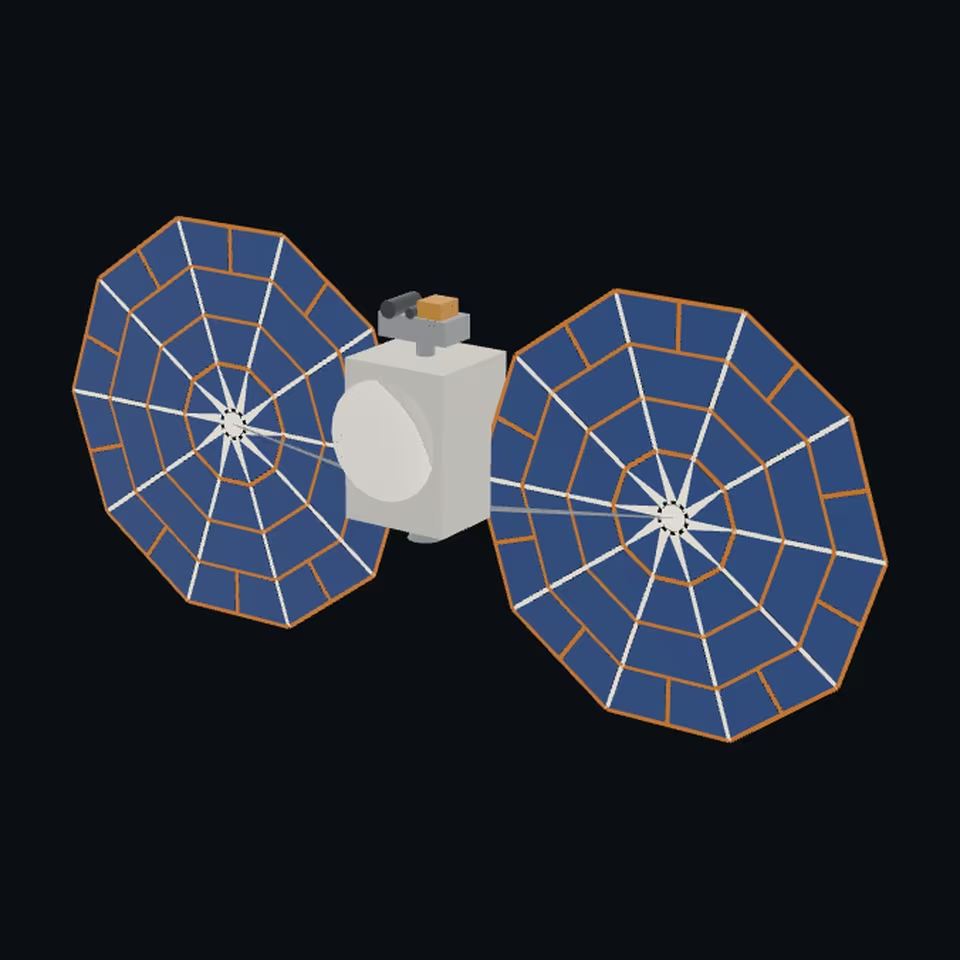
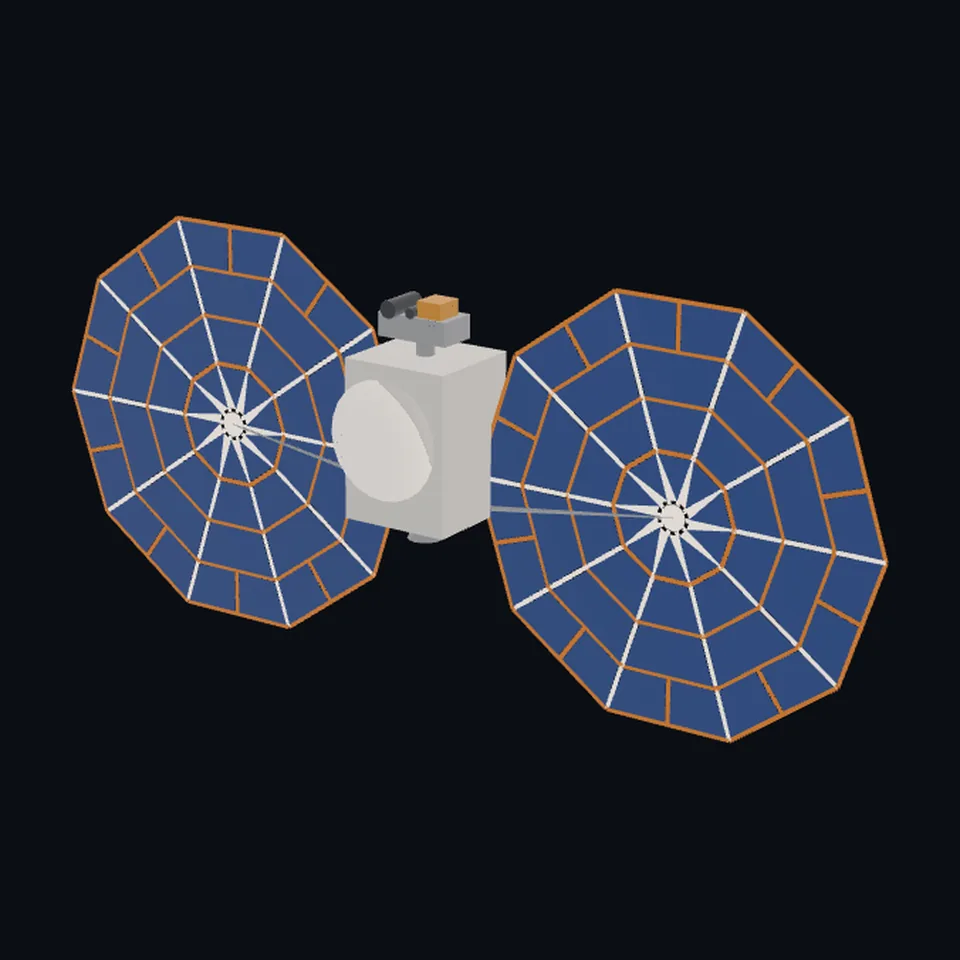
Lucy is one of the 203 3D models Space Radar made itself: a deep-space probe, built in code from published dimensions and photographs, with no image-to-3D generator and no one else’s mesh.
Shape built from published dimensions and pictures; details simplified. It has 3,210 triangles in a 26 kB glTF file, and is 16 m across at full scale.
On Space Radar’s live map it is drawn where the craft is today. Open it on the map.
Dimensions and their sources
| Measure | Value |
|---|---|
| Tip to tip | 16 m |
| Array diameter | 7.3 m |
| Hga | 2 m |
| Bus | 1.9 m |
| Bus height | 2.7 m |
| Bus depth | 1.8 m |
NASA Science, 'Lucy Spacecraft', science.nasa.gov/mission/lucy/spacecraft, OPENED 2026-10-15: 'The Lucy spacecraft is more than 52 feet (16 meters) from tip to tip when its solar arrays are deployed.'; 'Most of Lucy's size comes from its huge solar panels, each close to 24 feet (7 meters) in diameter.'; 'In addition to these instruments, Lucy has a 6.5-foot-wide (2-meter) high gain antenna which will serve as the primary communications relay between the spacecraft and Earth.' eoPortal, eoportal.org/satellite-missions/lucy, OPENED 2026-10-15: 'Diameter of solar panels: 7.3 m (use of 2 solar panels)'; 'deployed two large circular solar arrays, each 7.3 meters in diameter. The arrays are designed to unfurl like fans and latch into place. While one array, called -Y, did completely unfurl and latch, the other, +Y, did not latch into place .'; 'The Lucy spacecraft will be over 13 m from tip to tip' (an older figure; NASA's 16 m is built). Olkin et al. 2021, 'The Lucy Mission to the Trojan Asteroids: Instrumentation and Encounter Concept of Operations', PSJ 2:172, iopscience.iop.org/article/10.3847/PSJ/abf83f (CC BY 4.0), OPENED 2026-10-15: 'Lucy’s scientific instruments and the terminal tracking cameras are mounted on an IPP (Figure 3 ) which is connected to the spacecraft by a two-axis gimbal.' OURS: the bus (1.9 x 2.7 x 1.8 m, read off NASA's illustration against the 2 m dish), the IPP's size and place, the hubs' place, the ten gores (counted on NASA's illustration). (read 2026-10-15)
How it was made
Built in code from published dimensions and photographs, with no image-to-3D generator and no one else’s mesh. 3D model: built by Space Radar from published dimensions and NASA pictures (public domain).
The full record
built by this project in code (the private tool model-from-images: assemble.py, from a yaml of primitives), from the cited dimensions and the pictures under `references`; no image-to-3D model was used, and no published mesh (NASA Science's 3D models, 100 resources listed 2026-10-15, and NASA's 3D Resources, 1 583 paths, have none of this craft); NASA's and JPL's own pictures (public domain) were looked at for the layout and are not in the file; the instrument platform's description is Olkin et al. 2021 (CC BY 4.0)
Where the map uses it. JPL Horizons -49, Lucy (data/sample.js `deep-lucy`), on its way to Jupiter's Trojan asteroids: NASA's probe with two round fan-folded arrays 7.3 m across and a 2 m dish. It was the generic probe; public #1081
Licence note. Public domain (NASA's pictures, which the layout was read off: looked at, with credit; nothing of them is in the file); the shape is this project's, under this repository's licence, built from published numbers (facts) and the description of the instrument platform in Olkin et al. 2021 (CC BY 4.0, credited). NO LOGO AND NO LETTERING is on the mesh (the plaque Lucy carries is not drawn).
References 3
What the shape was compared with. None of these pictures is in the file.
- Illustration of the deployed Lucy spacecraftNASAPublic domain (NASA, Lucy press kit; Commons' LicenseShortName, read 2026-10-15)
- Lucy-ArtistsConceptNASA/SwRIPublic domain (NASA/SwRI; Commons' LicenseShortName, read 2026-10-15)
- Lucy Spacecraft Will Slingshot Around Earth (SVS14225)NASA's Scientific Visualization StudioPublic domain (NASA's Scientific Visualization Studio; Commons' LicenseShortName, read 2026-10-15)


Use it
The model is under the MIT licence: use it, change it and share it, in any project, also a paid one. Keep the credit:
Lucy 3D model by Space Radar (spaceradar.ai), MIT LicenseAny glTF 2.0 loader that reads meshopt compression (EXT_meshopt_compression) opens the file: three.js with its MeshoptDecoder, Babylon.js, model-viewer. Tools such as glTF-Transform can write an uncompressed copy.
Or embed the viewer in your page:
<iframe src="https://www.spaceradar.ai/model/?id=lucy" title="Lucy, 3D model by Space Radar" width="600" height="450" loading="lazy" style="border:0;max-width:100%"></iframe>Related models
Galileo's atmospheric probe
Shape built from published dimensions and pictures; details simplified.