
Hayabusa2
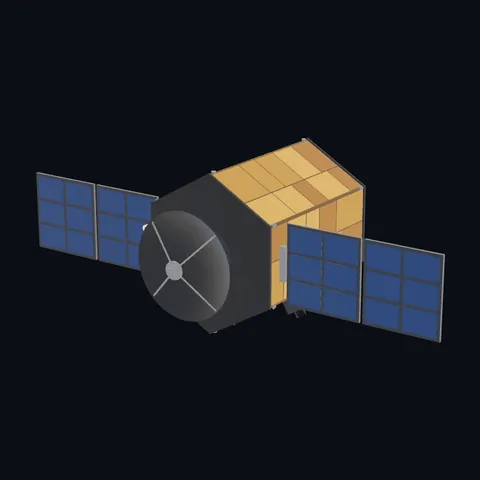
Shape built from published dimensions and pictures; details simplified.
Turn it in 3D
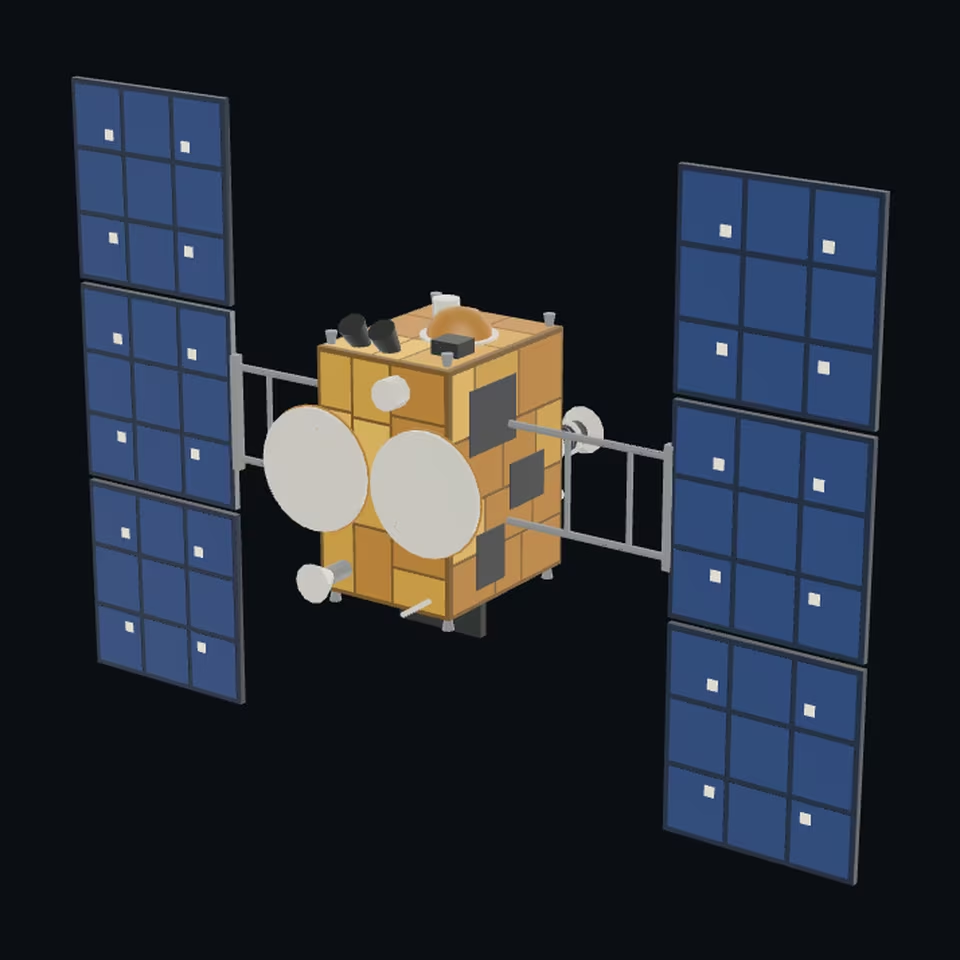
Open the 3D viewer (www.spaceradar.ai).
The viewer loads when you ask: about 700 kB the first time (three.js and the model), much less after.
Pictures 4
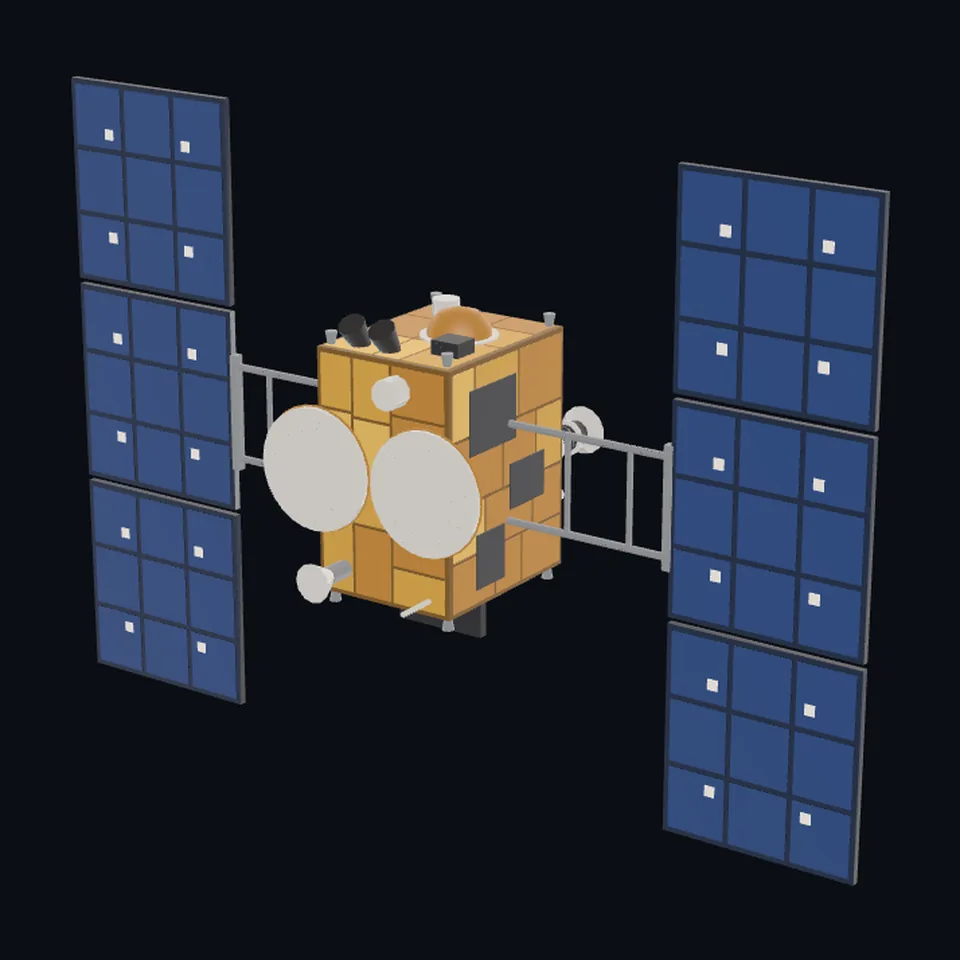 Three-quarter view
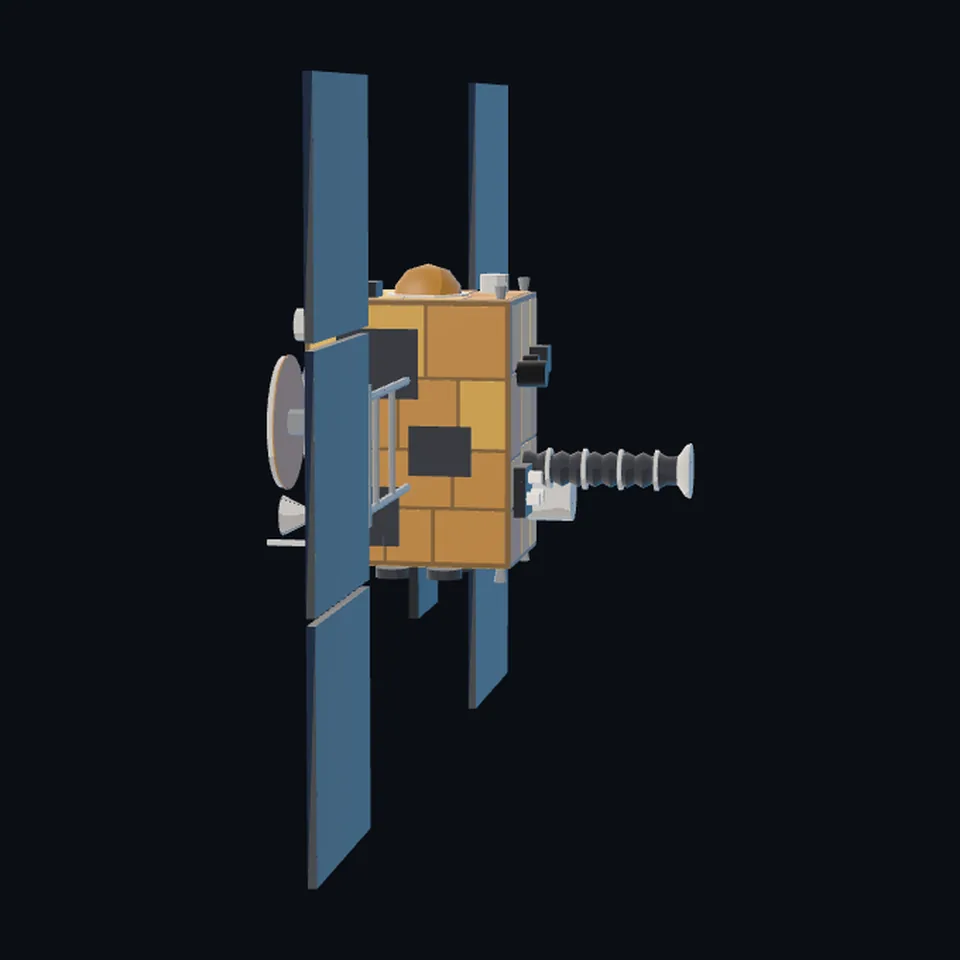 From the side
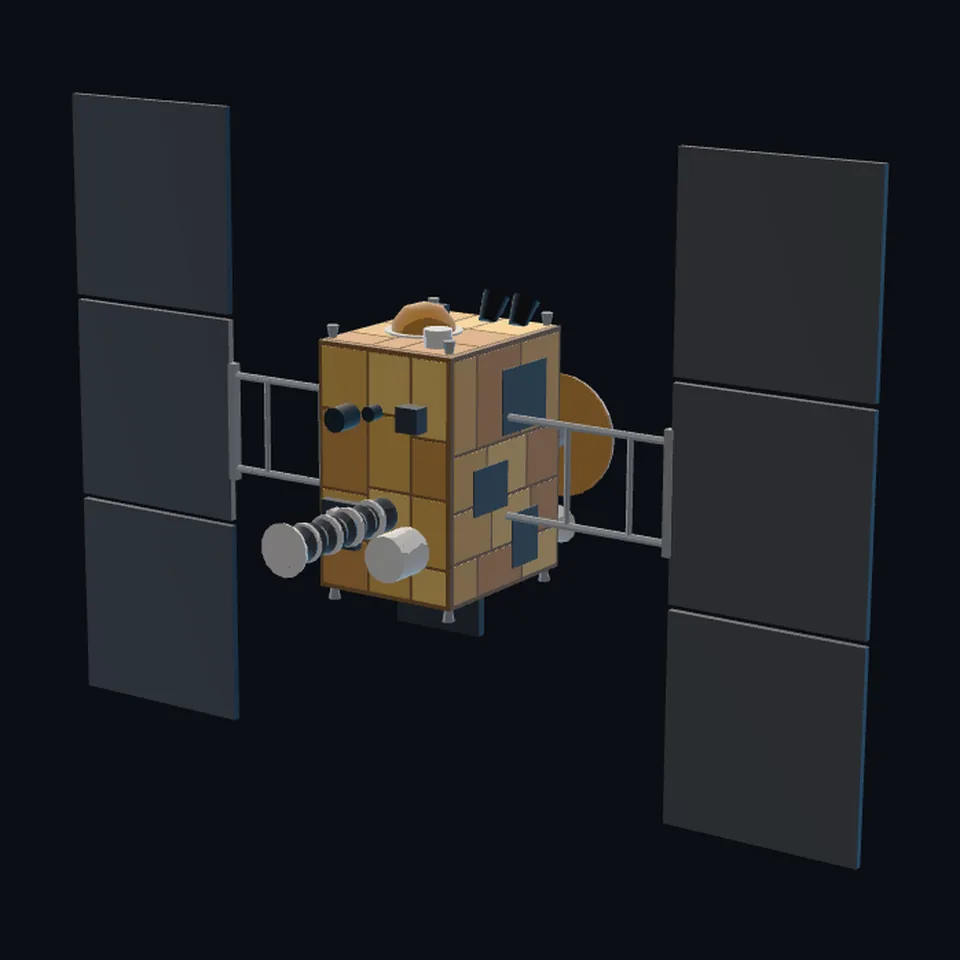 From behind
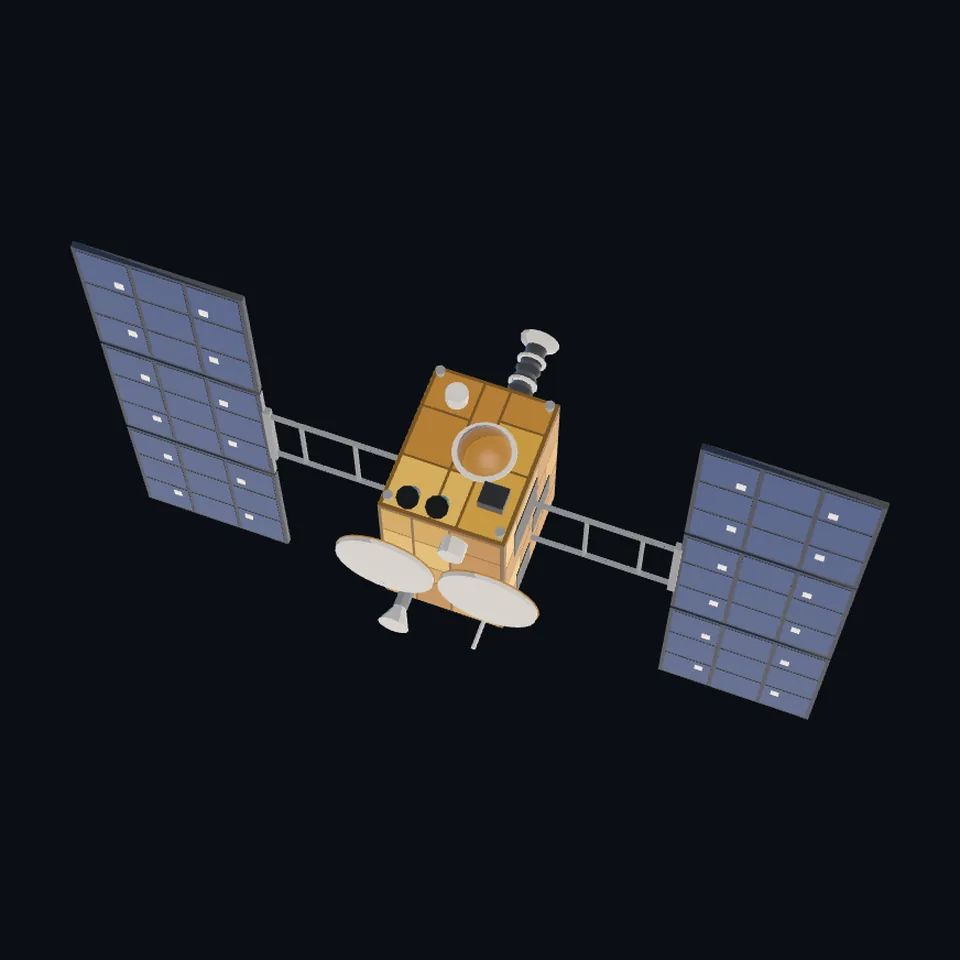 From above
About this model
Hayabusa2 is one of the 203 3D models Space Radar made itself: a deep-space probe, built in code from published dimensions and photographs, with no image-to-3D generator and no one else’s mesh.
Shape built from published dimensions and pictures; details simplified. It has 13,178 triangles in a 86 kB glTF file, and is 6.0 m across at full scale.
On Space Radar’s live map it is drawn where the craft is today. Open it on the map.
Dimensions and their sources
| Measure | Value |
|---|---|
| Body x | 1 m |
| Body y | 1.6 m |
| Body z | 1.25 m |
| Span | 6 m |
| Arrays y | 4.23 m |
| Capsule | 0.4 m |
eoPortal, 'Hayabusa-2', eoportal.org/satellite-missions/hayabusa-2, OPENED 2026-10-20: 'The Hayabusa-2 spacecraft has a stowed size of 1.6 m x 1 m x 1.25 m (height). With the solar panels deployed, the 600 kg satellite as a width of 6 m.'; 'Size: 1.6 m×1.0 m×1.4 m(height) box structure with two fixed SAPs'; 'Hayabusa-2 uses two planar HGAs'; 'IES (Ion Engine System): Xe microwave discharge ion engine system; Maximum thrust 28 mN, Isp=2800 s; 4 thruster heads on gimballed stage'; 'RCS (Reaction Control System): Bi-propellant hydrazine system, 20 N thruster x 12'. Wikipedia, 'Hayabusa2', OPENED 2026-10-20: '1 × 1.6 × 1.25 m'; solar arrays '6 m × 4.23 m'; 'The container is 40 cm (16 in) external diameter, 20 cm (7.9 in) in height'. The two pages give the height as 1.25 m and 1.4 m: 1.25 m is built. DERIVED: each wing 1.33 x 4.23 m. OURS: the antennas' 0.8 m, the sampler horn's 1 m, the ladder, every instrument's size and place. (read 2026-10-20)
How it was made
Built in code from published dimensions and photographs, with no image-to-3D generator and no one else’s mesh. 3D model: built by Space Radar from published dimensions, DLR renders (CC BY 2.0) and a Planetary Society diagram (CC BY 3.0).
The full record
built by this project in code (the private tool model-from-images: assemble.py, from a yaml of primitives), from the cited dimensions and the pictures under `references`; no image-to-3D model was used, and no published mesh: JAXA publishes no model of the probe under terms that allow an altered derivative, and NASA has none (searched 2026-10-20); DLR's renders (CC BY 2.0) and The Planetary Society's diagram (CC BY 3.0) were looked at for the layout and are not in the file; JAXA's 1:20 model (photograph CC BY-SA 4.0) and JAXA's labelled views were looked at only. NO JAXA PICTURE OR MODEL IS IN THE FILE
Where the map uses it. JPL Horizons -37, Hayabusa2 (data/sample.js `deep-hayabusa2`), JAXA's sample-return probe, back from Ryugu in 2020 and bound for 1998 KY26: a gold box with two flat antennas on top, two three-panel wings on ladders, the ion engines on one face and the sampler horn below. It was the generic probe; public #1087
Licence note. CC BY 2.0 (DLR's renders) and CC BY 3.0 (The Planetary Society's diagram), which the layout was read off: looked at, with credit; nothing of them is in the file. The shape is this project's, under this repository's licence, built from published numbers (facts). JAXA's 1:20 model (photograph CC BY-SA 4.0) was looked at only. NO JAXA PICTURE OR MODEL IS IN THE FILE. NO LOGO AND NO LETTERING is on the mesh.
References 4
What the shape was compared with. None of these pictures is in the file.
- Hayabusa2 front viewDLR, CC BY 2.0CC BY 2.0 (DLR German Aerospace Center; Commons' LicenseShortName, read 2026-10-20)
- Hayabusa2 side viewDLR, CC BY 2.0CC BY 2.0 (DLR German Aerospace Center; Commons' LicenseShortName, read 2026-10-20)
- Model of Hayabusa2 at the Australian Space Discovery Centre (DSCF4736)PangalauCC BY-SA 4.0 (Pangalau; Commons' LicenseShortName, read 2026-10-20): share-alike, LOOKED AT ONLY for the wings' layout and the two flat antennas
- 20190605 hayabusa-diagram-tpr-01The Planetary Society (E. Lakdawalla, C. H. Braden, L. A. Roberts), CC BY 3.0CC BY 3.0 (Emily Lakdawalla, Charles H. Braden, and Loren A. Roberts for The Planetary Society; Commons' LicenseShortName, read 2026-10-20)


Use it
The model is under the MIT licence: use it, change it and share it, in any project, also a paid one. Keep the credit:
Hayabusa2 3D model by Space Radar (spaceradar.ai), MIT LicenseAny glTF 2.0 loader that reads meshopt compression (EXT_meshopt_compression) opens the file: three.js with its MeshoptDecoder, Babylon.js, model-viewer. Tools such as glTF-Transform can write an uncompressed copy.
Or embed the viewer in your page:
<iframe src="https://www.spaceradar.ai/model/?id=hayabusa2" title="Hayabusa2, 3D model by Space Radar" width="600" height="450" loading="lazy" style="border:0;max-width:100%"></iframe>Related models
Galileo's atmospheric probe
Shape built from published dimensions and pictures; details simplified.
Hope (Emirates Mars Mission)
Shape built from published dimensions and pictures; details simplified.