
BepiColombo
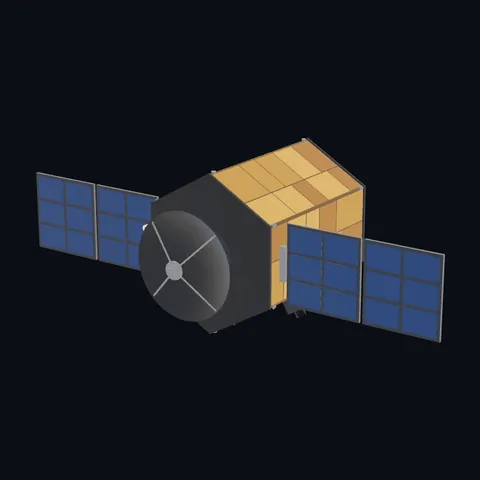
Shape built from published dimensions and pictures; details simplified.
Turn it in 3D
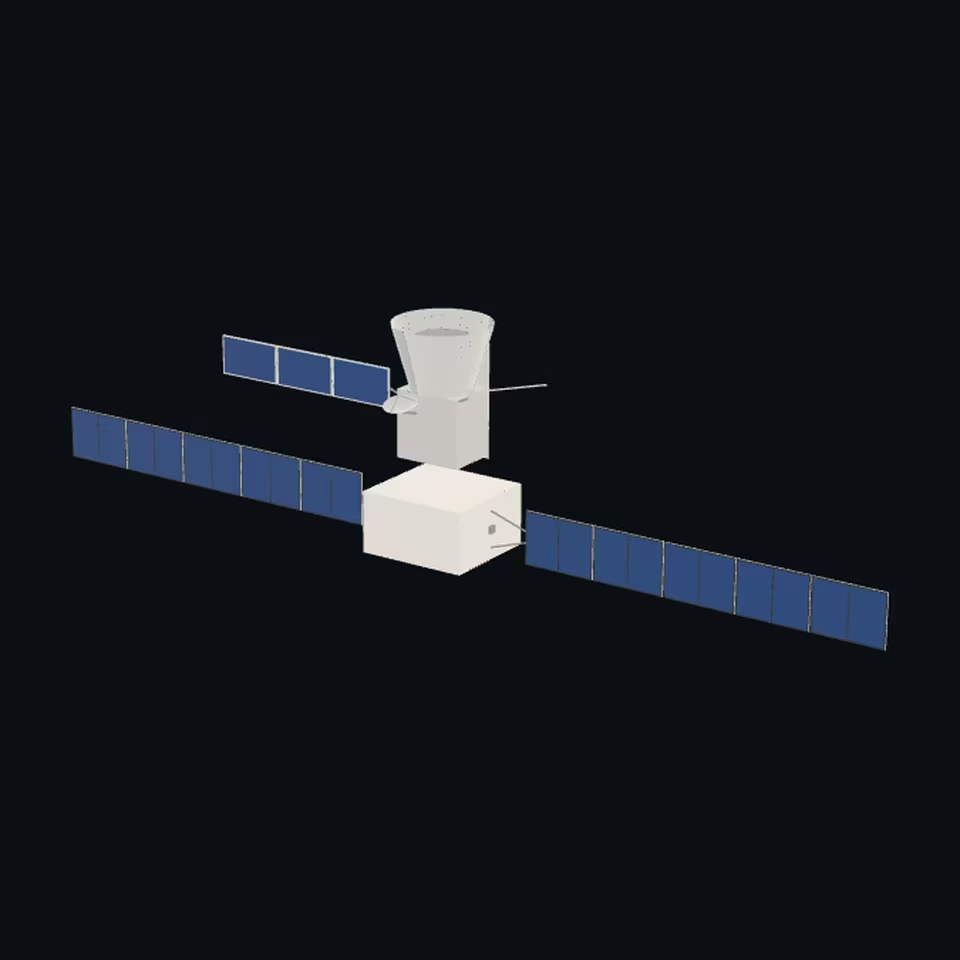
Open the 3D viewer (www.spaceradar.ai).
The viewer loads when you ask: about 700 kB the first time (three.js and the model), much less after.
Pictures 4
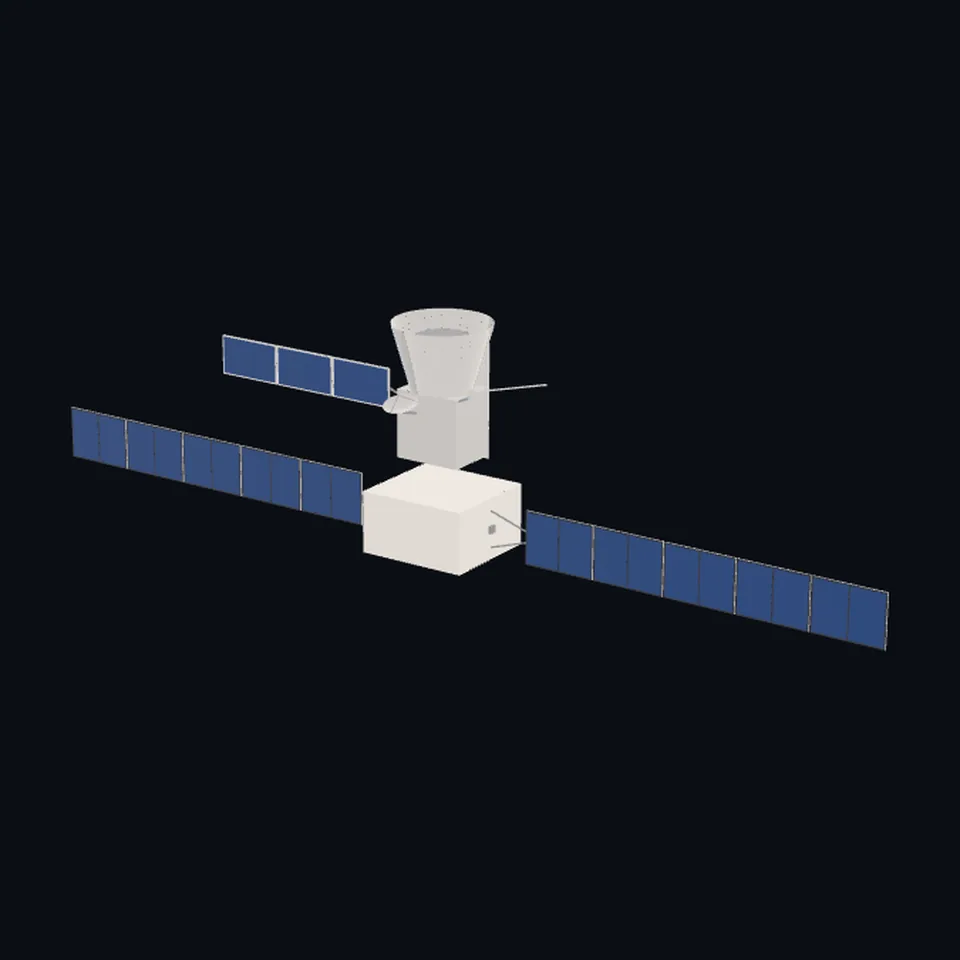 Three-quarter view
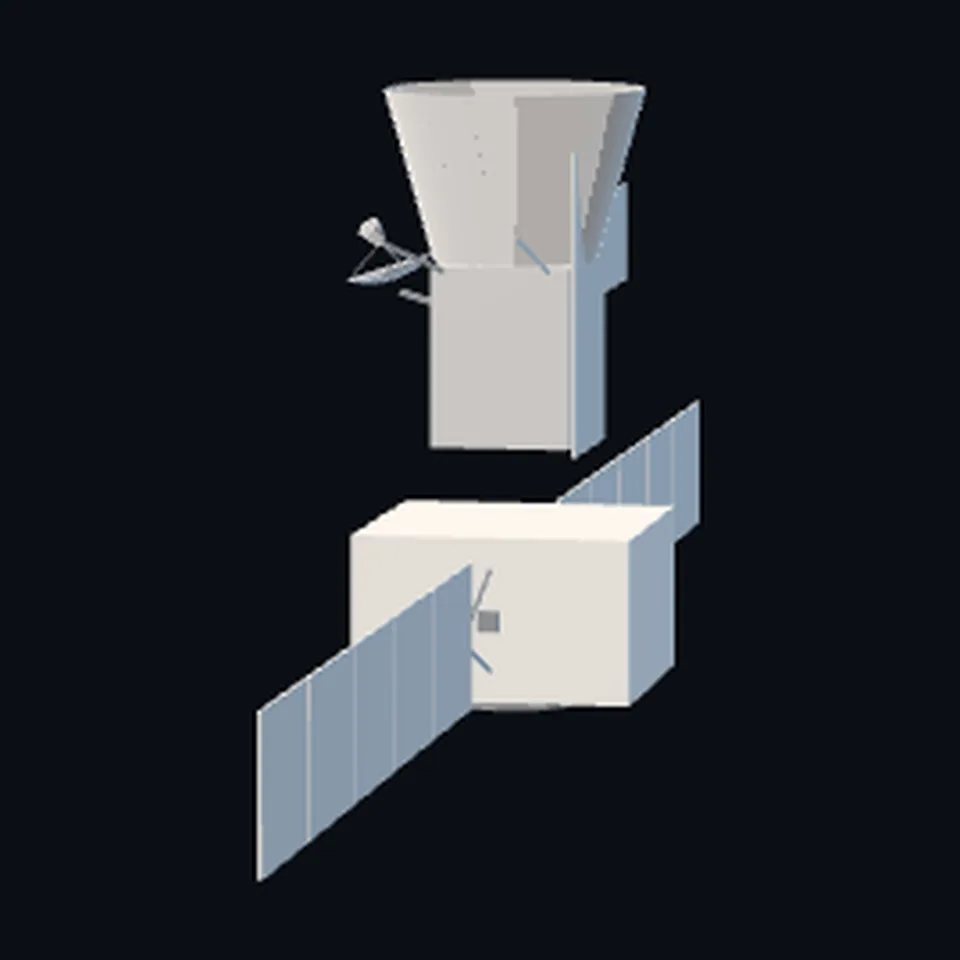 From the side
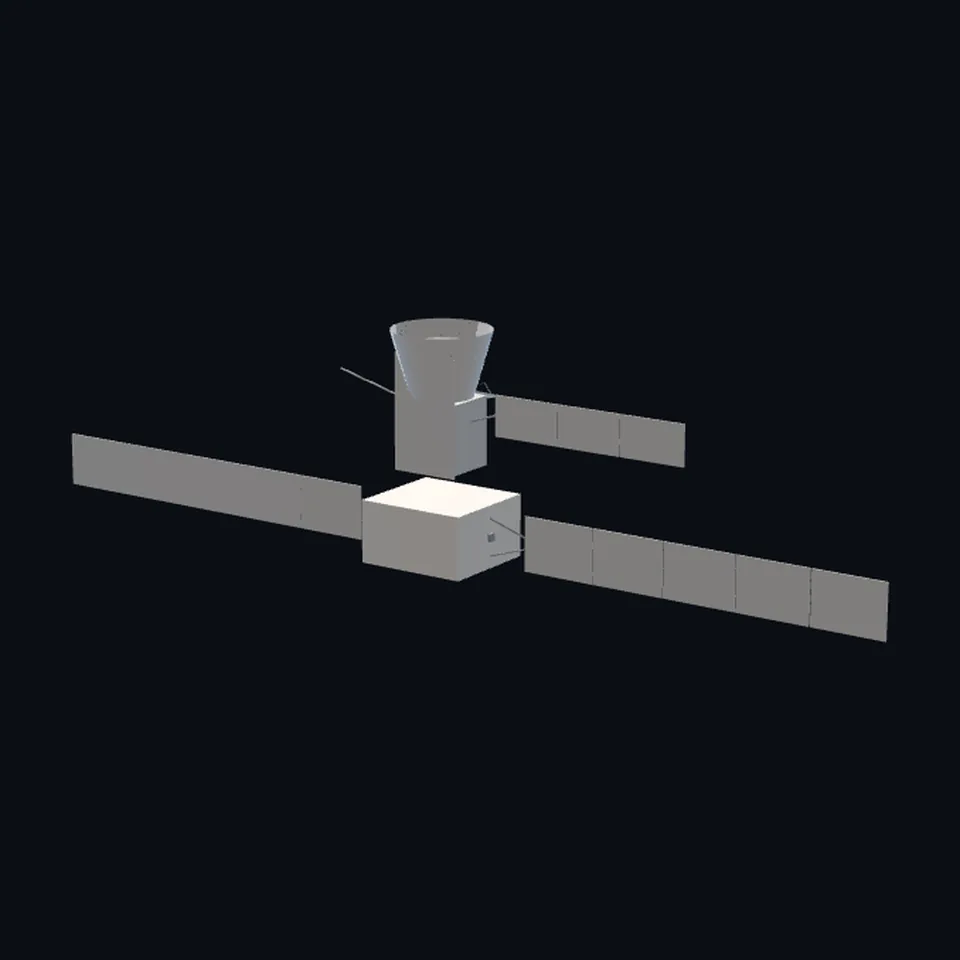 From behind
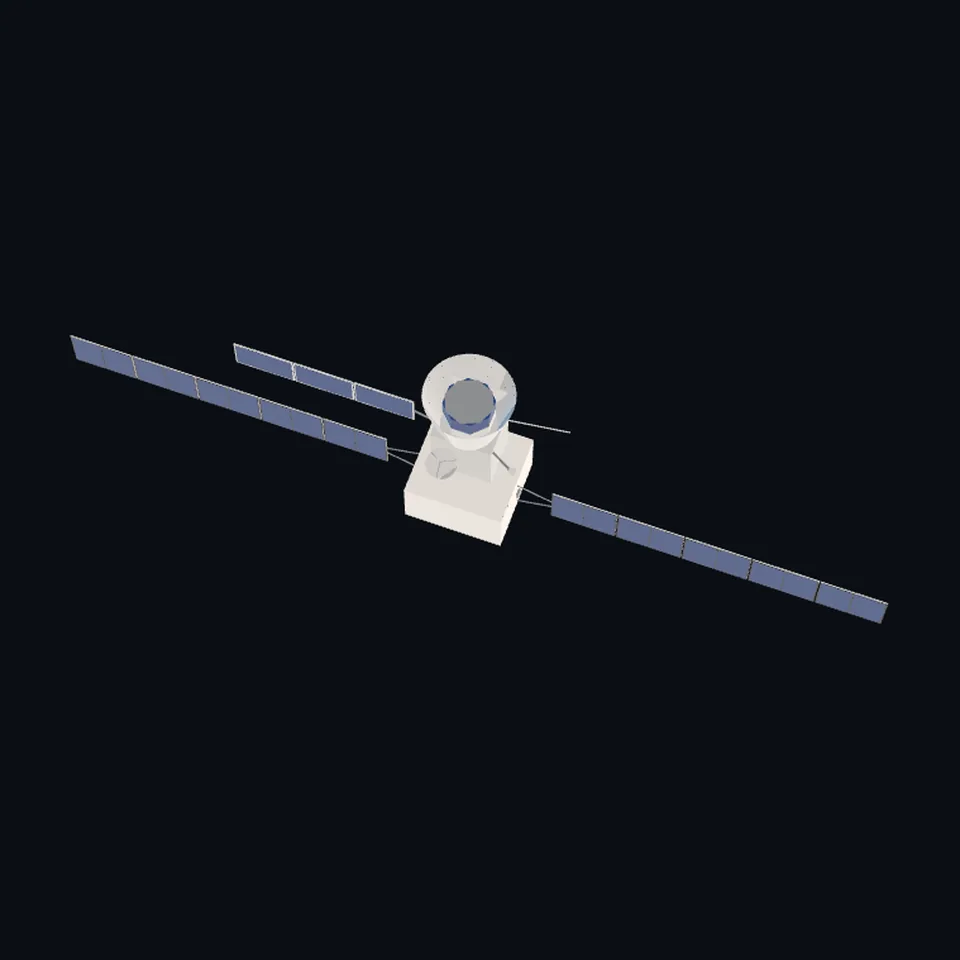 From above
About this model
BepiColombo is one of the 203 3D models Space Radar made itself: a deep-space probe, built in code from published dimensions and photographs, with no image-to-3D generator and no one else’s mesh.
Shape built from published dimensions and pictures; details simplified. It has 7,332 triangles in a 38 kB glTF file, and is 30 m across at full scale.
On Space Radar’s live map it is drawn where the craft is today. Open it on the map.
Dimensions and their sources
| Measure | Value |
|---|---|
| Composite x | 3.9 m |
| Composite y | 3.6 m |
| Height | 6.3 m |
| Span | 30 m |
| Mpo | 2.4 m |
| Mpo y | 2.2 m |
| Mpo z | 1.7 m |
| Radiator | 3.7 m |
| Mpo wing | 7.5 m |
| Mio | 1.8 m |
| Mio height | 1.1 m |
ESA, 'BepiColombo factsheet', esa.int/Science_Exploration/Space_Science/BepiColombo/BepiColomb…, OPENED 2026-10-15: 'Composite spacecraft: 3.9 x 3.6 x 6.3 m (~30 m with MTM solar wings deployed)'; 'MPO: 2.4 x 2.2 x 1.7 m; radiator width: 3.7 m, solar wing (deployed): 7.5 m'; 'MMO: 1.8 m diameter, 1.1 m high'. Benkhoff et al. 2021, link.springer.com/article/10.1007/s11214-021-00861-4 (CC BY 4.0), OPENED 2026-10-15: 'The two wings of the transfer module total about 42 m2 and have to be rotated away from the Sun to avoid overheating.'; 'the MPO solar panel, which has a length of about 7.5 m'; 'The solar array is a single 3-panel wing with one side covered with solar cells.'; 'The conical shape of the MOSIF – with an opening angle of about 16° - is needed'; 'The external appearance has an octagonal shape, which can be surrounded by a 1.8 m diameter circle. The height of the side panel is 1.1 m'; 'using its four 125 mN ion thrusters'. eoPortal, eoportal.org/satellite-missions/bepicolombo, OPENED 2026-10-15: 'its solar wings extending about 14 m either side of the module'; 'the two 15 meter-long solar arrays of the BepiColombo MTM'; 'a 2-axis steerable 1.1 m diameter HGA (High Gain Antenna)'; 'The 2.5 m long boom carrying the magnetometer sensors'; 'The scaled-up T6 thrusters are 22 cm in diameter'. DERIVED: each MTM panel 2.4 x 1.75 m (42 m2 over ten), the yoke 1.3 m (30 m span). OURS: the MTM box 3.6 x 3.4 x 2.0 m, the split of the 6.3 m stack, the MPO's wing panels, the sunshield's height, every antenna's pointing. (read 2026-10-15)
How it was made
Built in code from published dimensions and photographs, with no image-to-3D generator and no one else’s mesh. 3D model: built by Space Radar from published dimensions and figures by Benkhoff et al. 2021 and Magnafico et al. 2024 (CC BY 4.0).
The full record
built by this project in code (the private tool model-from-images: assemble.py, from a yaml of primitives), from the cited dimensions and the pictures under `references`; no image-to-3D model was used, and no published mesh (NASA Science's 3D models, 100 resources listed 2026-10-15, and NASA's 3D Resources, 1 583 paths, have none of this craft); NO ESA PICTURE OR MODEL IS IN THE FILE: ESA's published numbers were read as numbers. ESA's terms for the images on its site, read 2026-10-15 (esa.int/ESA_Multimedia/Terms_and_Conditions): 'The website of the European Space Agency (the ESA Website) provides to users an online access to space images and videos for education, editorial and/or information purposes only. All other uses (e.g. commercial ones) are excluded and require a specific licence.' No JAXA picture was used. The layout was read off two figures of papers published under CC BY 4.0 (credited under references)
Where the map uses it. JPL Horizons -121, BepiColombo (data/sample.js `deep-bepicolombo`), drawn AS ITS CRUISE STACK: ESA's Mercury Transfer Module with its two long wings, the Mercury Planetary Orbiter with its radiator, dish and own wing, and JAXA's Mio inside its conical sunshield. It enters orbit round Mercury in November 2026 and the stack comes apart then; the record does not know when it has. It was the generic probe; public #1083
Licence note. CC BY 4.0 (figures of Benkhoff et al. 2021 and Magnafico et al. 2024, which the layout was read off: looked at, with credit; nothing of them is in the file) and CC BY 3.0 (SkywalkerPL's photograph of the MPO at ESTEC, for its colours); the shape is this project's, under this repository's licence, built from published numbers (facts). ESA's renders and photographs (CC BY-SA 3.0 IGO) were looked at only. NO ESA OR JAXA PICTURE OR MODEL IS IN THE FILE. NO LOGO AND NO LETTERING is on the mesh.
References 4
What the shape was compared with. None of these pictures is in the file.
- BepiColombo cruise configurationJ. Benkhoff et al. 2021, CC BY 4.0CC BY 4.0 (J. Benkhoff et al., 'BepiColombo - Mission Overview and Science Goals', Space Sci. Rev. 217:90 (2021), Fig. 10; Commons' LicenseShortName, read 2026-10-15)
- BepiColombo MCS compositionC. Magnafico et al. 2024, CC BY 4.0CC BY 4.0 (C. Magnafico et al., arXiv:2409.02015; Commons' LicenseShortName, read 2026-10-15)
- BepiColombo MPO ESTECSkywalkerPL (Wikimedia Commons)CC BY 3.0 (SkywalkerPL, own work; Commons' LicenseShortName, read 2026-10-15)
- BepiColombo stack croppedESACC BY-SA 3.0 IGO (ESA; read 2026-10-15): share-alike, LOOKED AT ONLY for the blankets, never fetched by the tool and not on any sheet


Use it
The model is under the MIT licence: use it, change it and share it, in any project, also a paid one. Keep the credit:
BepiColombo 3D model by Space Radar (spaceradar.ai), MIT LicenseAny glTF 2.0 loader that reads meshopt compression (EXT_meshopt_compression) opens the file: three.js with its MeshoptDecoder, Babylon.js, model-viewer. Tools such as glTF-Transform can write an uncompressed copy.
Or embed the viewer in your page:
<iframe src="https://www.spaceradar.ai/model/?id=bepicolombo" title="BepiColombo, 3D model by Space Radar" width="600" height="450" loading="lazy" style="border:0;max-width:100%"></iframe>Related models
Galileo's atmospheric probe
Shape built from published dimensions and pictures; details simplified.
Hope (Emirates Mars Mission)
Shape built from published dimensions and pictures; details simplified.