
Meteosat Second Generation
Shape built from published dimensions and pictures; details simplified.
Turn it in 3D
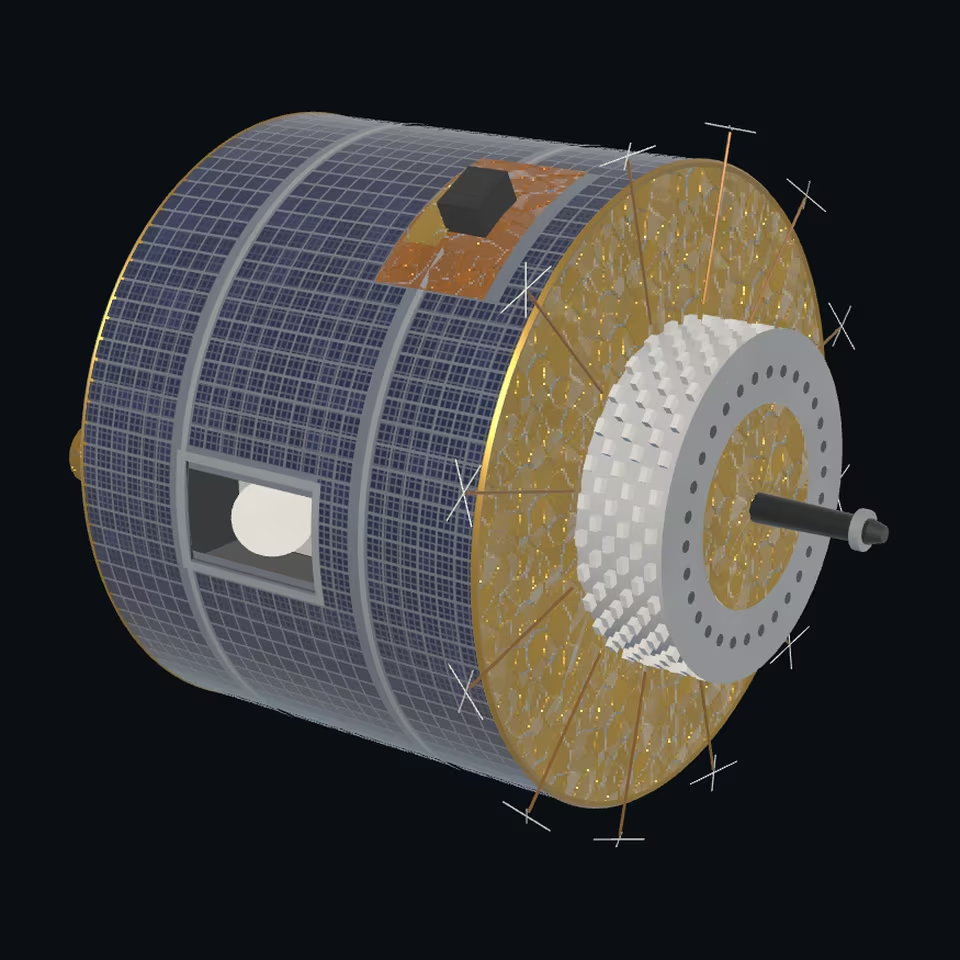
Open the 3D viewer (www.spaceradar.ai).
The viewer loads when you ask: about 700 kB the first time (three.js and the model), much less after.
Pictures 4
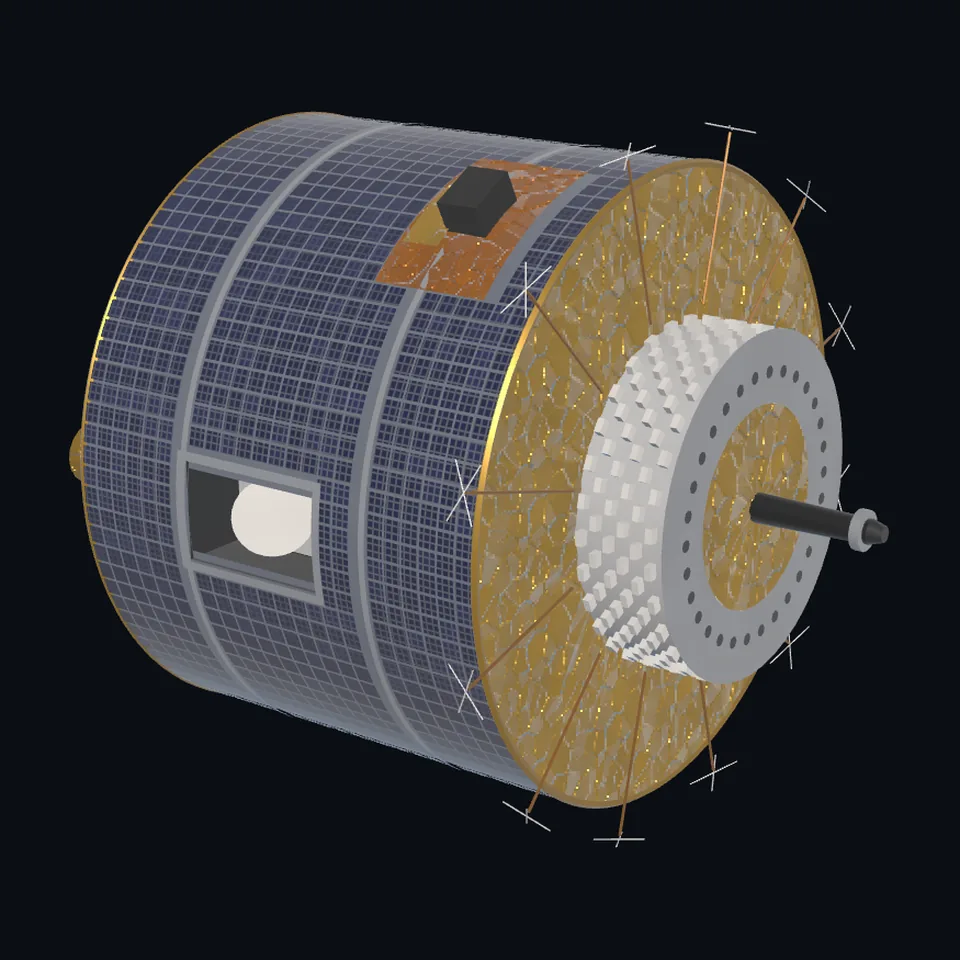 Three-quarter view
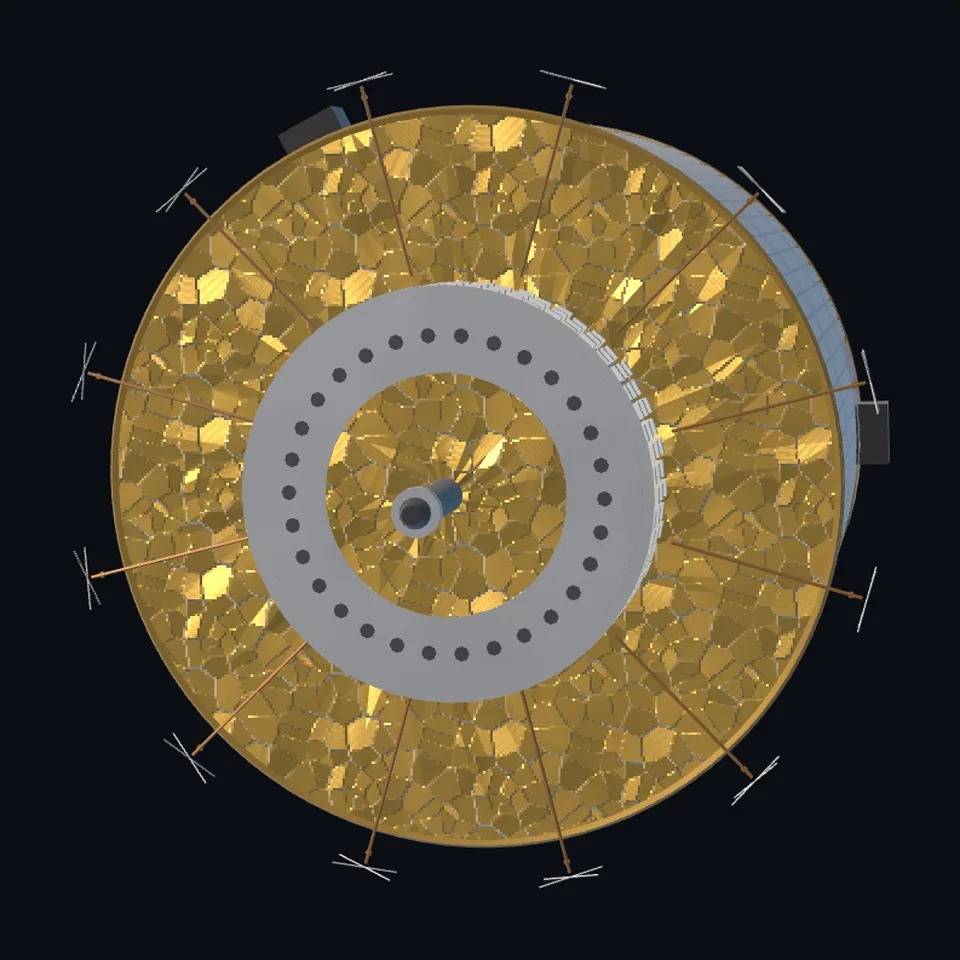 From the side
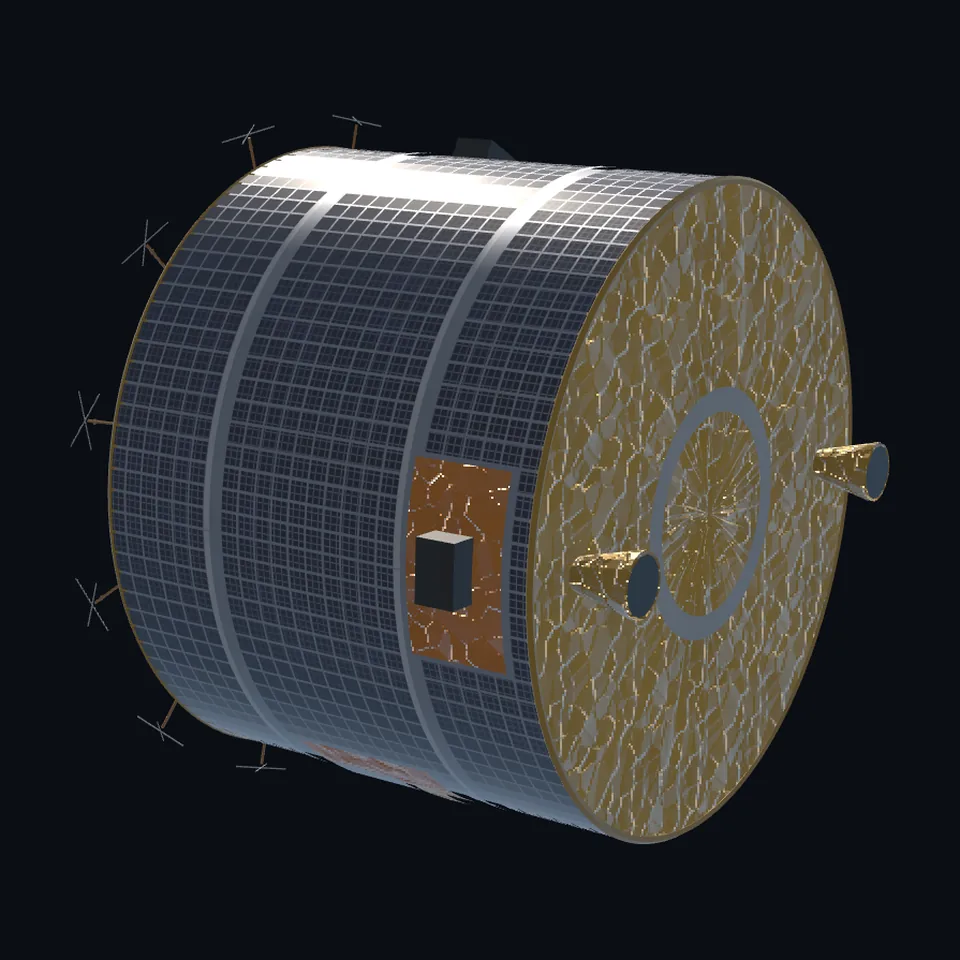 From behind
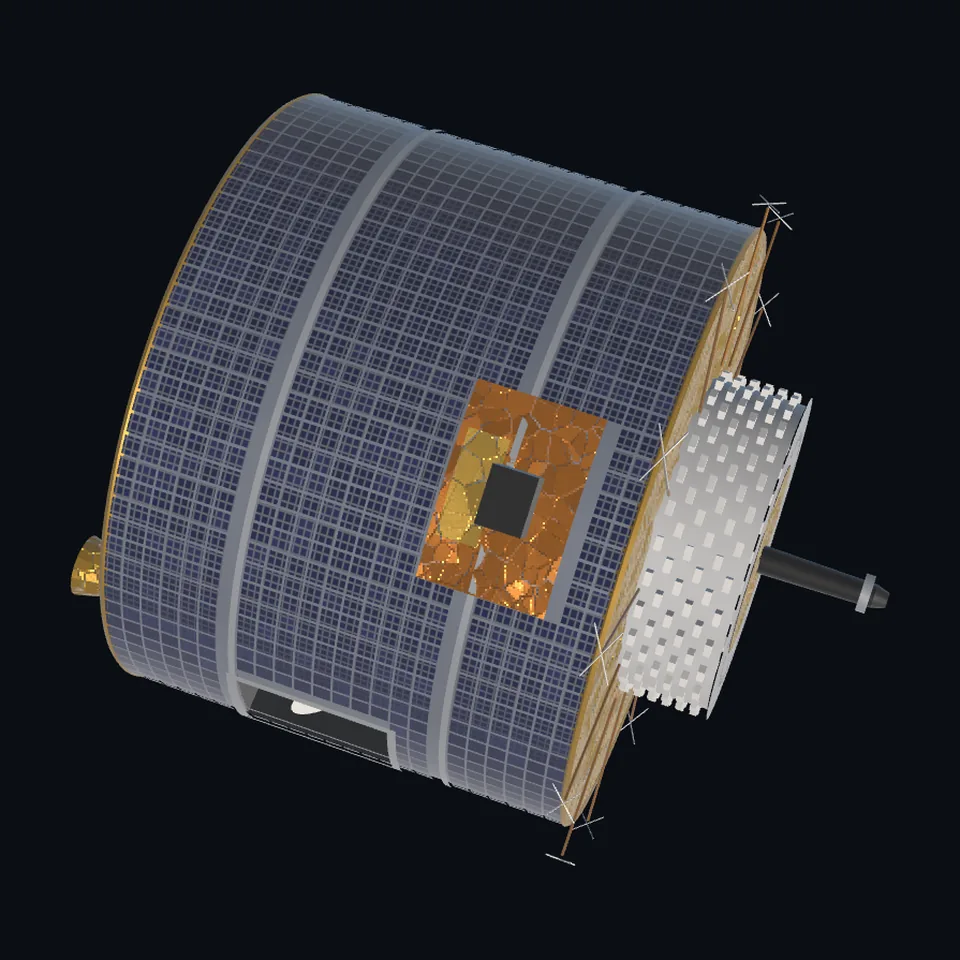 From above
About this model
Meteosat Second Generation is one of the 203 3D models Space Radar made itself: a satellite, built in code from published dimensions and photographs, with no image-to-3D generator and no one else’s mesh.
Shape built from published dimensions and pictures; details simplified. It has 14,526 triangles in a 145 kB glTF file, and is 3.7 m across at full scale.
On Space Radar’s live map it is drawn for the object with NORAD catalogue number 28912, where its published orbit puts it now. Open it on the map.
Dimensions and their sources
| Measure | Value |
|---|---|
| Diameter | 3.2 m |
| Height | 3.7 m |
| Body height | 2.4 m |
| Aperture | 0.8 m |
eoPortal, Meteosat Second Generation, eoportal.org/satellite-missions/meteosat-second-generation, OPENED 2026-10-27: 'The S/C body is a cylindrical-shaped solar drum, 3.2 m in diameter and 3.7 m in height (2.4 m body height)'; 'The solar array is composed of 8 body mounted panels' with '7854 Silicon High Eta cells'; SEVIRI's Earth radiation entry 'a 50 cm x 80 cm aperture'; spin 100 rpm about the north-south axis; the communications payload in the upper compartment. OURS: the cells drawn as 0.10 m modules (the cited 7854 cells are about 0.05 m), the three patches' places and sizes, the opening's place (the middle compartment, toward the Earth) and its orientation (0.8 m along the spin axis), the antenna stack's sizes (a 0.5 m drum of slot stubs under a lightened ring and a 0.7 m mast), twelve rods with crossed dipoles round the north plate, the two thruster cones and the apogee engine's bay on the south plate (read 2026-10-27)
How it was made
Built in code from published dimensions and photographs, with no image-to-3D generator and no one else’s mesh. 3D model: built by Space Radar from eoPortal's published dimensions; compared with pictures by Neq00 (CC BY-SA 4.0) and Diba (CC BY-SA 2.0 de).
The full record
built by this project in code (release 1.4.0 stage r14-m4: one script a craft on release 1.3.0 W3-b's part library, lib.py and parts.py, kept with the stage's notes in ~/space-radar-handoff/release-1.4/r14-m4/build), from the cited dimensions and the pictures under `references`; no image-to-3D model was used, and no published mesh: a search for one on 2026-10-27 found none, NASA's 3D Resources has none of these craft, and EUMETSAT publishes no model of its satellites that was found, and ESA's multimedia terms (the ESA Standard Licence) allow use for information and education, not an altered model (read 2026-10-27)
Where the map uses it. NORAD 28912 (METEOSAT-9, MSG-2), 38552 (METEOSAT-10, MSG-3) and 40732 (METEOSAT-11, MSG-4) in the live saved data of 2026-10-12: EUMETSAT's Meteosat Second Generation, the spinning drums, 3.2 m across, covered in solar cells, the radiometer's opening in their side. They wore the shape of the geostationary bus (a box with two wings, which they do not have); public #1114. Not METEOSAT-8 (MSG-1, drifted out of use) and not the first generation, which are other drums.
Licence note. No ESA or EUMETSAT picture or model is in the file. Compared with, with credit: two museum models of the craft at EUMETSAT and Wetterpark Offenbach by Neq00 (CC BY-SA 4.0), Diba (CC BY-SA 2.0 de) and a public-domain picture, and SEVIRI's layout drawing (public domain), all on Wikimedia Commons; nothing of them is in the file. The shape is this project's, under this repository's licence, built from published numbers (facts).
References 4
What the shape was compared with. None of these pictures is in the file.
- EUMETSAT – Model of MSG.jpgNeq00, CC BY-SA 4.0CC BY-SA 4.0 (Commons' LicenseShortName, read 2026-10-27)
- EUMETSAT MSG model.jpgpublic domainPublic domain (Commons' LicenseShortName, read 2026-10-27)
- Wetterpark-Offenbach-01.jpgdiba, CC BY-SA 2.0 deCC BY-SA 2.0 de (Commons' LicenseShortName, read 2026-10-27)
- SEVIRI Instrument.pngpublic domainPublic domain (Commons' LicenseShortName, read 2026-10-27)


Use it
The model is under the MIT licence: use it, change it and share it, in any project, also a paid one. Keep the credit:
Meteosat Second Generation 3D model by Space Radar (spaceradar.ai), MIT LicenseAny glTF 2.0 loader that reads meshopt compression (EXT_meshopt_compression) opens the file: three.js with its MeshoptDecoder, Babylon.js, model-viewer. Tools such as glTF-Transform can write an uncompressed copy.
Or embed the viewer in your page:
<iframe src="https://www.spaceradar.ai/model/?id=meteosat-msg" title="Meteosat Second Generation, 3D model by Space Radar" width="600" height="450" loading="lazy" style="border:0;max-width:100%"></iframe>Related models
FORMOSAT-7 (COSMIC-2)
Shape built from published dimensions and pictures; details simplified.