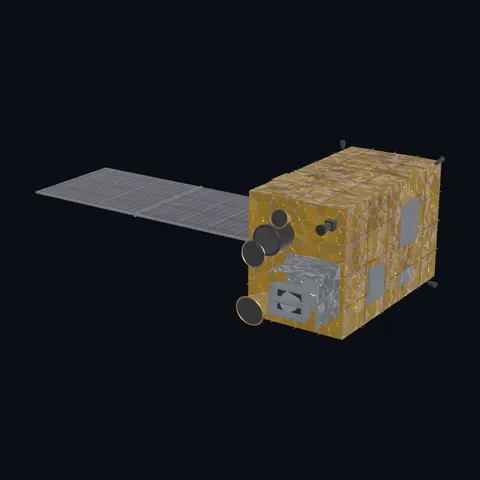
Fengyun-2
Shape built from published dimensions and pictures; details simplified.
Turn it in 3D
Open the 3D viewer (www.spaceradar.ai).
The viewer loads when you ask: about 700 kB the first time (three.js and the model), much less after.
About this model
Fengyun-2 is one of the 203 3D models Space Radar made itself: a satellite, built in code from published dimensions and photographs, with no image-to-3D generator and no one else’s mesh.
Shape built from published dimensions and pictures; details simplified. It has 9,252 triangles in a 94 kB glTF file, and is 4.5 m across at full scale.
On Space Radar’s live map it is drawn for the object with NORAD catalogue number 40367, where its published orbit puts it now. Open it on the map.
Dimensions and their sources
| Measure | Value |
|---|---|
| Diameter | 2.1 m |
| Drum height | 1.6 m |
| Length | 4.5 m |
eoPortal, FY-2, eoportal.org/satellite-missions/fy-2, OPENED 2026-10-27: 'a diameter of 2.1 m' and the drum 'about 1.6 m (cylinder)'; for FY-2F 'a length of 4.5 m' (FY-2G and -2H 'identical performance parameters as its predecessor'); 'dual spin-stabilized at 100 rpm with a despun antenna platform'; 'Power (280 W) is generated by surface-mounted solar cells'; a 'mechanically despun S-band antenna, and a UHF receive antenna'. Two cited lengths differ (the drum 1.6 m, the whole craft 4.5 m): both are built, the drum 1.6 m and the whole 4.5 m. OURS: the cone (0.55 m), the mast (1.3 m), the belt (0.2 m), the window (0.38 by 0.5 m), the two ribbed antenna cages, the nozzle (read 2026-10-27)
How it was made
Built in code from published dimensions and photographs, with no image-to-3D generator and no one else’s mesh. 3D model: built by Space Radar from eoPortal's published dimensions; compared with a picture by Jakubhal (CC BY-SA 4.0).
The full record
built by this project in code (release 1.4.0 stage r14-m4: one script a craft on release 1.3.0 W3-b's part library, lib.py and parts.py, kept with the stage's notes in ~/space-radar-handoff/release-1.4/r14-m4/build), from the cited dimensions and the pictures under `references`; no image-to-3D model was used, and no published mesh: a search for one on 2026-10-27 found none, NASA's 3D Resources has none of these craft, and the China Meteorological Administration publishes no model that was found (read 2026-10-27)
Where the map uses it. NORAD 40367 (FENGYUN 2G) and 43491 (FENGYUN 2H) in the live saved data of 2026-10-12: China's spin-stabilised geostationary weather satellites, the same kind of drum as Meteosat Second Generation's (one shared builder). They wore the shape of the geostationary bus (a winged box); public #1116. Not Fengyun-3 or -4 (their own files or the class shape), and not the earlier FY-2 craft, which are not in the live data.
Licence note. No CMA picture or model is in the file. Compared with, with credit: a museum model of Fengyun-2 by Jakubhal (CC BY-SA 4.0) on Wikimedia Commons; nothing of it is in the file. The shape is this project's, under this repository's licence, built from published numbers (facts).
References 1
What the shape was compared with. None of these pictures is in the file.
- 20090829 Model of Fengyun-2 4002.JPGJakubhal, CC BY-SA 4.0CC BY-SA 4.0 (Commons' LicenseShortName, read 2026-10-27)

Use it
The model is under the MIT licence: use it, change it and share it, in any project, also a paid one. Keep the credit:
Fengyun-2 3D model by Space Radar (spaceradar.ai), MIT LicenseAny glTF 2.0 loader that reads meshopt compression (EXT_meshopt_compression) opens the file: three.js with its MeshoptDecoder, Babylon.js, model-viewer. Tools such as glTF-Transform can write an uncompressed copy.
Or embed the viewer in your page:
<iframe src="https://www.spaceradar.ai/model/?id=fengyun-2" title="Fengyun-2, 3D model by Space Radar" width="600" height="450" loading="lazy" style="border:0;max-width:100%"></iframe>Related models
FORMOSAT-7 (COSMIC-2)
Shape built from published dimensions and pictures; details simplified.