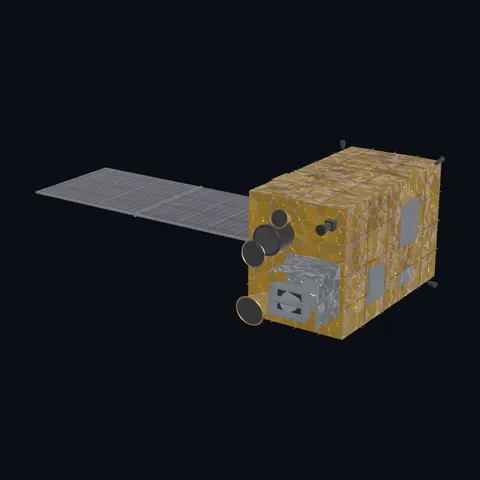
Fengyun-3
Shape built from published dimensions and pictures; details simplified.
Turn it in 3D
Open the 3D viewer (www.spaceradar.ai).
The viewer loads when you ask: about 700 kB the first time (three.js and the model), much less after.
Pictures 4
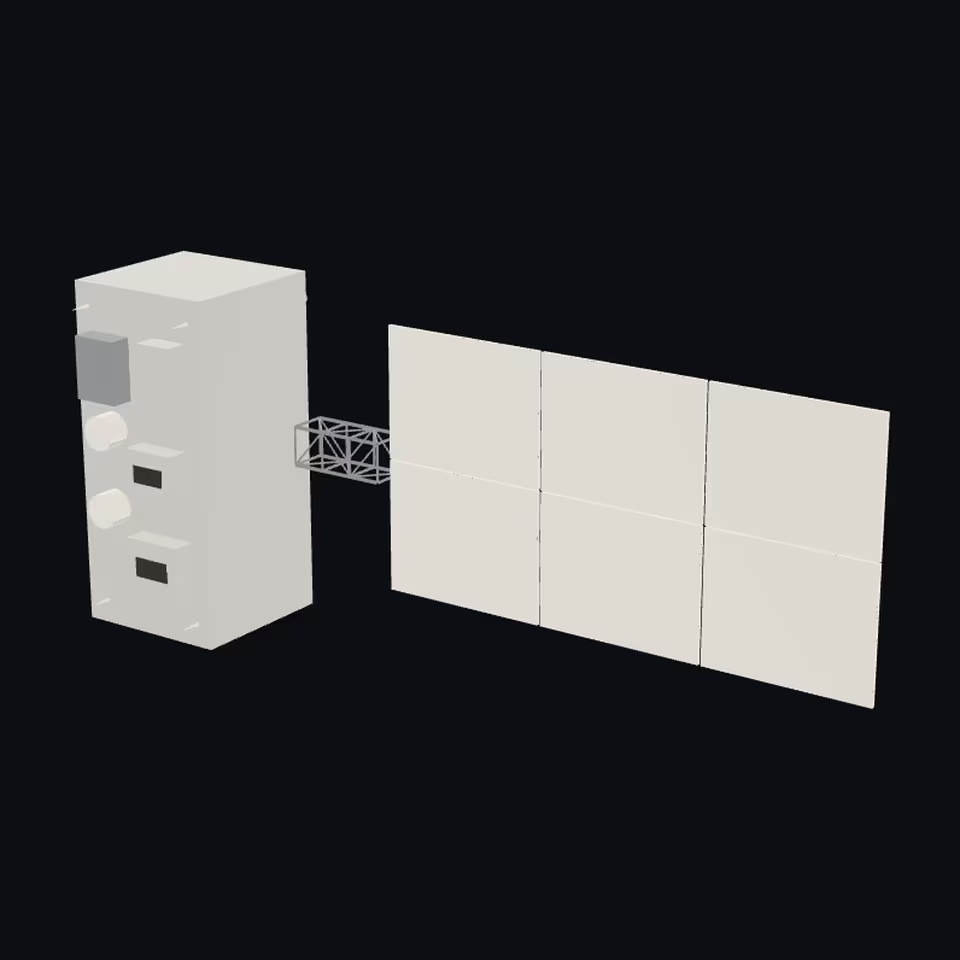
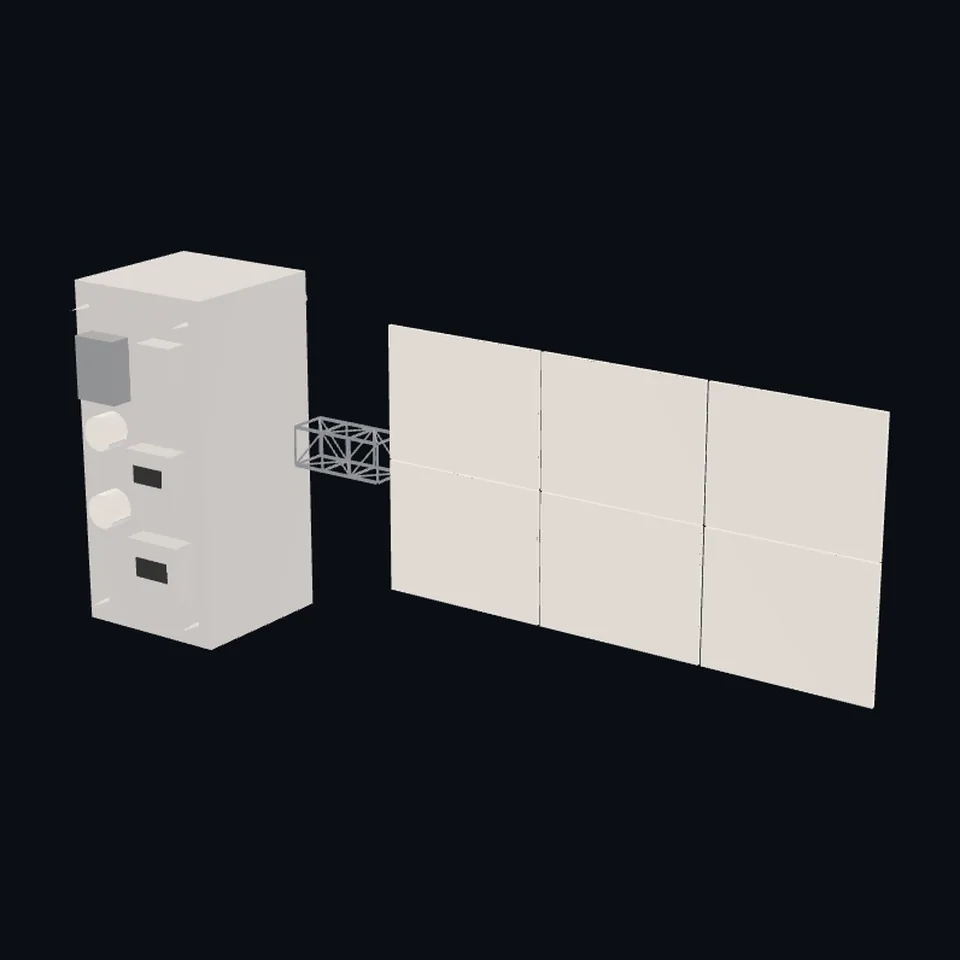 Three-quarter view
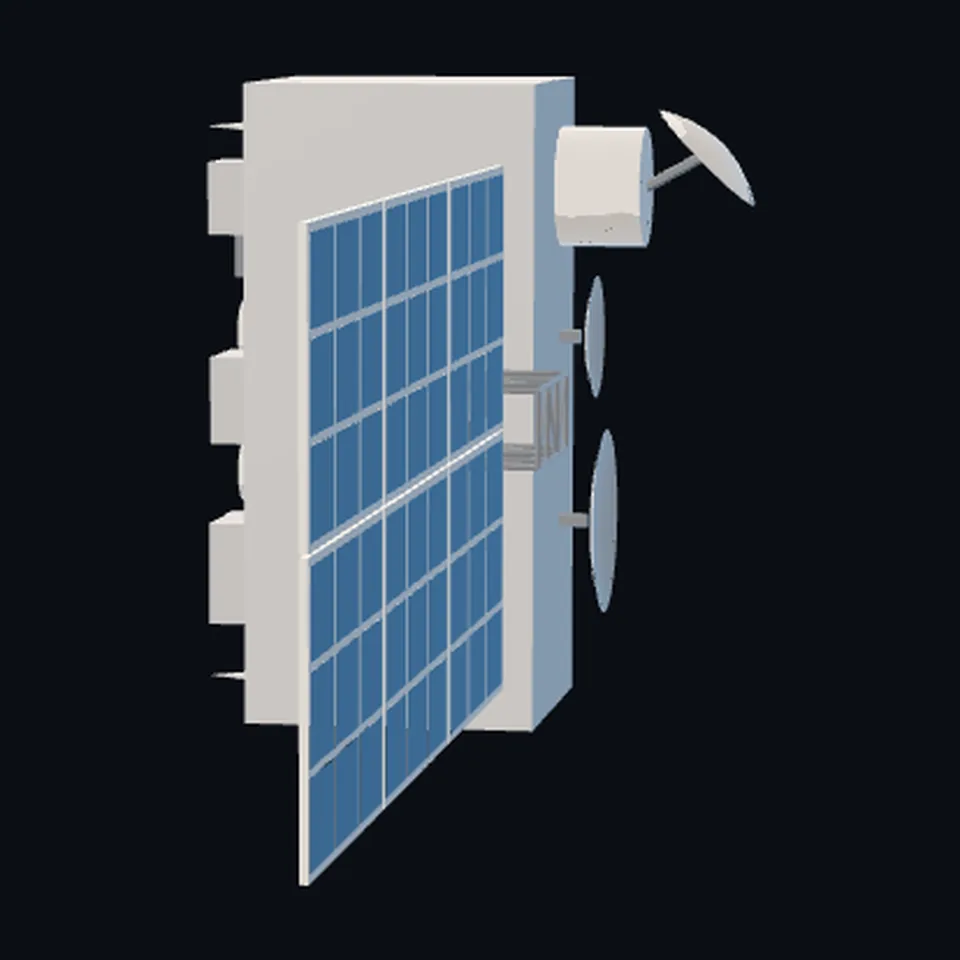 From the side
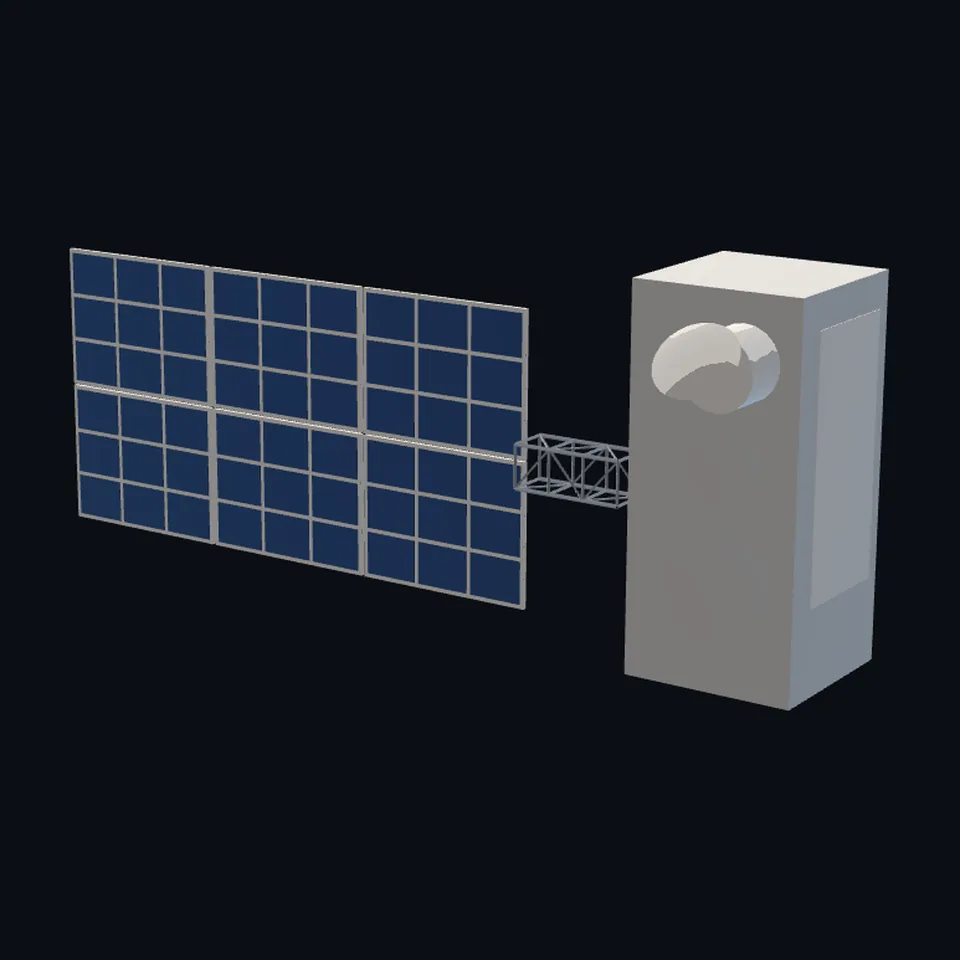 From behind
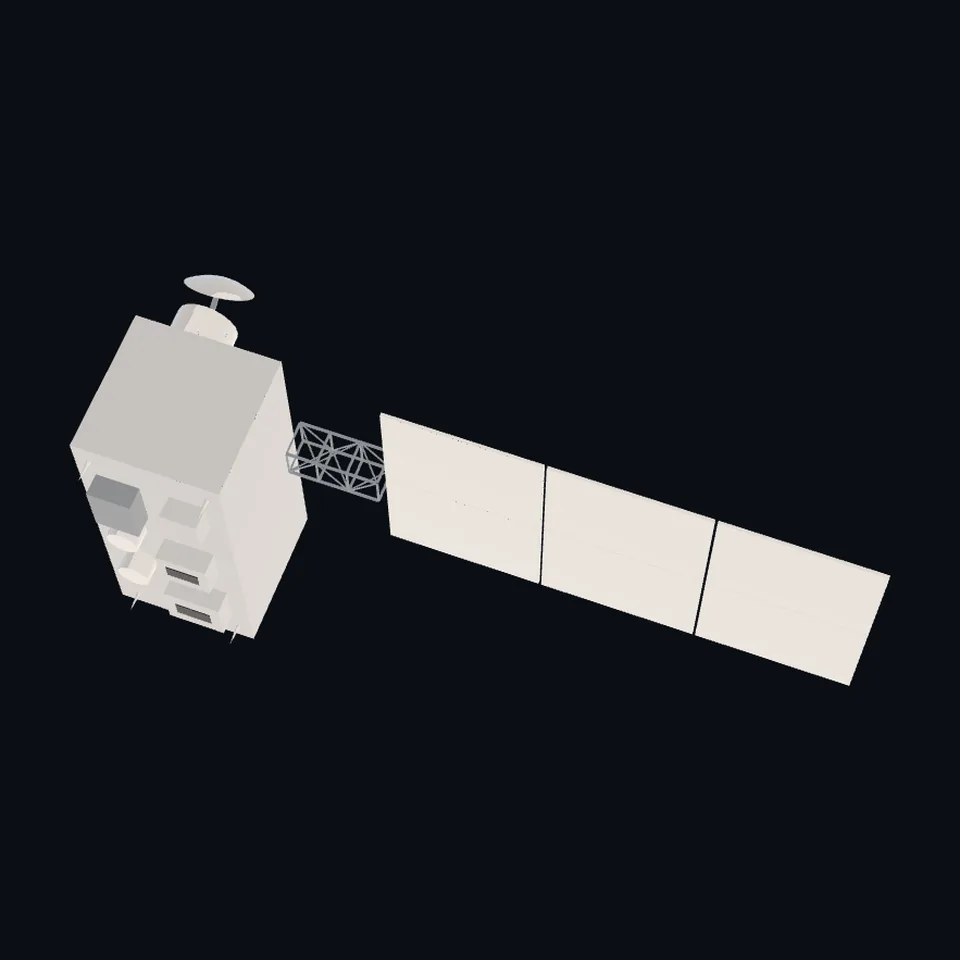 From above
About this model
Fengyun-3 is one of the 203 3D models Space Radar made itself: a satellite, built in code from published dimensions and photographs, with no image-to-3D generator and no one else’s mesh.
Shape built from published dimensions and pictures; details simplified. It has 7,608 triangles in a 41 kB glTF file, and is 10 m across at full scale.
On Space Radar’s live map it is drawn for 4 catalogued objects, each where its published orbit puts it now. Open it on the map.
Dimensions and their sources
| Measure | Value |
|---|---|
| Length | 4.4 m |
| Width | 2 m |
| Height | 2 m |
| Span | 10 m |
| Flight height | 3.79 m |
| Solar array | 22.464 m² |
| Mwri reflector | 0.9774 m |
eoPortal, eoportal.org/satellite-missions/fy-3, OPENED 2026-10-14: 'The FY-3 series spacecraft, developed at Shanghai Academy of Spaceflight Technology (SAST), features a 2450 kg hexahedron bus with one solar panel mounted on one side of the satellite's main body.'; 'The spacecraft structure is a hexahedron of 4.4 m x 2.0 m x 2.0 m in a stowed configuration and 4.4 m x 10 m x 3.8 m in the deployed state.'; 'The FY-3 features one solar panel mounted on one side of the satellite's main body (making the span length of the satellite 10 m in flight configuration).'; 'Body size: 4400 mm x 2000 mm x 2000 mm (x, y, z)'; 'Flight size: 4460 mm x 10000 mm x 3790 mm (x, y, z)'; 'The solar array of 22.464 m2 with an output power of 2.48 kW (EOL), average = 1100 W'; 'The FY-3 bus contains three major modules: a service module, a payload module, and a propulsion module.'; MWRI: 'It is comprised of an offset parabolic reflector with the dimensions of 977.4 mm x 897.0 mm which are illuminated by 4 separate feed horns.'; 'The reflector and feed horn are mounted on a drum'; 'the project developed two quasi-optical reflectors with diameters of 860 mm and 1300 mm, respectively, which are mounted on the opposite direction of hot load and the top of satellite platform.' READ OFF THE PHOTOGRAPH OF THE MOCKUP: the silver blankets, the wing on a truss yoke from the body's upper edge with two panels across, the white reflector above the body at one end, silver instrument housings with dark apertures and white rods on one face. OURS: the wing's six-panel split and its flat lie (chosen to fit the cited flight size), every instrument's size and place, the MWRI's drum and tilt. (read 2026-10-14)
How it was made
Built in code from published dimensions and photographs, with no image-to-3D generator and no one else’s mesh. 3D model: built by Space Radar from published dimensions and a photograph of the Fengyun-3 mockup by Hibiki Watabe (CC BY 2.0).
The full record
built by this project in code (the private tool model-from-images: assemble.py, from a yaml of primitives), from the cited dimensions and the pictures under `references`; no image-to-3D model was used, and no published mesh (NASA's 3D Resources has none of this craft; the survey of 2026-10-13 found no agency model of it under usable terms); no CMA, NSMC or SAST picture or model was used
Where the map uses it. FENGYUN 3A (32958), 3B (37214), 3C (39260) and 3D (43010) in the live saved data of 2026-10-12: China's polar-orbiting weather satellites of the first batch, SAST's long box with one wing. They had no route and wore the shape of their class (a box with two wings and a dish). The second batch (3E, 3F, 3G with its rain radar, 3H) carries other instruments and keeps that shape; public #996 (Fengyun-4 is not built: no opened page gives its size)
Licence note. CC BY 2.0 (a visitor's photograph of the Fengyun-3 mockup in the Shanghai Science and Technology Museum, which the layout was read off: looked at, with credit; nothing of the picture is in the file); the shape is this project's, under this repository's licence, built from published numbers (facts). NO CMA, NSMC OR SAST PICTURE WAS USED. NO LOGO AND NO LETTERING is on the mesh (the mockup's placard carries its maker's name; the file does not).
References 1
What the shape was compared with. None of these pictures is in the file.
- Fengyun 3 satellite mockupHibiki Watabe (Wikimedia Commons, CC BY 2.0)CC BY 2.0 (Hibiki Watabe; the Commons API's LicenseShortName, read 2026-10-14)

Use it
The model is under the MIT licence: use it, change it and share it, in any project, also a paid one. Keep the credit:
Fengyun-3 3D model by Space Radar (spaceradar.ai), MIT LicenseAny glTF 2.0 loader that reads meshopt compression (EXT_meshopt_compression) opens the file: three.js with its MeshoptDecoder, Babylon.js, model-viewer. Tools such as glTF-Transform can write an uncompressed copy.
Or embed the viewer in your page:
<iframe src="https://www.spaceradar.ai/model/?id=fengyun-3" title="Fengyun-3, 3D model by Space Radar" width="600" height="450" loading="lazy" style="border:0;max-width:100%"></iframe>Related models
FORMOSAT-7 (COSMIC-2)
Shape built from published dimensions and pictures; details simplified.