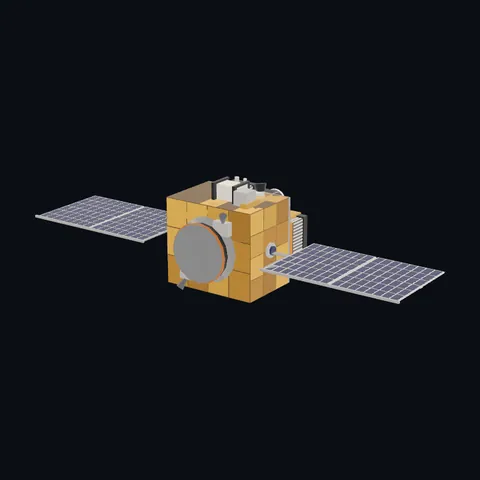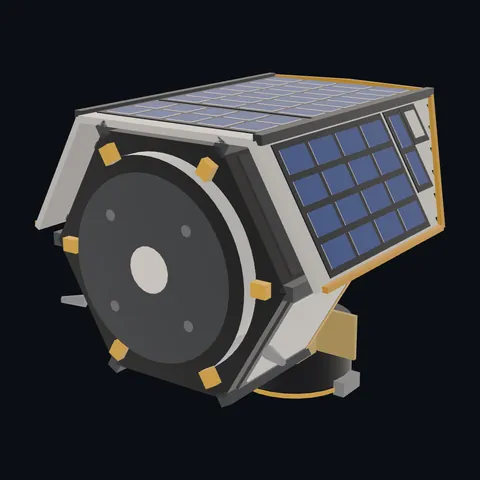
Gaia
Shape built from published dimensions and pictures; details simplified.
Turn it in 3D
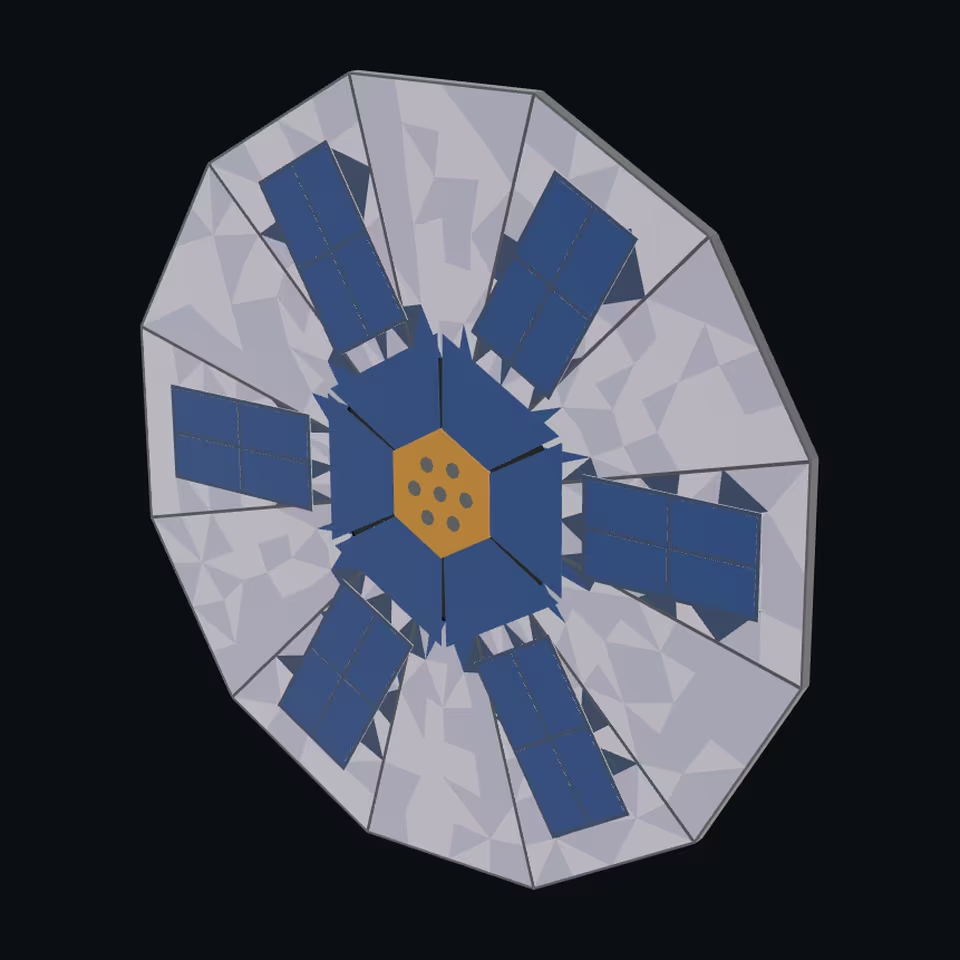
Open the 3D viewer (www.spaceradar.ai).
The viewer loads when you ask: about 700 kB the first time (three.js and the model), much less after.
Pictures 4
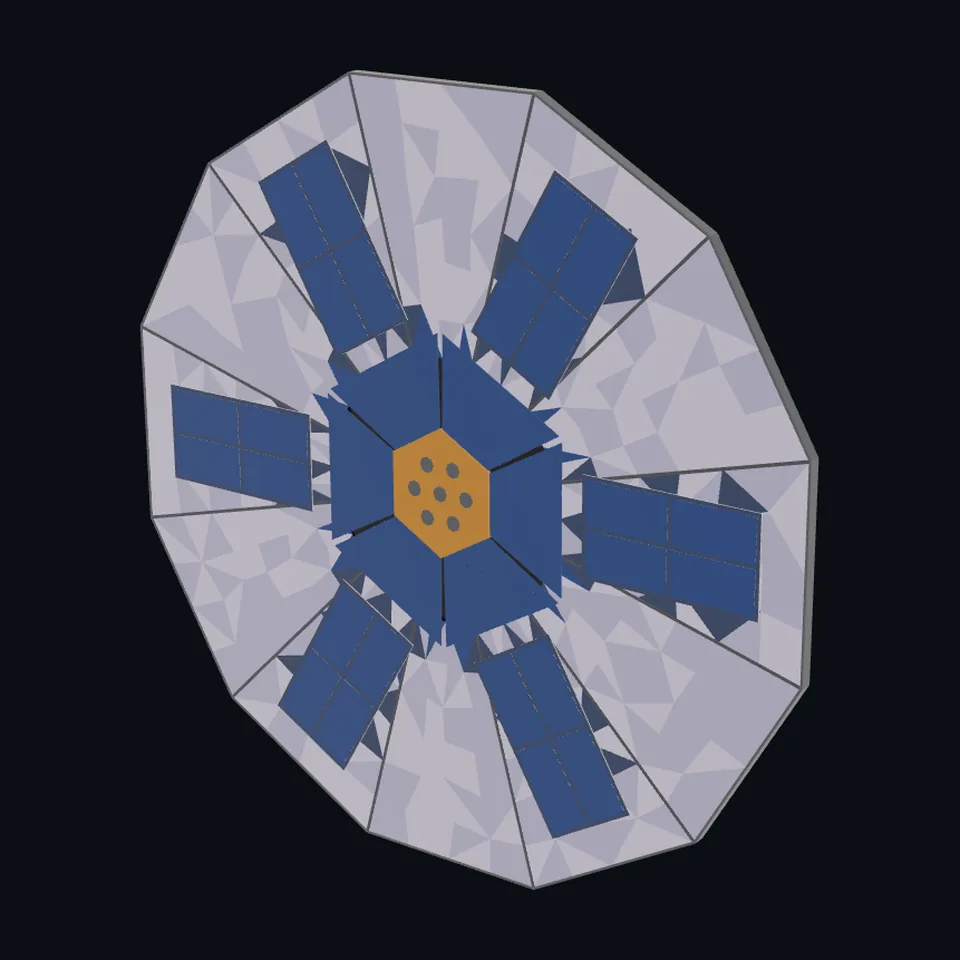 Three-quarter view
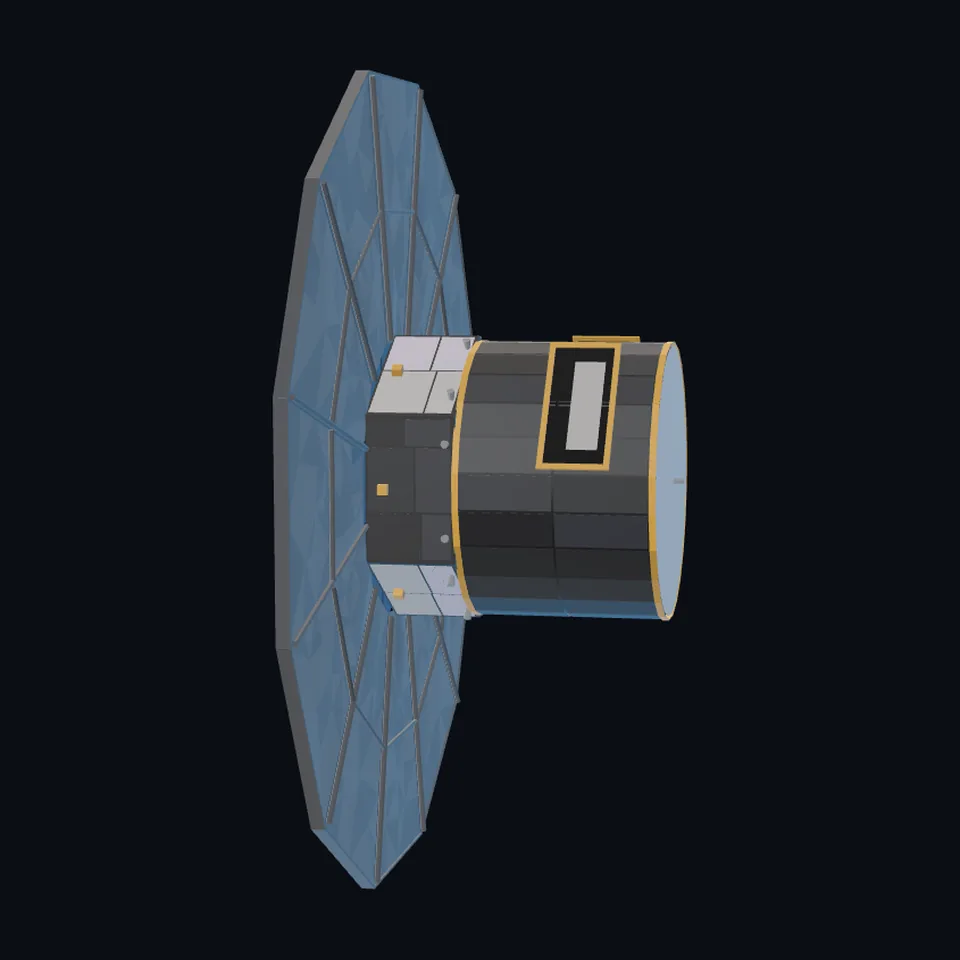 From the side
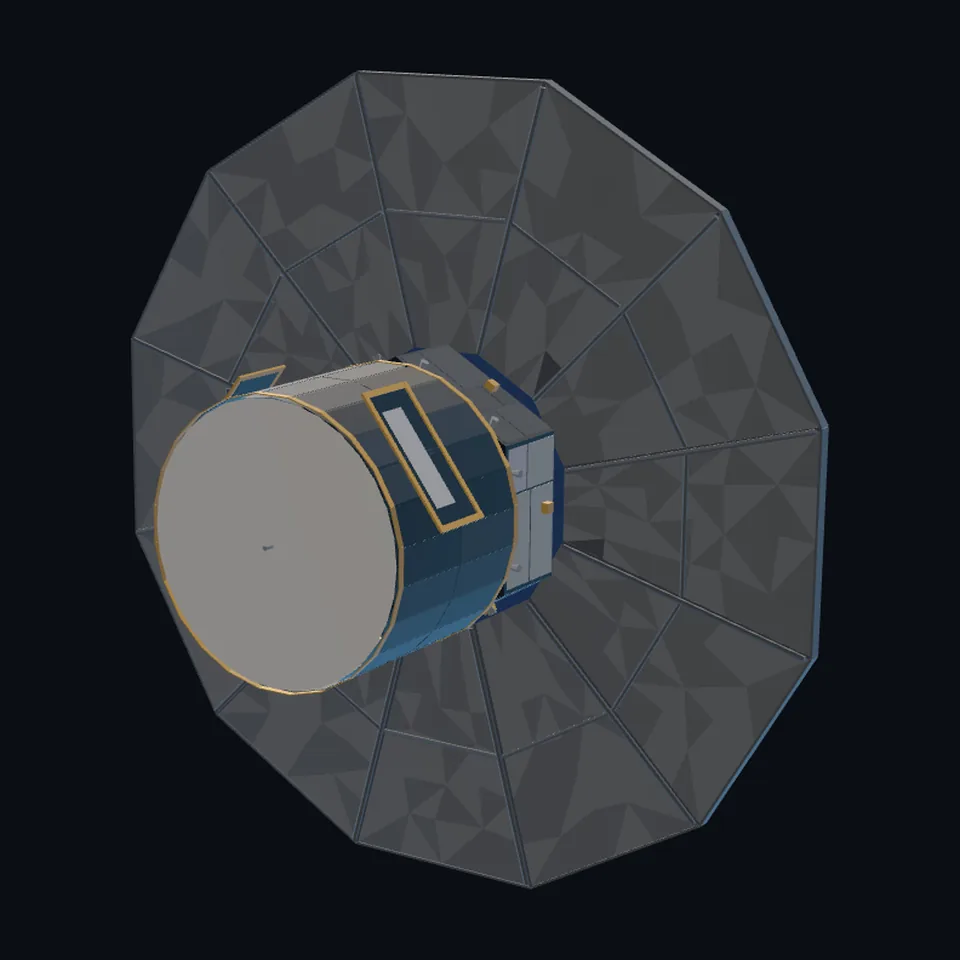 From behind
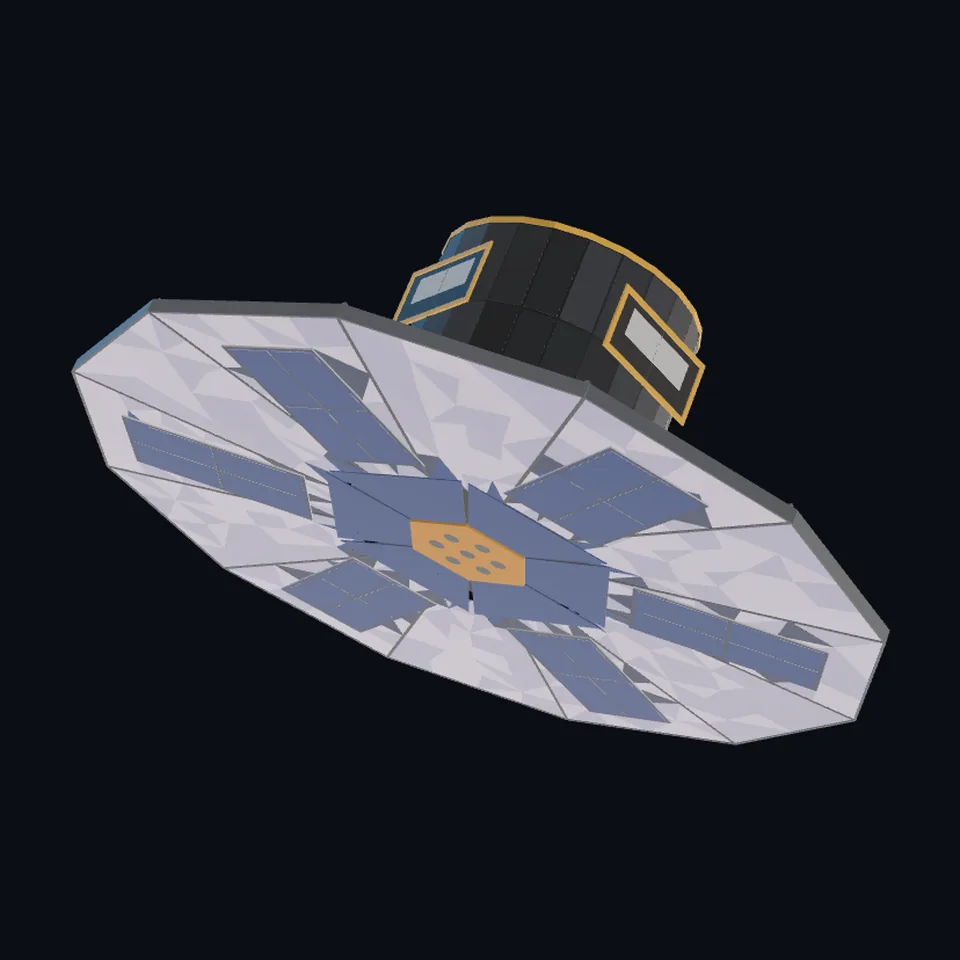 From above
About this model
Gaia is one of the 203 3D models Space Radar made itself: a space telescope, built in code from published dimensions and photographs, with no image-to-3D generator and no one else’s mesh.
Shape built from published dimensions and pictures; details simplified. It has 10,544 triangles in a 97 kB glTF file, and is 10 m across at full scale.
On Space Radar’s live map it is drawn where the craft is today. Open it on the map.
Dimensions and their sources
| Measure | Value |
|---|---|
| Shield | 10 m |
| Height | 3.5 m |
| Svm tube | 1.17 m |
| Primary x | 1.45 m |
| Primary y | 0.5 m |
Wikipedia, 'Gaia (spacecraft)', en.wikipedia.org/wiki/Gaia_(spacecraft), OPENED 2026-10-20: 'After launch, a 10-metre-diameter sunshade was deployed.'; 'consisted of two telescopes providing two observing directions with a fixed, wide angle of 106.5° between them'; '1.45 × 0.5 m primary mirror for each telescope'. eoPortal, eoportal.org/satellite-missions/gaia, OPENED 2026-10-20: 'Spacecraft dimensions Height = 3.5 m, deployed diameter = 10 m'; 'The sunshield measured about 10 m across, too large for the launch vehicle fairing, so it comprises a dozen folding panels that will be deployed after launch.'; 'Some of the solar array panels that are needed to generate power are fixed on the sunshield, with the rest on the bottom of the spacecraft.'; 'Attached to the DSA were six rectangular solar panels (with triple-junction solar GaAs cells) that are constantly facing the sun once the shield was deployed.'; 'The module consisted of a central tube that was about 1.17 m long and hosts six radial panels to create a hexagonal spacecraft shape'; 'a bi-propellant Chemical Propulsion System (2 x 8 10 N thrusters used in cold redundancy)'; 'The Micro-propulsion System (2 x 6 proportional micro-thrusters)'. ESA, 'Gaia factsheet', OPENED 2026-10-20: '10 m across, with solar array deployed'. OURS: the drum's 3.3 m, the service module's 3.0 m across flats and 1.1 m, the openings' size and height, the six panels' 2.3 x 1.25 m and the fixed ring's 1.9 m, read off the photographs against the cited 10 m and 3.5 m. (read 2026-10-20)
How it was made
Built in code from published dimensions and photographs, with no image-to-3D generator and no one else’s mesh. 3D model: built by Space Radar from published dimensions and a photograph of the full-size model (CC BY 2.0).
The full record
built by this project in code (the private tool model-from-images: assemble.py, from a yaml of primitives), from the cited dimensions and the pictures under `references`; no image-to-3D model was used, and no published mesh: ESA publishes no model of Gaia under terms that allow a derivative (its planetarium models, e.g. Webb's, may not be altered), and NASA's 3D Resources and NASA Science have none; a photograph of the full-size model's Sun side (CC BY 2.0) was looked at for the layout and is not in the file; NO ESA PICTURE OR MODEL IS IN THE FILE: ESA's published numbers were read as numbers. ESA's terms for the images on its site, read 2026-10-15 (esa.int/ESA_Multimedia/Terms_and_Conditions): 'The website of the European Space Agency (the ESA Website) provides to users an online access to space images and videos for education, editorial and/or information purposes only. All other uses (e.g. commercial ones) are excluded and require a specific licence.' ESA's renders on Wikimedia Commons are CC BY-SA 3.0 IGO (share-alike) and were looked at only
Where the map uses it. JPL Horizons -139479, Gaia (data/sample.js `deep-gaia`), ESA's astrometry telescope, since March 2025 switched off on a disposal orbit round the Sun: a black drum on a hexagonal service module over a twelve-sided sunshield 10 m across, its Sun side carrying the cells and the phased-array antenna. It was the procedural shape (scene/models.js buildGaia), which stays as what is drawn while the file is in flight; public #1086
Licence note. CC BY 2.0 (the photograph of the full-size model's Sun side, which the layout of the cells was read off: looked at, with credit; nothing of it is in the file); the shape is this project's, under this repository's licence, built from published numbers (facts). The photograph of the model at Le Bourget (CC BY-SA 3.0) and ESA's render (CC BY-SA 3.0 IGO) were looked at only. NO ESA PICTURE OR MODEL IS IN THE FILE. NO LOGO AND NO LETTERING is on the mesh.
References 3
What the shape was compared with. None of these pictures is in the file.
- GAIA (14050944939)DLR, CC BY 2.0CC BY 2.0 (DLR German Aerospace Center; Commons' LicenseShortName, read 2026-10-20): a photograph of the full-size model of Gaia's Sun side, its six cell panels, the fixed ring and the antenna
- Maquette de Gaia salon du Bourget 2013 DSC 0191PlineCC BY-SA 3.0 (Pline; Commons' LicenseShortName, read 2026-10-20): share-alike, LOOKED AT ONLY for the cold side's foil and gold patches
- Gaia spacecraftESACC BY-SA 3.0 IGO (European Space Agency; Commons' LicenseShortName, read 2026-10-20): share-alike, LOOKED AT ONLY for the drum, its openings and the service module


Use it
The model is under the MIT licence: use it, change it and share it, in any project, also a paid one. Keep the credit:
Gaia 3D model by Space Radar (spaceradar.ai), MIT LicenseAny glTF 2.0 loader that reads meshopt compression (EXT_meshopt_compression) opens the file: three.js with its MeshoptDecoder, Babylon.js, model-viewer. Tools such as glTF-Transform can write an uncompressed copy.
Or embed the viewer in your page:
<iframe src="https://www.spaceradar.ai/model/?id=gaia" title="Gaia, 3D model by Space Radar" width="600" height="450" loading="lazy" style="border:0;max-width:100%"></iframe>Related models
Hubble at release (STS-31, 1990)
Shape built from published dimensions and pictures; details simplified.
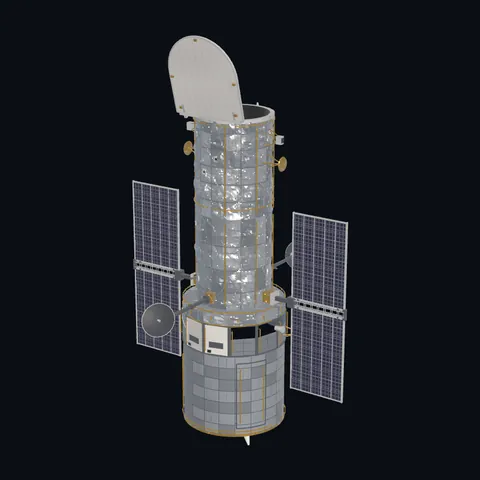
Hubble Space Telescope
Shape built from published dimensions and pictures; details simplified.