
CHEOPS
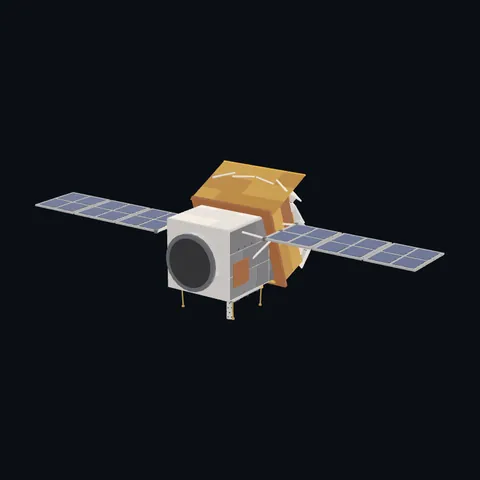
Shape built from published dimensions and pictures; details simplified.
Turn it in 3D
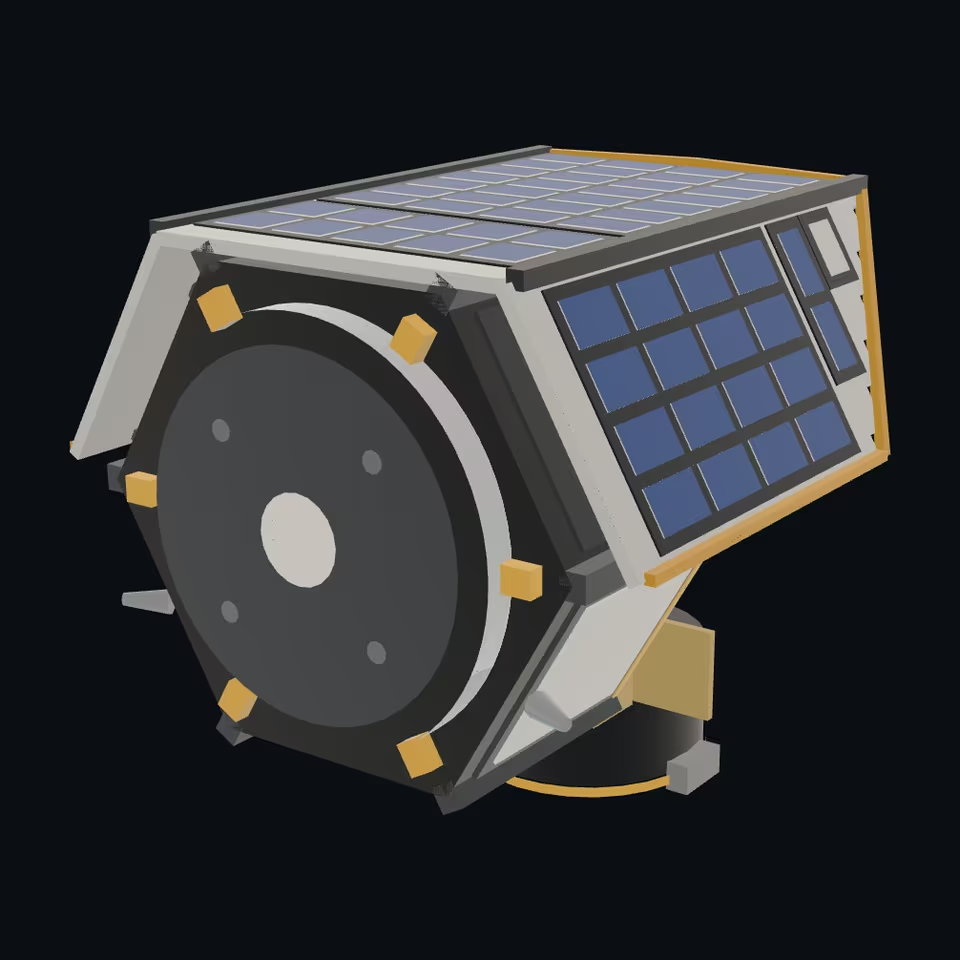
Open the 3D viewer (www.spaceradar.ai).
The viewer loads when you ask: about 700 kB the first time (three.js and the model), much less after.
Pictures 4
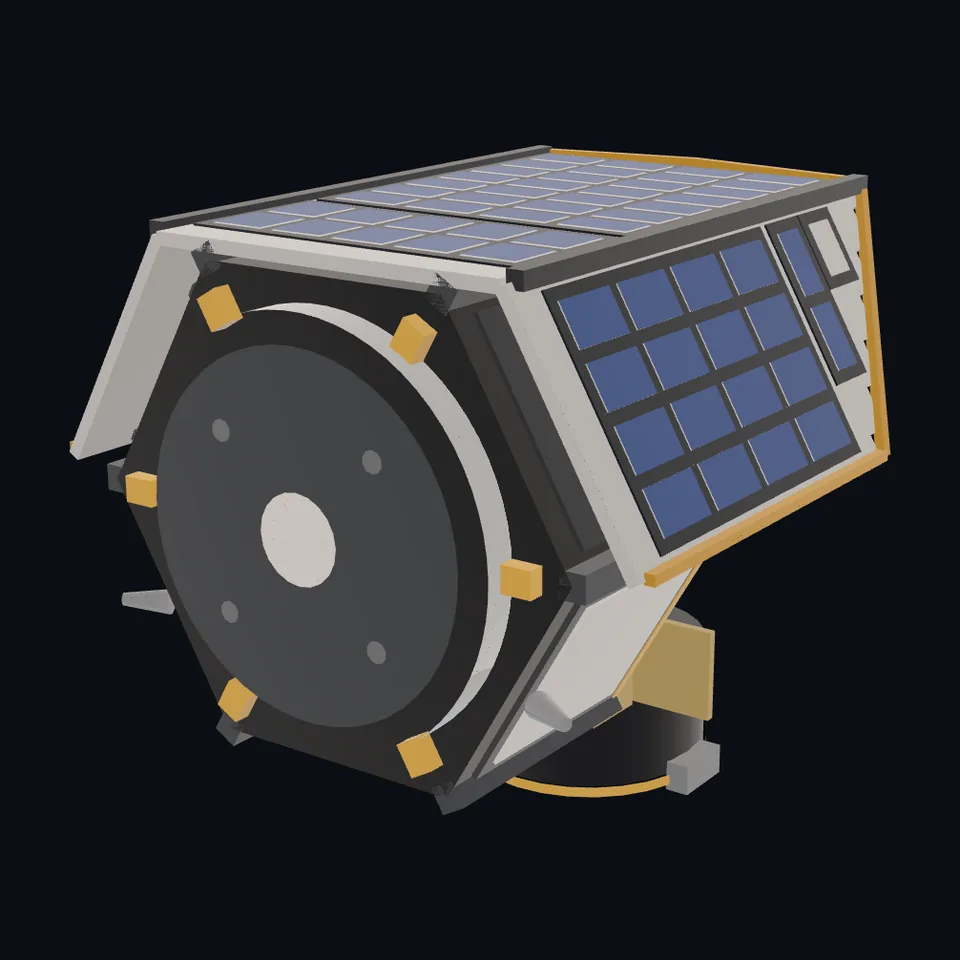 Three-quarter view
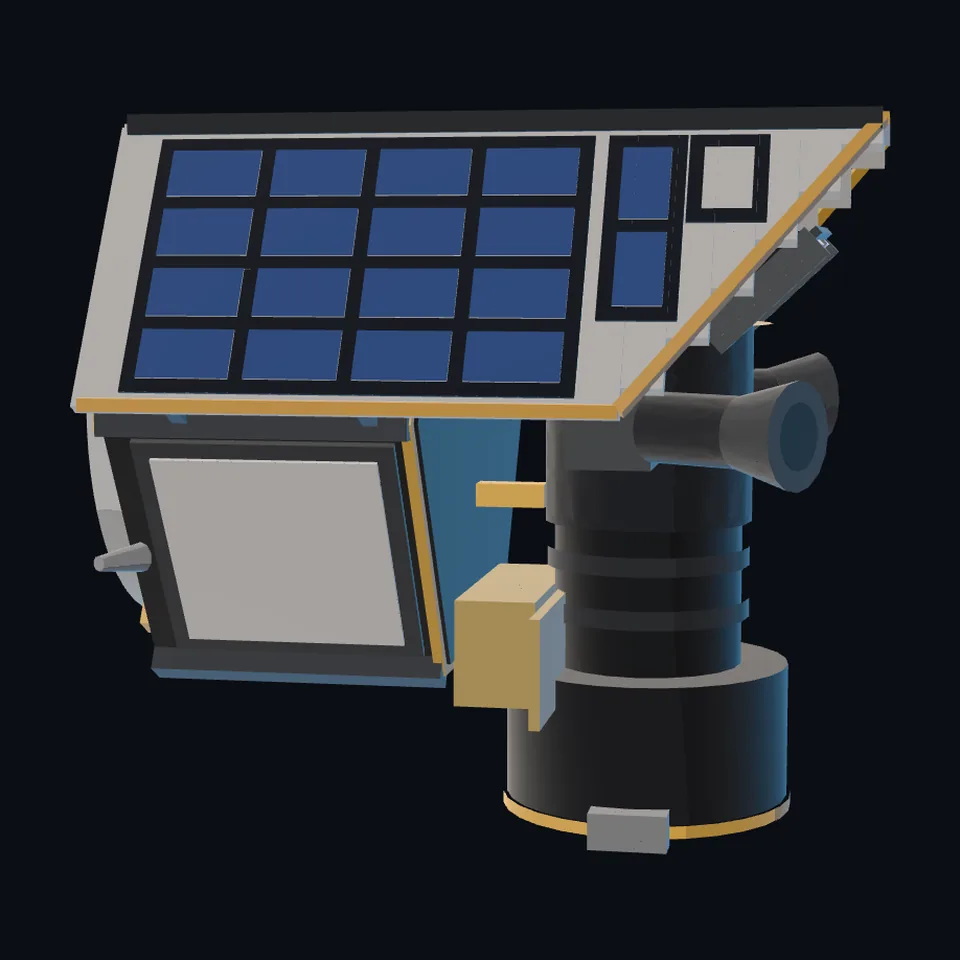 From the side
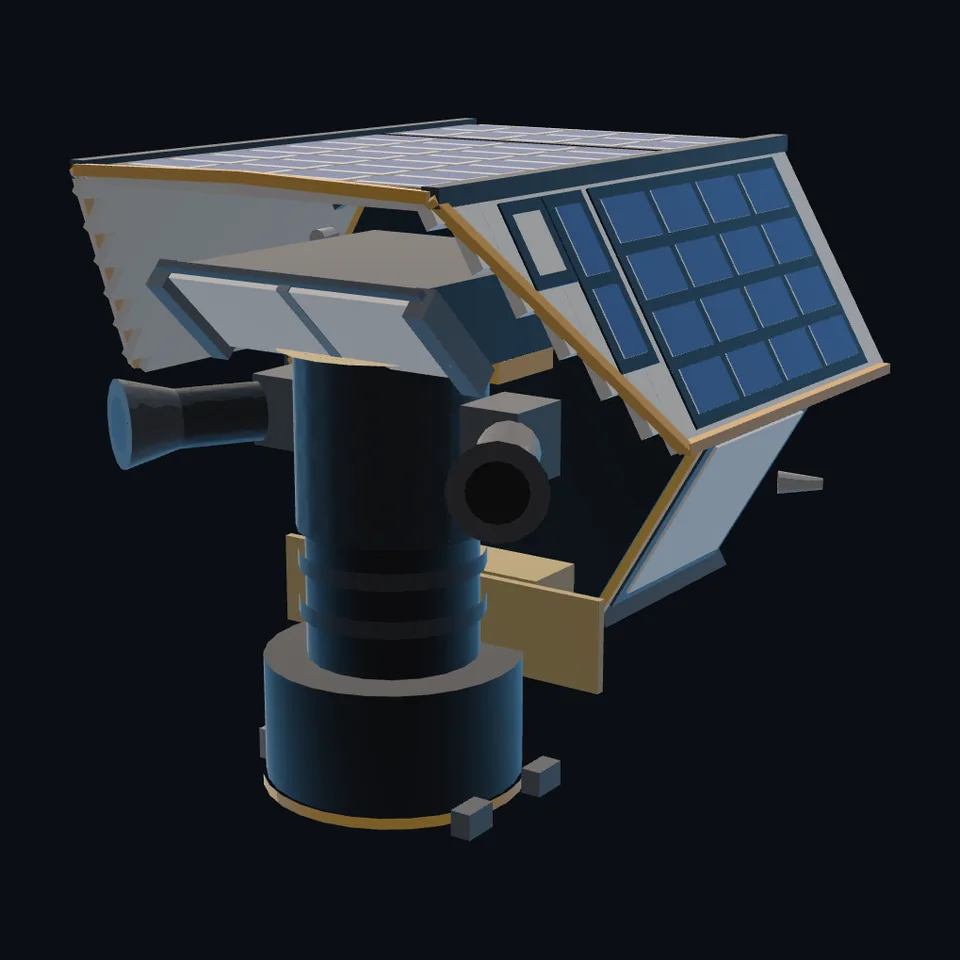 From behind
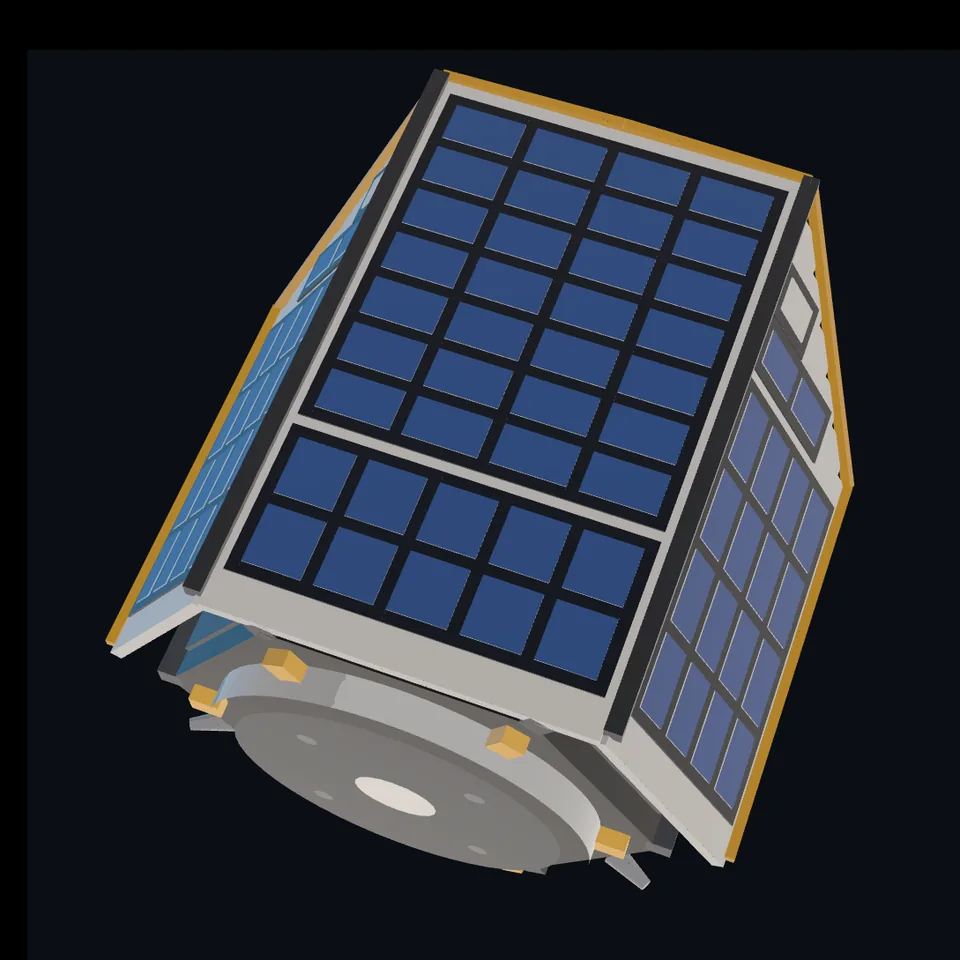 From above
About this model
CHEOPS is one of the 203 3D models Space Radar made itself: a space telescope, built in code from published dimensions and photographs, with no image-to-3D generator and no one else’s mesh.
Shape built from published dimensions and pictures; details simplified. It has 16,617 triangles in a 114 kB glTF file, and is 1.6 m across at full scale.
On Space Radar’s live map it is drawn for the object with NORAD catalogue number 44874, where its published orbit puts it now. Open it on the map.
Dimensions and their sources
| Measure | Value |
|---|---|
| Height | 1.55 m |
| Width | 1.49 m |
| Depth | 1.4 m |
| Hex side | 0.606 m |
| Hex across flats | 1.05 m |
| Platform height | 0.61 m |
| Ring | 0.937 m |
| Baffle | 0.6 m |
| Telescope length | 1.2 m |
ESA's CHEOPS paper model (pdf, sci.esa.int/documents/34122/36173/1567260328395-CHEOPS_paper_mod…, text and pages read 2026-11-03): 'total launch mass of approximately 300 kg and dimensions of 1.55m (height) x 1.49m (width, measured from solar array edge to edge) x 1.4m (depth)'; its steps place the Sun shield and arrays behind the platform, 'Fold the Sunshield (dark grey) and Solar Arrays (blue)', 'Glue the two Star Tracker Optical Heads ... on either side of the Telescope Tube, positioning them at a 60 degrees angle with the platform top panel'. Benz et al. 2021, arXiv:2009.11633 (opened 2026-11-03): 'the spacecraft is just above 1.5 m tall and has a footprint remaining within a circle of 1.6 m in radius. The total wet-mass is close to 275 kg'; 'a compact platform body, with a hexagonal-prismatic shape and body-mounted solar arrays, which also maintain the instrument and its radiators in the shade'; 'The three lateral panels in the anti-Sun direction are equipped with radiators'; 'installation of the instrument on top of the platform, behind a fixed Sun-shield, also supporting the Solar Arrays'; 'The total geometric area is about 2.5 square meters'; 'a 320 mm diameter primary mirror'; 'two star trackers ... optical heads ... mounted directly on the OTA structure'; the baffle 'a cylindrical aluminum tube with a number of circular vanes and black coating' ending in a cover with 'a spring-loaded hinge' and a Frangibolt. ESA, 'Designing and building Cheops' (www.esa.int, opened 2026-11-03 through a fetcher): 'a 300 mm effective aperture telescope', 'a large external baffle, a smaller internal one and vanes inside the telescope', 'A sunshield keeps the instrument shaded', two instrument radiators, 'two star trackers mounted directly onto the instrument'. READ BY THE LEAD SESSION on 2026-11-03 (sentences as it reported them; not re-opened by the builder): eoPortal (www.eoportal.org/satellite-missions/cheops) 'hexagonal prismatic platform', three body-mounted solar-array panels 'at 67 degrees between them', 'a fixed sunshield in the central solar panel shading the instrument radiators', the bottom surface 'the launcher interface (937 clamp-band ring)', 'Size: 1,6 m height, 290 kg'; the University of Bern (cheops.space.unibe.ch/mission/spacecraft) 'approx. 1.5 x 1.5 x 1.5 m and a hexagonal base structure', 'The sun-shield wraps around the hexagon', the telescope '30 cm aperture, 1.2 length including baffle'. DERIVED, NOT CITED: the paper model's net is the faithful LAYOUT but its '1:15' does not fit its own stated size (at 4.07 mm a page pixel the Sun shield would stand 1.73 m tall and the platform be 1.30 m across the flats, against 1.55 m and 1.49 m overall); the net was therefore scaled at 3.3 mm a pixel, the one scale at which the central panel (268 px, 0.88 m) plus one wing (184 px, 0.606 m, equal to one hexagon side) makes the cited 1.49 m, the shield and its ring make the cited 1.55 m, the interface ring (0.937 m) lies inside the hexagon's 1.05 m flats and the baffle comes to 0.60 m, which figure 5's 300 mm scale bar agrees with (0.53 to 0.6 m). THE STATED OVERALL SIZE AND THE NET'S PROPORTIONS WERE USED, NOT THE '1:15'. READ OFF THE PICTURES, NOT CITED: the hexagon's orientation (a face toward the Sun shield and one toward the telescope), the platform height 0.61 m, the telescope's diameters (0.60 baffle, 0.40 secondary baffle, 0.44 telescope structure) and lengths along its axis, the focal-plane housing's size and its sloping top, the two radiators' size and tilt (DRAWN TILTED on the housing's slope, as figure 5 and ESA's illustration show them, not bent 90 degrees to the shield as the paper model's step 6 says), the star-tracker heads' size and 60 degree elevation, the wings' chamfered tops (0.45 m lower at the outer edge), the braces, the antennas, the isolator brackets and the gold edge strips. (read 2026-11-03)
How it was made
Built in code from published dimensions and photographs, with no image-to-3D generator and no one else’s mesh. 3D model: built by Space Radar from ESA's, the University of Bern's and the mission paper's published dimensions and from pictures of CHEOPS by ESA and the University of Bern (looked at only; none is in the file).
The full record
built by this project in code (the private tool model-from-images: assemble.py, from a yaml of primitives), from the cited dimensions and the pictures under `references`; no image-to-3D model was used, and no published mesh (NASA's 3D Resources on GitHub and science.nasa.gov/3d-resources, read 2026-11-03: none of this craft; ESA publishes no 3D model of it and its terms forbid derivatives)
Where the map uses it. NORAD 44874 (CHEOPS): ESA's and Switzerland's CHaracterising ExOPlanet Satellite, launched 2019, a 32 cm telescope behind a long baffle on a hexagonal Airbus platform with its three-panel Sun shield and solar array behind it. It had no model of its own; public #963
Licence note. Not applicable to any picture: ESA's pictures of the craft (CC BY-SA 3.0 IGO), the University of Bern's photographs (CC BY-SA 4.0) and ESA's paper model were LOOKED AT ONLY, with credit; nothing of them is in the file, which is not derived from any of them. The mission paper's figures were looked at only too. The shape is this project's, under this repository's licence, built from published numbers (facts) and from what the pictures show. NO LOGO AND NO LETTERING is on the mesh.
References 6
What the shape was compared with. None of these pictures is in the file.
- CHEOPS spacecraftESACC BY-SA 3.0 IGO (ESA; Commons' licence field, read 2026-11-03)
- Unibe CHEOPS 020 20200616 1200University of BernCC BY-SA 4.0 (Universitaet Bern; Commons' licence field, read 2026-11-03)
- Unibe space 01963 201801 1200University of BernCC BY-SA 4.0 (Universitaet Bern; Commons' licence field, read 2026-11-03)
- Cheops explores mysterious warm mini-Neptunes ESA24847678 (and Cheops unlocks family of six exoplanets in harmonic rhythm ESA25339453)ESACC BY-SA 3.0 IGO (ESA; Commons' licence field, read 2026-11-03)
- CHEOPS paper model (Assemble your own planet watcher, scale 1:15)ESAESA's own paper, no licence read; ESA's terms forbid derivatives, so it was read for numbers and layout only
- Benz, W., Broeg, C., Fortier, A., et al., 'The CHEOPS mission', Experimental Astronomy 51, 109 (2021), arXiv:2009.11633W. Benz et al. (University of Bern, ESA, Airbus Spain)no licence stated on the arXiv page (read 2026-11-03); sentences are quoted as facts


Use it
The model is under the MIT licence: use it, change it and share it, in any project, also a paid one. Keep the credit:
CHEOPS 3D model by Space Radar (spaceradar.ai), MIT LicenseAny glTF 2.0 loader that reads meshopt compression (EXT_meshopt_compression) opens the file: three.js with its MeshoptDecoder, Babylon.js, model-viewer. Tools such as glTF-Transform can write an uncompressed copy.
Or embed the viewer in your page:
<iframe src="https://www.spaceradar.ai/model/?id=cheops" title="CHEOPS, 3D model by Space Radar" width="600" height="450" loading="lazy" style="border:0;max-width:100%"></iframe>Related models
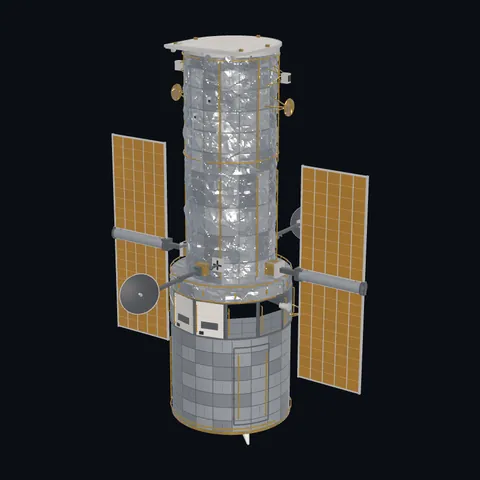
Hubble at release (STS-31, 1990)
Shape built from published dimensions and pictures; details simplified.
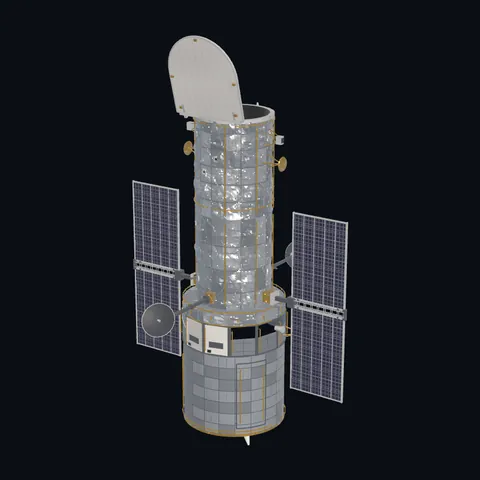
Hubble Space Telescope
Shape built from published dimensions and pictures; details simplified.
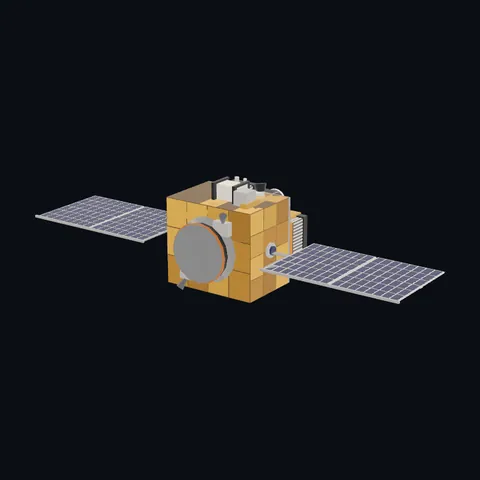
Einstein Probe
Shape built from published dimensions and pictures; details simplified.