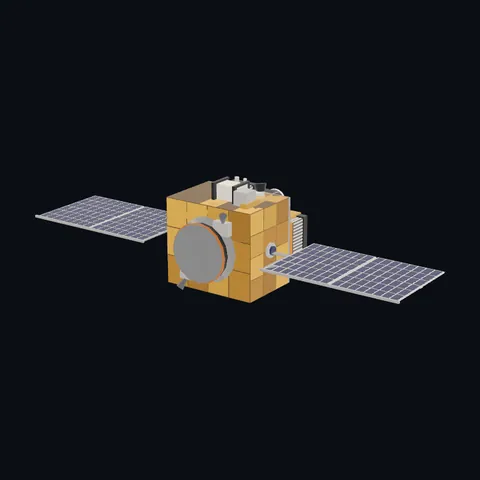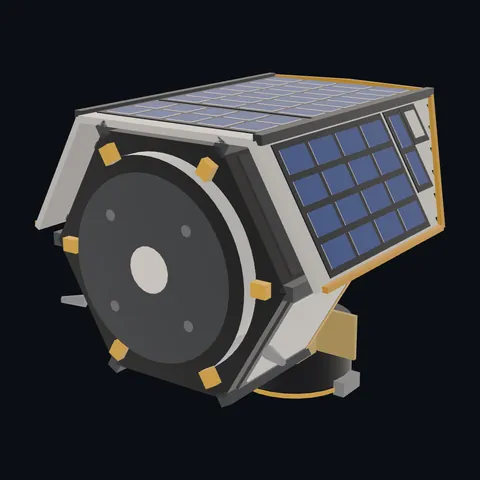
Einstein Probe
Shape built from published dimensions and pictures; details simplified.
Turn it in 3D
Open the 3D viewer (www.spaceradar.ai).
The viewer loads when you ask: about 700 kB the first time (three.js and the model), much less after.
Pictures 4
 Three-quarter view
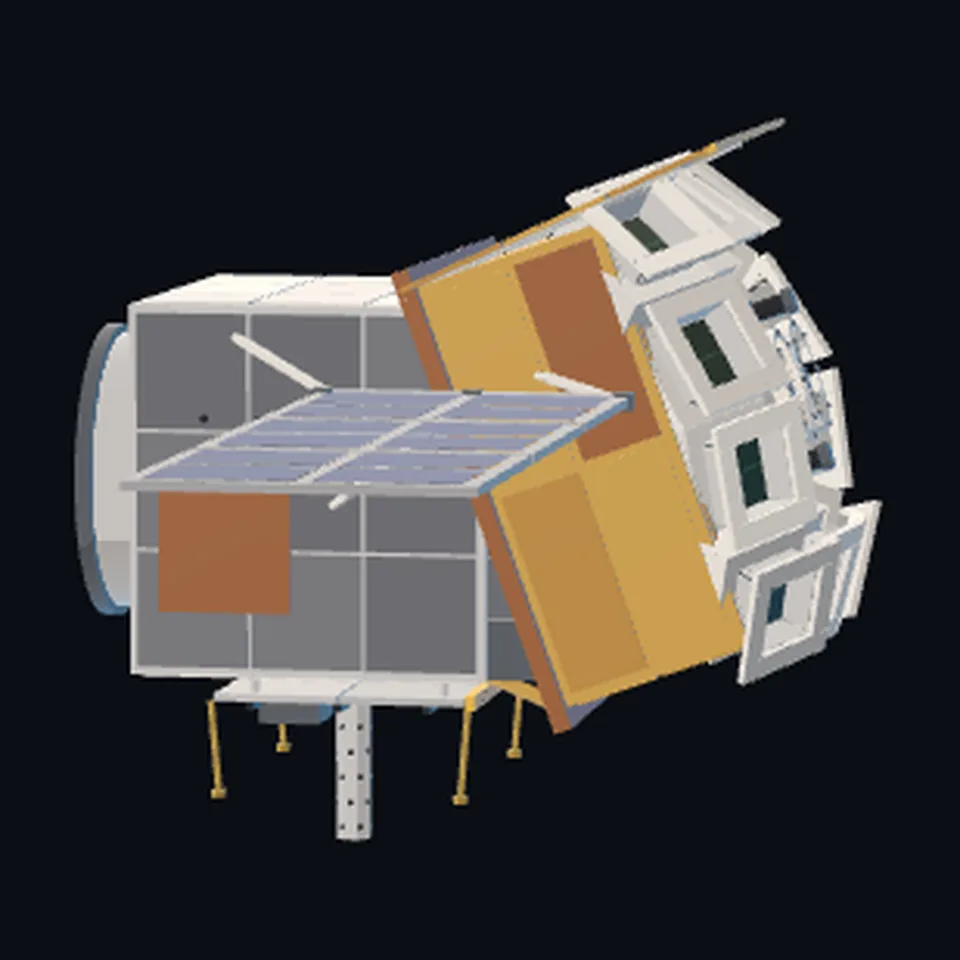 From the side
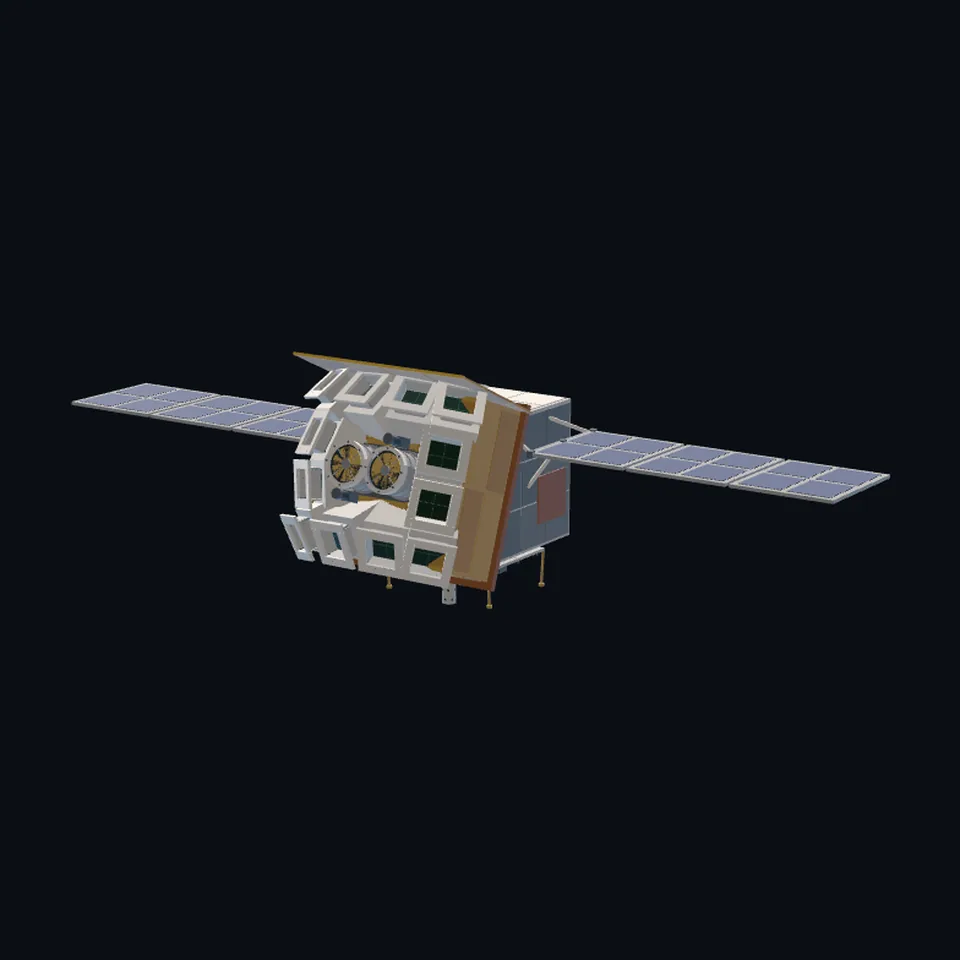 From behind
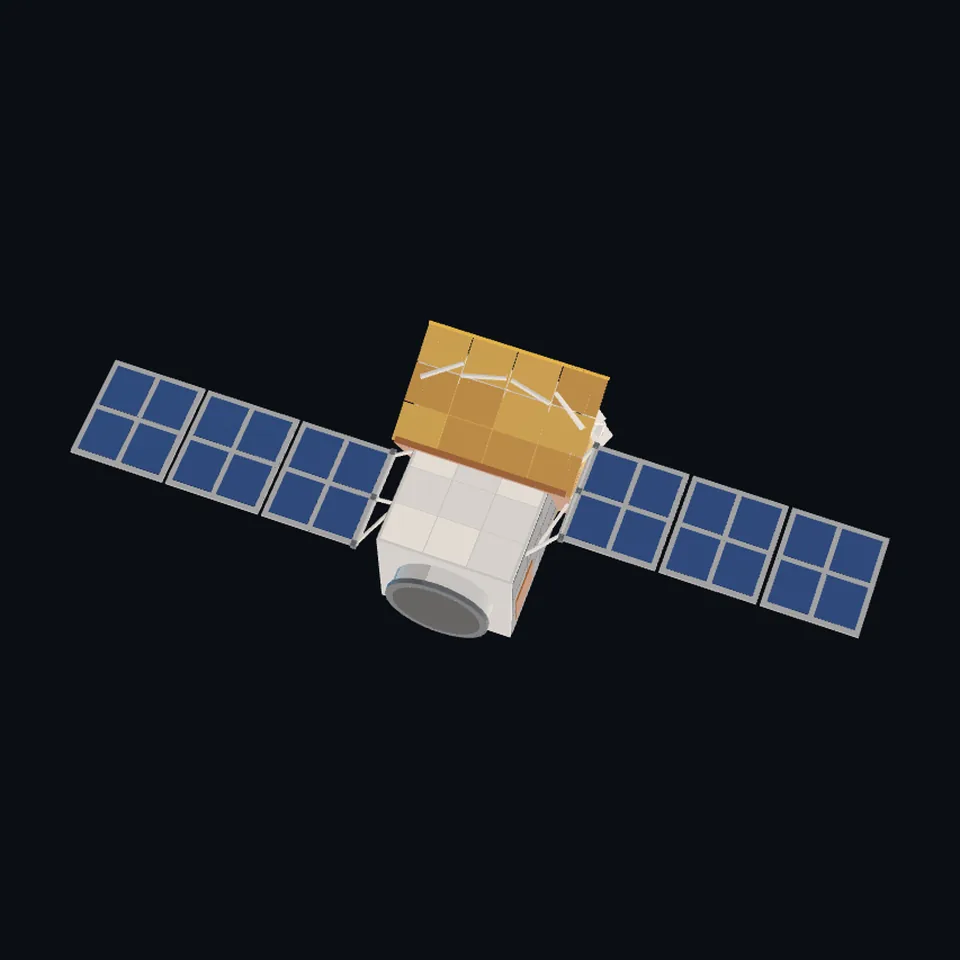 From above
About this model
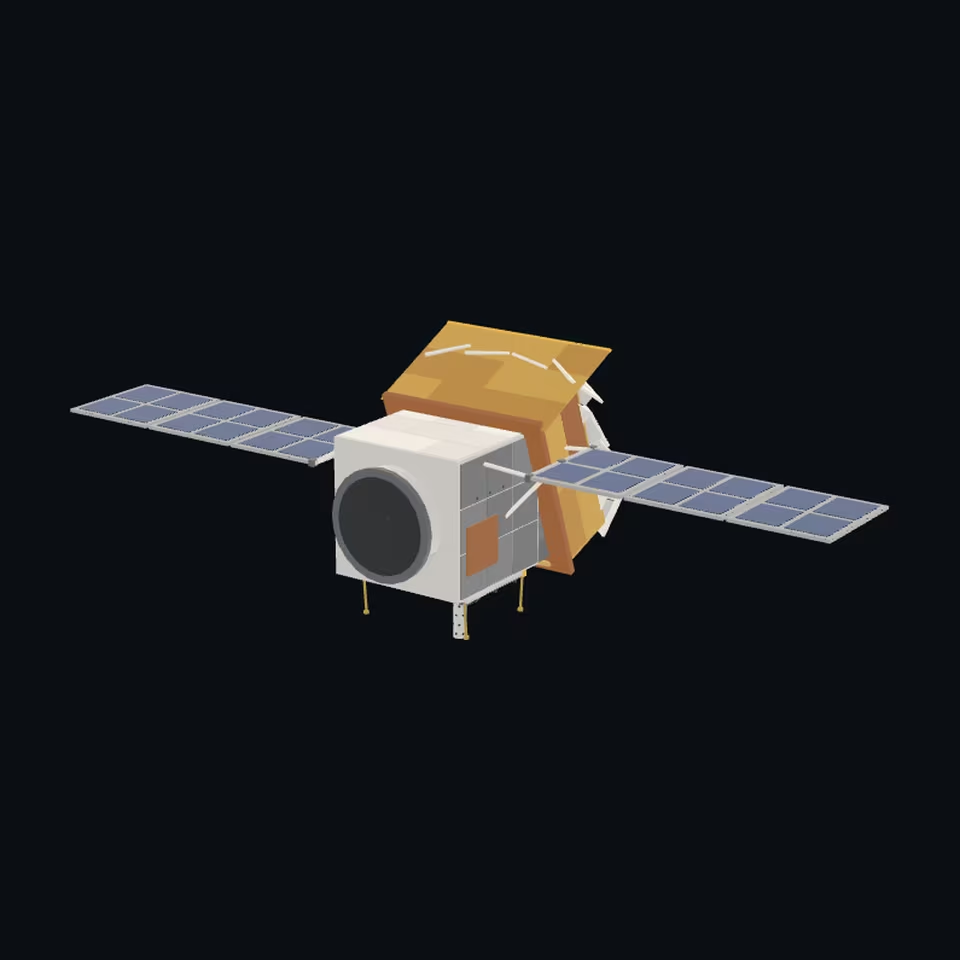
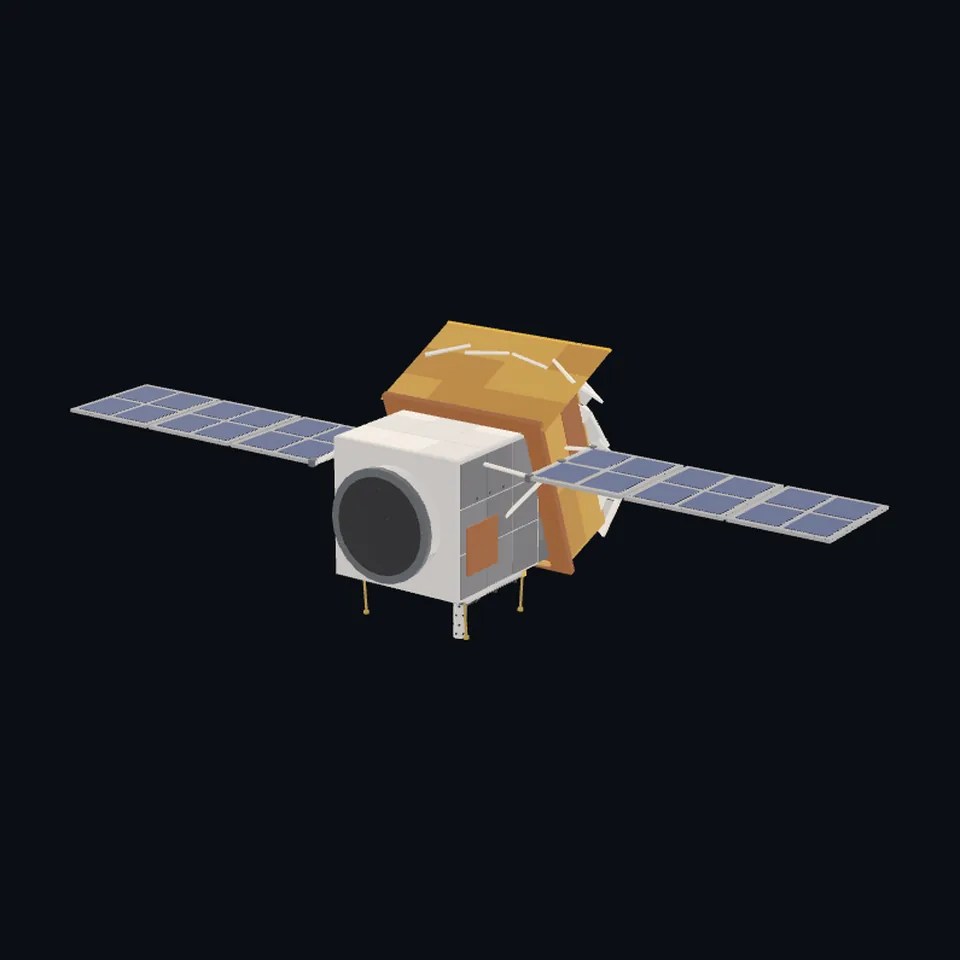
Einstein Probe is one of the 203 3D models Space Radar made itself: a space telescope, built in code from published dimensions and photographs, with no image-to-3D generator and no one else’s mesh.
Shape built from published dimensions and pictures; details simplified. It has 12,620 triangles in a 113 kB glTF file, and is 3.4 m across at full scale.
On Space Radar’s live map it is drawn for the object with NORAD catalogue number 58753, where its published orbit puts it now. Open it on the map.
Dimensions and their sources
| Measure | Value |
|---|---|
| Mass | 1450 kg |
| Stowed envelope | 3 × 3.4 m |
| Wxt modules | 12 |
| Wxt optics per module | 36 |
| Wxt optic | 42.5 mm |
| Wxt module mass | 17 kg |
| Fxt units | 2 |
| Fxt shells | 54 |
| Fxt focal length | 1.6 m |
ESA, 'Einstein Probe factsheet', esa.int/Science_Exploration/Space_Science/Einstein_Probe_factshe…, OPENED 2026-11-03: 'The satellite has a total mass of 1450 kg and measures 3 by 3.4 metres.'; 'The WXT consists of 12 modules, together creating a view of 3600 square degrees.'; 'The instrument comprises two identical units, each having a mirror module consisting of 54 gold coated shells.' Yuan, Zhang, Chen and Ling, 'The Einstein Probe Mission', arxiv.org/abs/2209.09763, OPENED 2026-11-03: 'There are twelve almost identical WXT modules, each of ~300 sq. deg. FoV'; 'The mirror assembly of each module comprises 36 MPO optics mounted on a supporting alloy frame. A optic has a size of 42.5x42.5 mm2'; 'Mass per module 17 kg'; 'The two FXT units are placed at the centre, surrounded by the twelve WXT modules' (the caption of figure 18); 'Each FXT unit is composed of three parts, an upper composite ..., a lower composite ..., and supporting structure. The upper composite is composed mainly of a mirror assembly, a thermal baffle, a sunshade cover, and an optical reference flange. A star sensor is also set on the shading cylinder.'; 'a focal length of 1.6 m'; 'The payload weights 564 kg, and the satellite has a weight <=1,450 kg and an average power 1,212 W'; 'solar-panel deployment test'. zh.wikipedia, '爱因斯坦探针卫星', OPENED 2026-11-03: the platform is IAMC's Phoenix-Eye-2 (凤眼二号) and the infobox lists 3.000 m x 3.605 m (it does not say which way, nor whether stowed). Gunter's Space Page, OPENED 2026-11-03: 'Power: 2 deployable solar arrays, batteries'. CelesTrak (gp.php?CATNR=58753, OPENED 2026-11-03): OBJECT_NAME 'EINSTEIN PROBE', OBJECT_ID 2024-007A; its rocket body is 58754. DERIVED: each WXT module's mouth is 0.30 m (6 optics of 42.5 mm is 0.255 m, with a frame). NOT CITED, READ OFF THE PICTURES AND ESTIMATES: the bus box (1.50 x 1.44 x 1.40 m), the payload cabin on it (1.80 x 1.70 x 0.76 m), the module face (0.48 m) and housing (0.46 m, 0.50 m deep), the ring's pitch (0.50 m), the 10 and 26 degree tilts that fan the ring, the FXT cylinders (0.43 m across, 0.41 m high), the sunshade, the equipment deck and the tube under the bus, and the SOLAR WINGS: three panels of 1.1 m by 1.2 m a wing, about 8.6 m tip to tip. NO PAGE OPENED GIVES THE ARRAY'S SIZE (the 3 x 3.4 m is read as the stowed envelope: the file's bus and payload are 1.5 m wide and 2.5 m tall with the adapter, the cabin 1.8 m wide), and the illustration and the qualification-model photograph disagree about how wide a panel is, so a value between them was taken: the wings' proportions are the least certain part of the file. (read 2026-11-03)
How it was made
Built in code from published dimensions and photographs, with no image-to-3D generator and no one else’s mesh. 3D model: built by Space Radar from ESA's and the mission paper's published numbers for the Einstein Probe, and from China News Service's illustrations (CC BY 4.0, China News Service).
The full record
built by this project in code (the private tool model-from-images: assemble.py, from a yaml of primitives, object `telescope-einstein-probe`), from the cited numbers and the pictures under `references`; no image-to-3D model was used, and no published mesh of the craft that this project may use (NASA's 3D Resources on GitHub, the whole tree, read 2026-11-03: none; ESA's pictures of it forbid derivative works, so they were not used)
Where the map uses it. NORAD 58753 (EINSTEIN PROBE, CelesTrak's name, read 2026-11-03): the Chinese Academy of Sciences' X-ray time-domain telescope with ESA and the Max Planck Institute for Extraterrestrial Physics, launched 9 January 2024. It had no route and was drawn as the generic satellite; public #972
Licence note. CC BY 4.0 (the two China News Service illustrations the layout was read from: looked at, with credit; nothing of them is in the file). The figures of Yuan et al. (arXiv:2209.09763) were looked at only. The shape is this project's, under this repository's licence, built from published numbers (facts). NO LOGO AND NO LETTERING is on the mesh.
References 4
What the shape was compared with. None of these pictures is in the file.
- Einstein Probe illustrationChina News Service, CC BY 4.0CC BY 4.0 (China News Service; Commons' LicenseShortName, read 2026-11-03)
- 爱因斯坦探针卫星China News Service, CC BY 4.0CC BY 4.0 (China News Service, 中国新闻社; Commons' LicenseShortName, read 2026-11-03)
- Yuan, Zhang, Chen and Ling, The Einstein Probe Mission (Handbook of X-ray and Gamma-ray Astrophysics)W. Yuan, C. Zhang, Y. Chen, Z. Ling (figures credited there to IAMC, SITP and IHEP of CAS)the authors' (arXiv preprint): looked at only
- EP project brief (Einstein Probe 项目简介, EP-SASE-JJ-01 V1.0, 3 Nov 2022), NAOC, CASNational Astronomical Observatories, CASNAOC's (a project brief): looked at only


Use it
The model is under the MIT licence: use it, change it and share it, in any project, also a paid one. Keep the credit:
Einstein Probe 3D model by Space Radar (spaceradar.ai), MIT LicenseAny glTF 2.0 loader that reads meshopt compression (EXT_meshopt_compression) opens the file: three.js with its MeshoptDecoder, Babylon.js, model-viewer. Tools such as glTF-Transform can write an uncompressed copy.
Or embed the viewer in your page:
<iframe src="https://www.spaceradar.ai/model/?id=einstein-probe" title="Einstein Probe, 3D model by Space Radar" width="600" height="450" loading="lazy" style="border:0;max-width:100%"></iframe>Related models
Hubble at release (STS-31, 1990)
Shape built from published dimensions and pictures; details simplified.
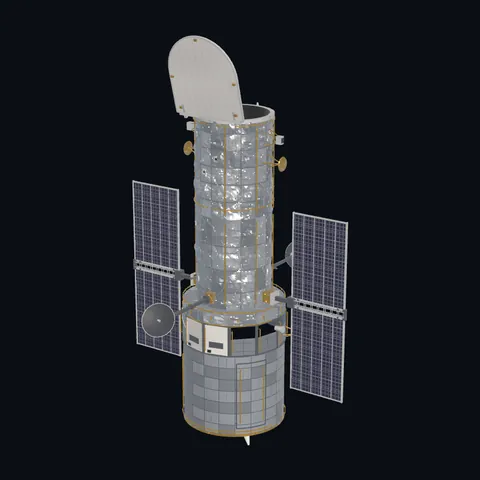
Hubble Space Telescope
Shape built from published dimensions and pictures; details simplified.