SMOS
Shape built from published dimensions and pictures; details simplified.
Turn it in 3D
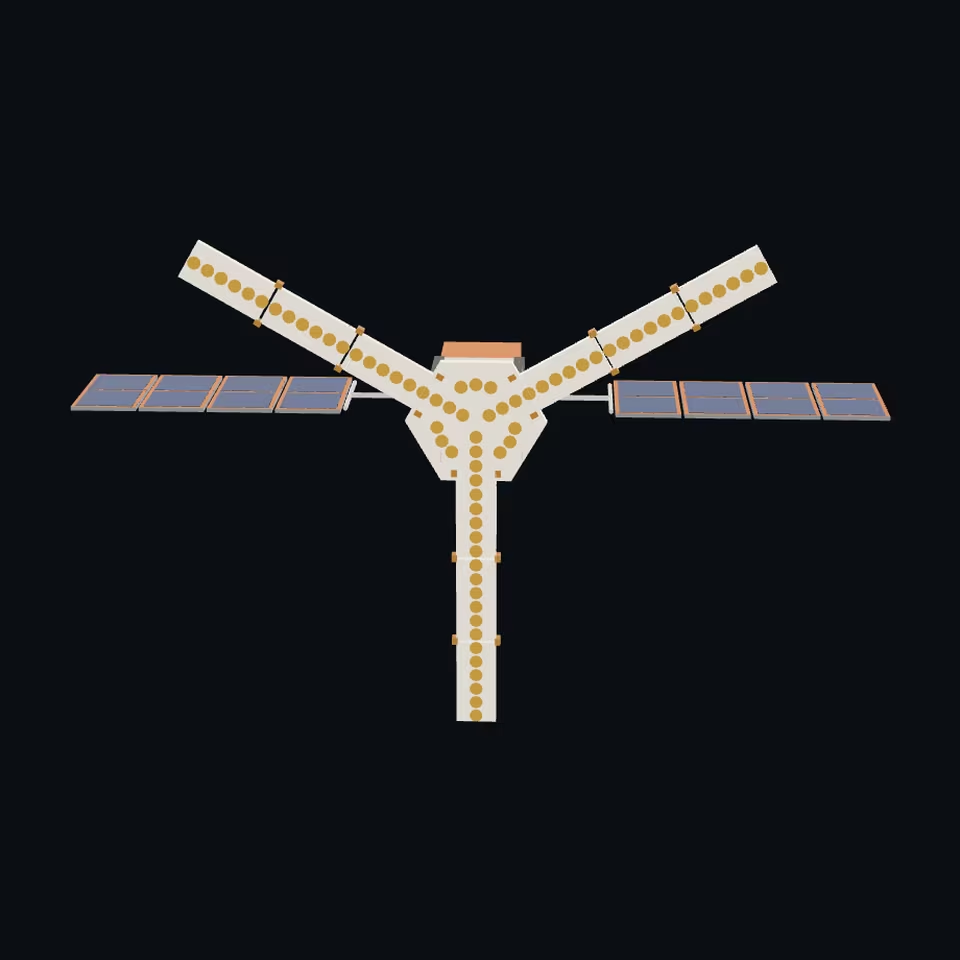
Open the 3D viewer (www.spaceradar.ai).
The viewer loads when you ask: about 700 kB the first time (three.js and the model), much less after.
Pictures 4
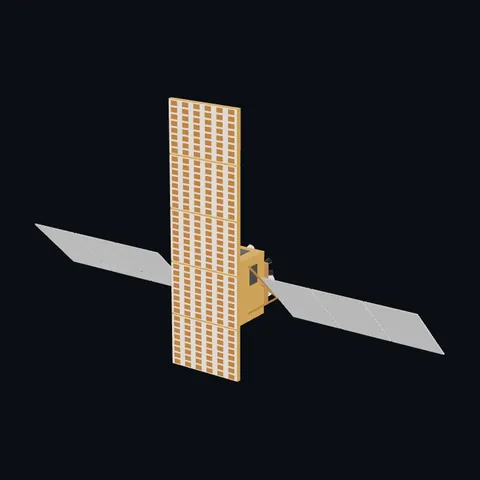
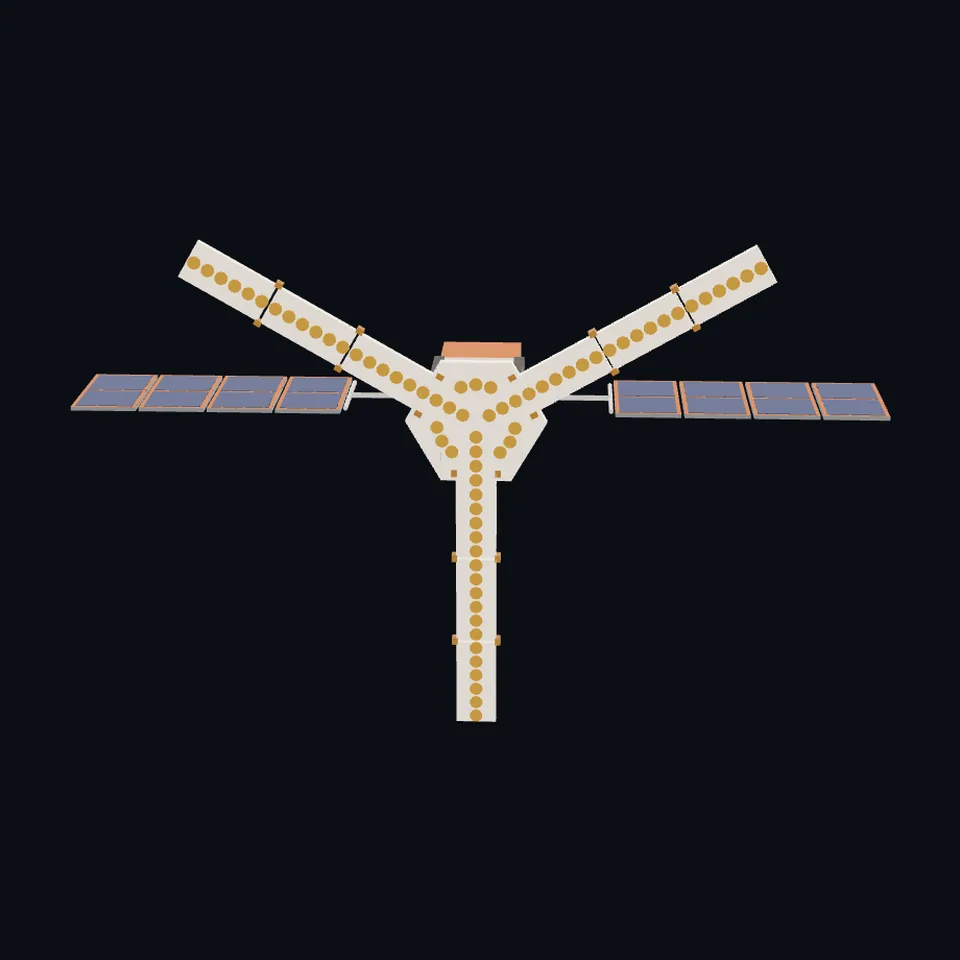 Three-quarter view
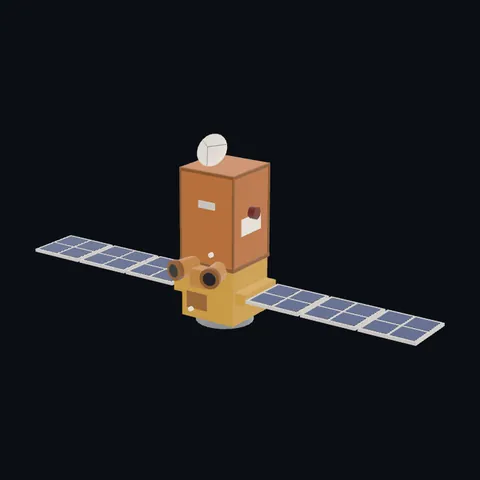
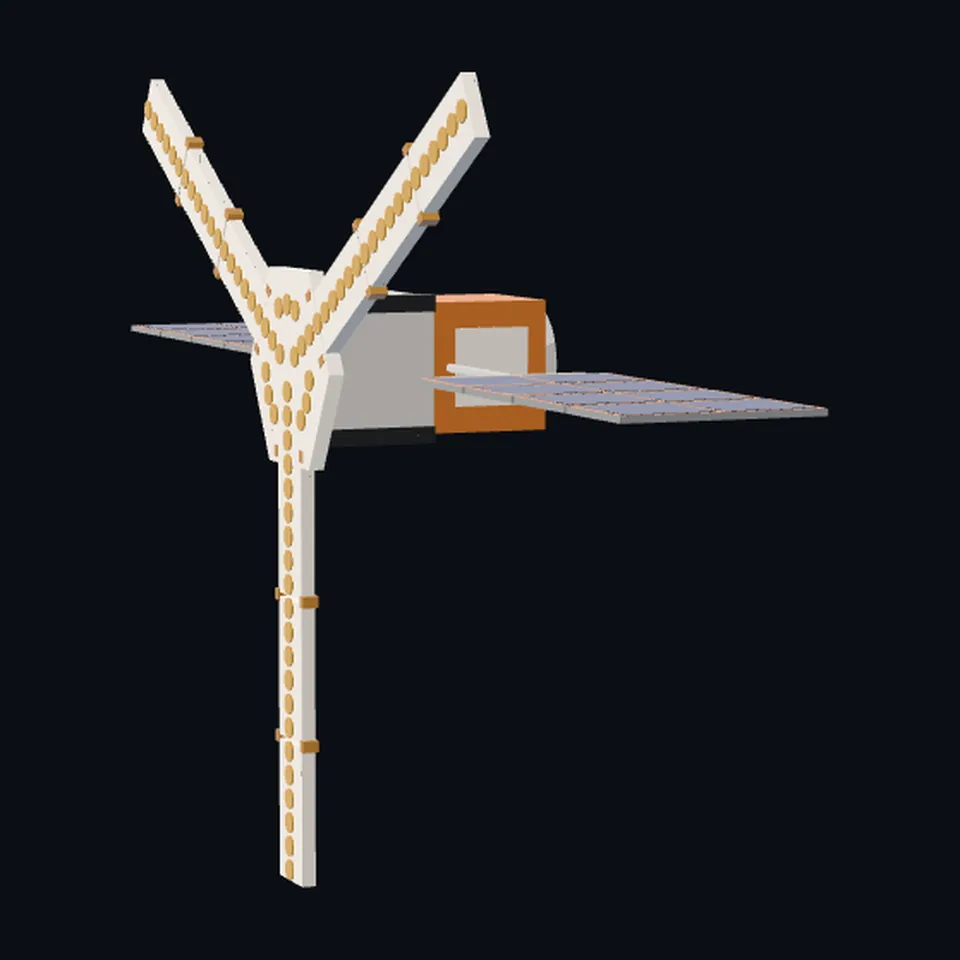 From the side
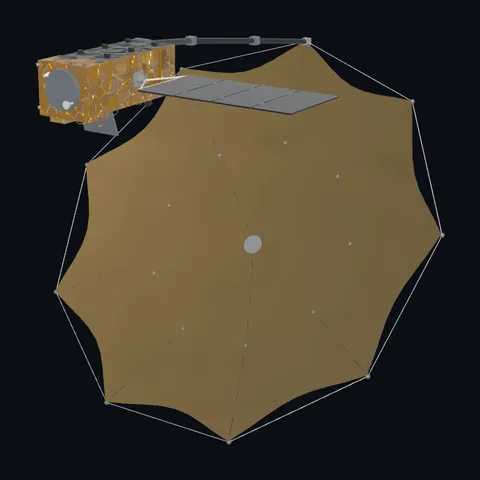
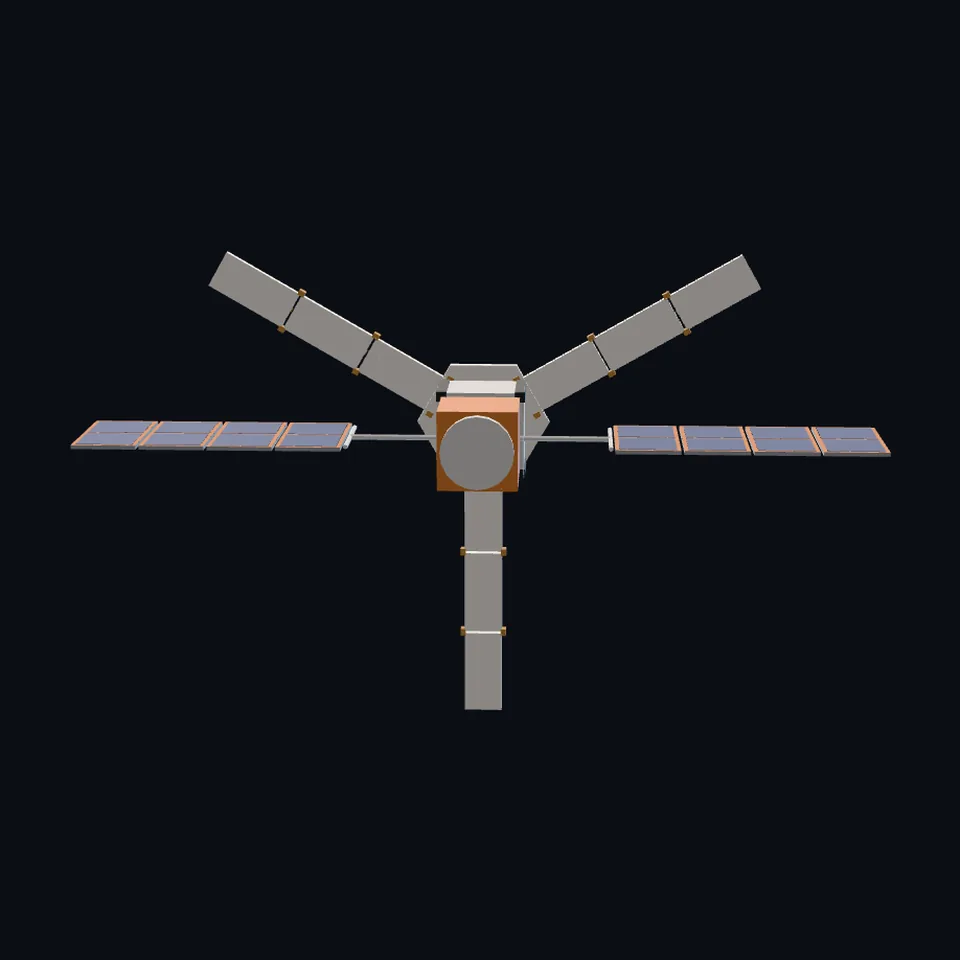 From behind
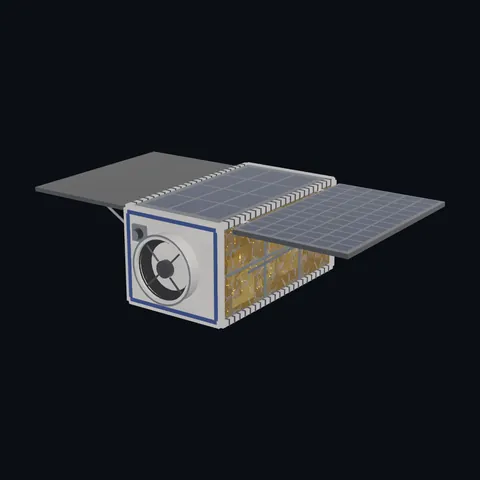
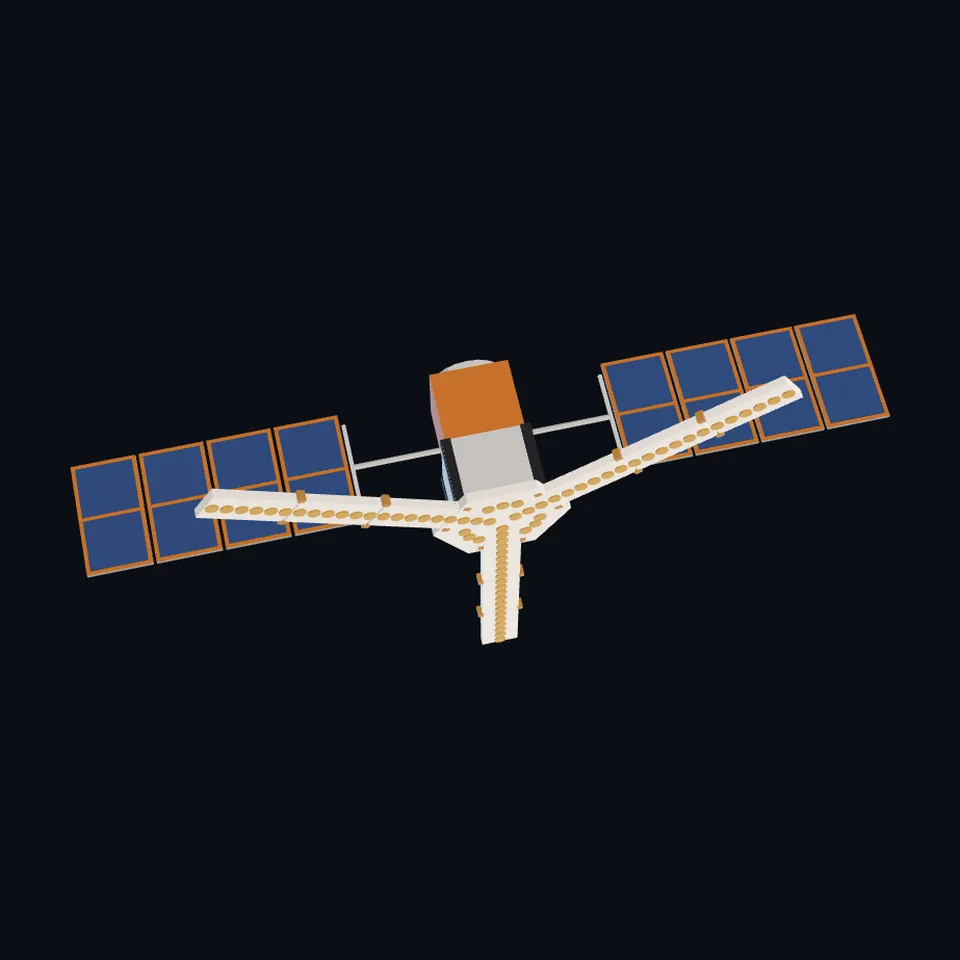 From above
About this model
SMOS is one of the 203 3D models Space Radar made itself: a satellite, built in code from published dimensions and photographs, with no image-to-3D generator and no one else’s mesh.
Shape built from published dimensions and pictures; details simplified. It has 6,672 triangles in a 53 kB glTF file, and is 8.0 m across at full scale.
On Space Radar’s live map it is drawn for the object with NORAD catalogue number 36036, where its published orbit puts it now. Open it on the map.
Dimensions and their sources
| Measure | Value |
|---|---|
| Bus | 1 × 1 × 1 m |
| Arm | 4 m |
| Y diameter | 8 m |
| Tilt | 32.5° |
| Licef | 69 |
| Licef diameter | 0.165 m |
| Wing panels | 4 |
| Wing panel | 1.5 × 0.8 m |
eoPortal, eoportal.org/satellite-missions/smos, OPENED 2026-10-14: 'The S/C bus is a box, nearly 1 m per side, with all the equipment units accommodated on four lateral panels and the lower plate.'; 'Electrical power is generated by two symmetric wing arrays with single-axis step motors. Each wing is composed of four deployable panels (1.5 m x 0.8 m) covered with silicon cells'; 'The SMOS spacecraft features an attitude in which the boresight of the antenna is forward tilted by 32.5º with respect to nadir. This configuration enables measurements at line-of-sight angles between 0º - 50º. The satellite employs yaw steering about the local normal.'; 'local equator crossing time at 6:00 AM on ascending node'; 'three coplanar arms consisting of an elementary antenna regularly spaced (0.875 λ, maximum redundancy) in a Y-shaped configuration'; 'each deployable antenna arm has a length of 4 m'; 'MIRAS, operating at L-band (1.4-1.427 GHz, or 21 cm wavelength), employs a Y-shaped antenna arrangement, consisting of three arms, separated at 120º.'; 'Each arm consists of three deployable segments.'; 'There are 69 antenna elements - the so-called LICEF (Lightweight Cost-Effective Front-end) receivers -, which are equally distributed over the three arms and the central structure (hub).'; 'All six LICEF receivers in each segment and the eighteen LICEF receivers on the Hub'. ESA, 'Facts and figures', esa.int/Applications/Observing_the_Earth/FutureEO/SMOS/Facts_and…, OPENED 2026-10-14 (words and numbers only): 'Satellite: Proteus platform adapted to the needs of SMOS'; 'with 69 antenna receivers distributed on a Y-shaped deployable antenna array and central hub'; 'Launched: 2 November 2009'; 'Sun-synchronous, quasi-circular, dusk-dawn'. ESA, 'Instrument', esa.int/Applications/Observing_the_Earth/FutureEO/SMOS/Instrumen…, OPENED 2026-10-14: 'once SMOS was in orbit each of the arms unfolded to form an unusual three-pointed star shape. Hence, with a diameter of eight metres, MIRAS is often dubbed a 'star in the sky'.'; 'One LICEF antenna weighs 190 g, is 165 mm in diameter and 19 mm high.' ESA, 'Satellite', esa.int/Applications/Observing_the_Earth/FutureEO/SMOS/Satellite…, OPENED 2026-10-14: 'The platform is small, occupying just one cubic metre'; 'In launch configuration, the overall dimensions, including the SMOS instrument, fitted into a cylinder 2.4 m high and 2.3 m in diameter.'; 'Each array is made up of four panels, each measuring 1.5×0.8 m. Since the orbit is Sun-synchronous, the solar arrays remain static.' READ: eoPortal's '4 m' arm and ESA's 'diameter of eight metres' are read as one number, the tips 4.0 m from the middle; it agrees with the spacing: six receivers a segment at 0.875 of 21.2 cm make a segment 1.11 m, three of them 3.34 m, and a hub of 0.66 m to the root. READ OFF DLR'S PHOTOGRAPHS of a model: the white arms with a row of gold discs, gold hinges between the segments; the silver central structure with dark corners under the Y; the orange bus with a white radiator; the launch ring at its far end; each wing on a boom from the bus's side, the panels' long side square to the boom, orange frames; one arm square to the booms. OURS: the hub's size and its 18 receivers' places (three in each arm's row, nine between), the arm's width and thickness, the boom's length, which arm points which way about the Sun. (read 2026-10-14)
How it was made
Built in code from published dimensions and photographs, with no image-to-3D generator and no one else’s mesh. 3D model: built by Space Radar from published dimensions and DLR's photographs of a model of SMOS (DLR German Aerospace Center, CC BY 2.0).
The full record
built by this project in code (the private tool model-from-images: assemble.py, from a yaml of primitives), from the cited dimensions and the pictures under `references`; no image-to-3D model was used, and no published mesh (NASA's 3D Resources has none of this craft; the survey of 2026-10-13 found no agency model of it under usable terms); ESA's own pictures and models were NOT used: ESA's terms forbid derivative works
Where the map uses it. NORAD 36036 (SMOS), the one record in the live saved data of 2026-10-12: ESA's soil moisture and ocean salinity mission, the Y of MIRAS on a Proteus bus. It had no route: it wore the shape of its class, a box with two wings and a dish; public #958
Licence note. CC BY 2.0 (DLR's photographs of a scale model, which the layout was read off: looked at, with credit; nothing of the pictures is in the file); the shape is this project's, under this repository's licence, built from published numbers (facts). NO ESA PICTURE WAS USED. NO LOGO AND NO LETTERING is on the mesh.
References 2
What the shape was compared with. None of these pictures is in the file.
- SMOS scale model (7628219434) (2)DLR German Aerospace CenterCC BY 2.0 (DLR German Aerospace Center, flickr; the Commons API's LicenseShortName, read 2026-10-14)
- SMOS scale model (7628218776) (2)DLR German Aerospace CenterCC BY 2.0 (DLR German Aerospace Center, flickr; the Commons API's LicenseShortName, read 2026-10-14)


Use it
The model is under the MIT licence: use it, change it and share it, in any project, also a paid one. Keep the credit:
SMOS 3D model by Space Radar (spaceradar.ai), MIT LicenseAny glTF 2.0 loader that reads meshopt compression (EXT_meshopt_compression) opens the file: three.js with its MeshoptDecoder, Babylon.js, model-viewer. Tools such as glTF-Transform can write an uncompressed copy.
Or embed the viewer in your page:
<iframe src="https://www.spaceradar.ai/model/?id=smos" title="SMOS, 3D model by Space Radar" width="600" height="450" loading="lazy" style="border:0;max-width:100%"></iframe>Related models