Sentinel-3
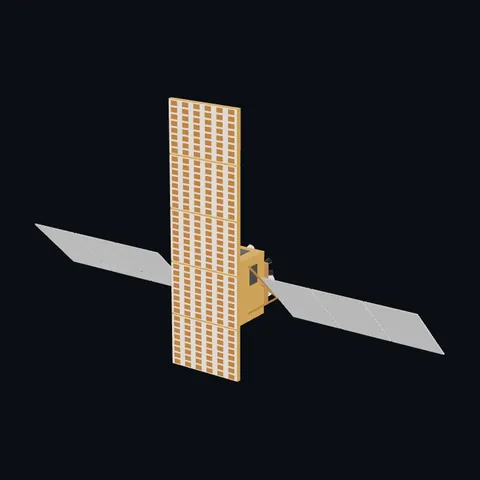
Shape built from published dimensions and pictures; details simplified.
Turn it in 3D
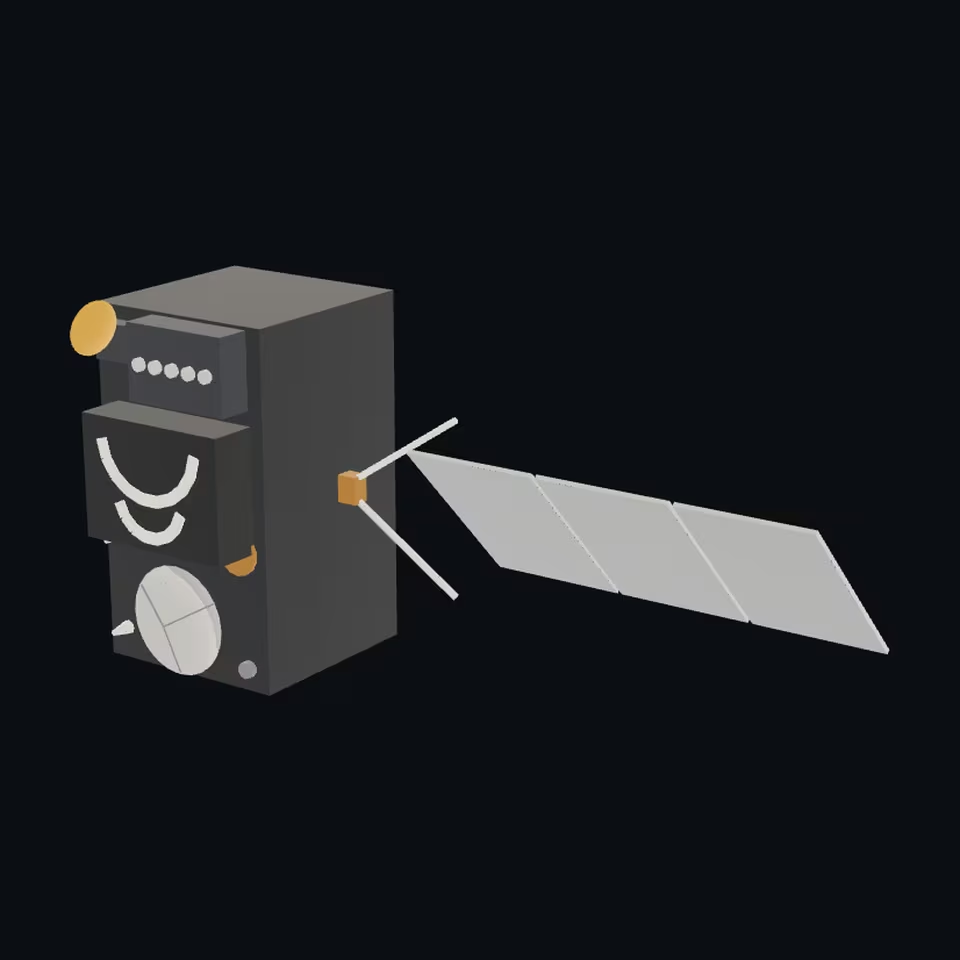
Open the 3D viewer (www.spaceradar.ai).
The viewer loads when you ask: about 700 kB the first time (three.js and the model), much less after.
Pictures 4
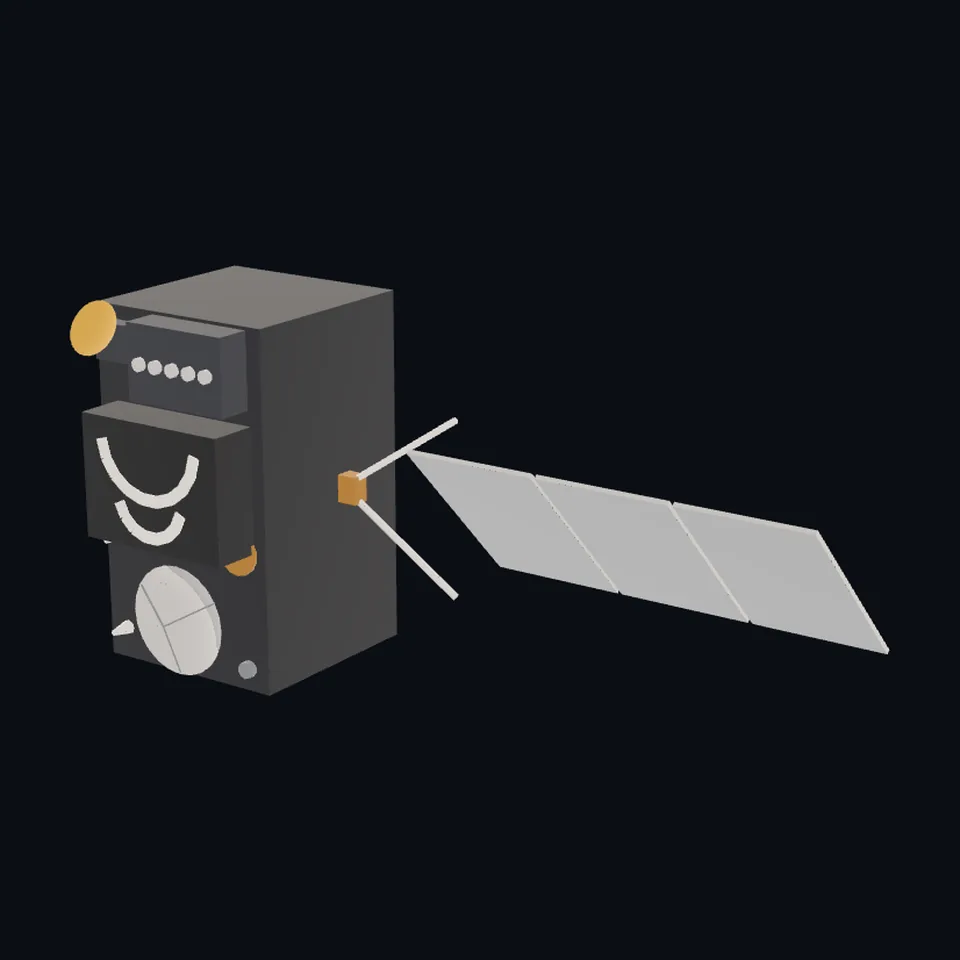 Three-quarter view
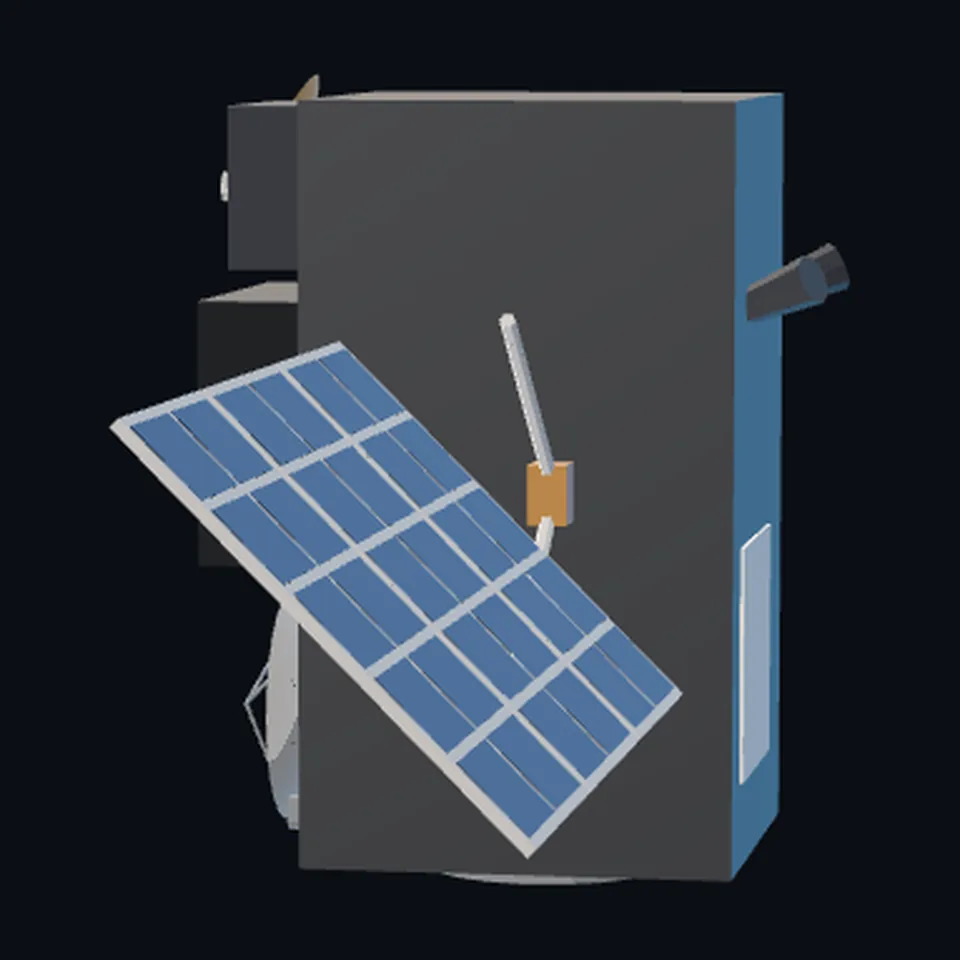 From the side
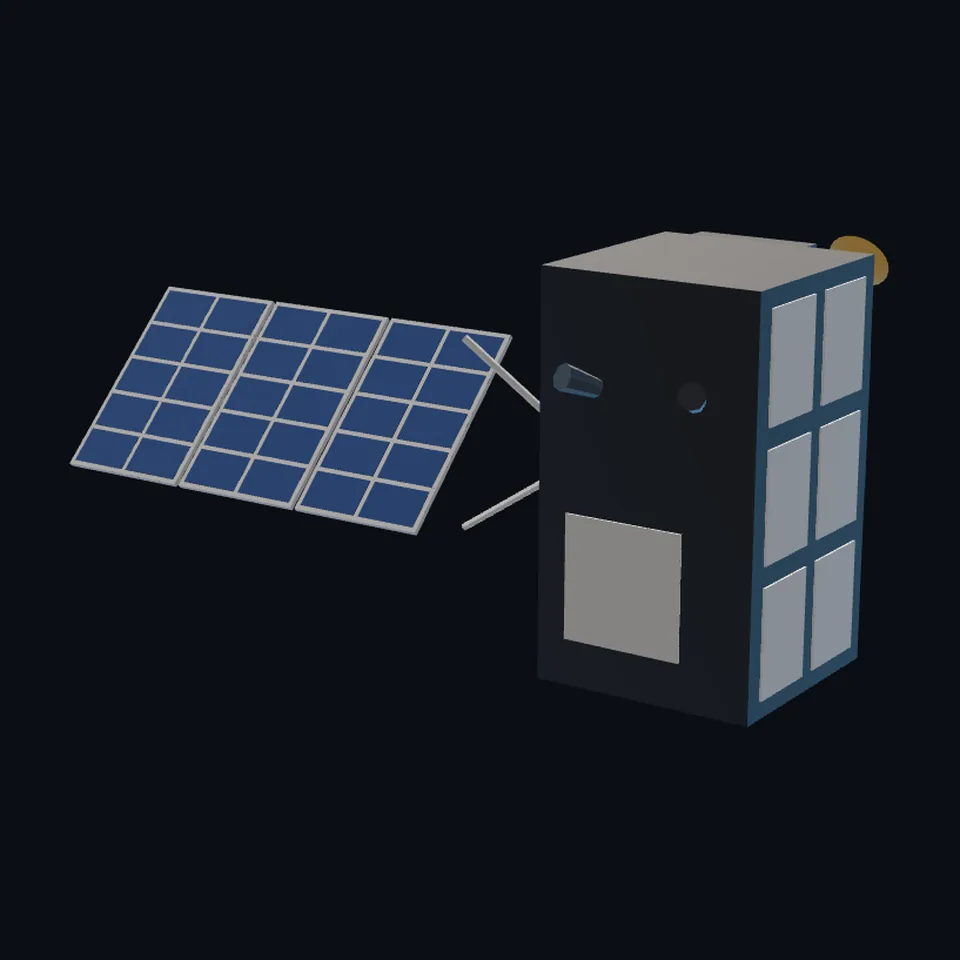 From behind
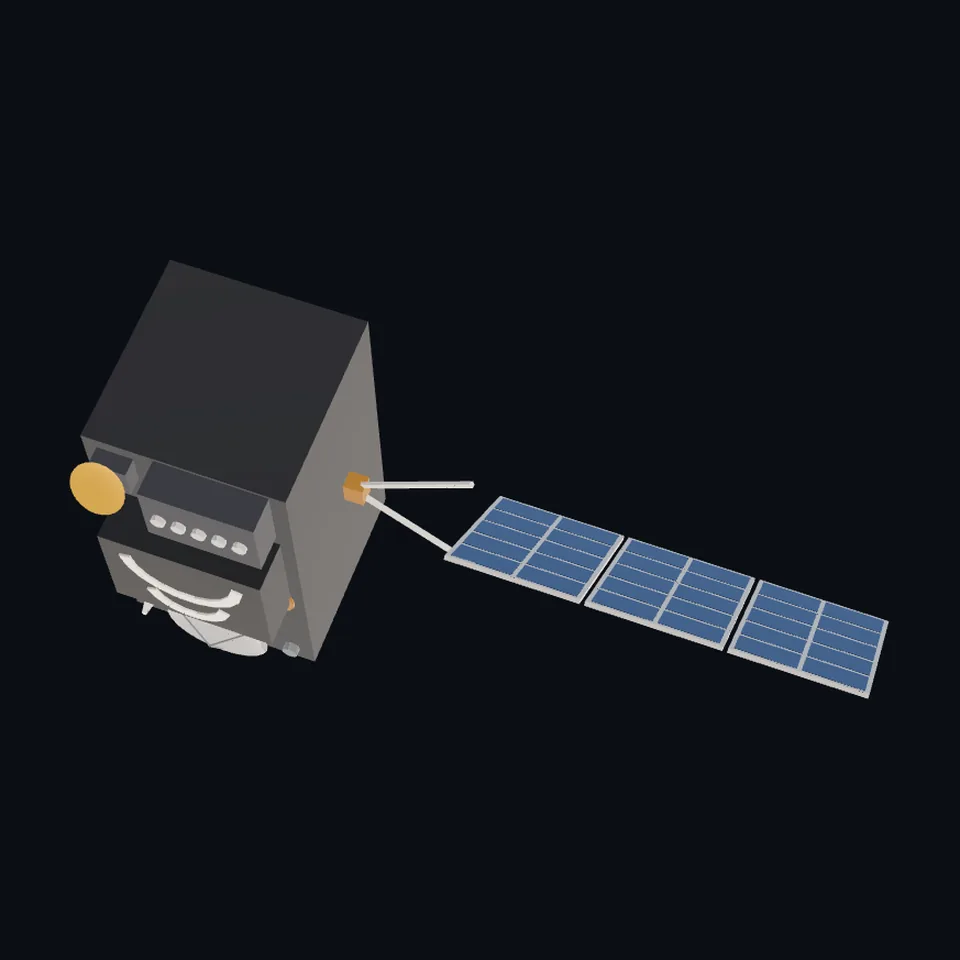 From above
About this model
Sentinel-3 is one of the 203 3D models Space Radar made itself: a satellite, built in code from published dimensions and photographs, with no image-to-3D generator and no one else’s mesh.
Shape built from published dimensions and pictures; details simplified. It has 6,558 triangles in a 44 kB glTF file, and is 3.9 m across at full scale.
On Space Radar’s live map it is drawn for the object with NORAD catalogue number 41335, where its published orbit puts it now. Open it on the map.
Dimensions and their sources
| Measure | Value |
|---|---|
| Bus long | 3.9 m |
| Bus wide | 2.2 m |
| Bus deep | 2.21 m |
| Sral dish | 1.2 m |
| Sral focal | 0.43 m |
| Mwr reflector | 0.6 m |
| Olci long | 1.24 m |
| Olci wide | 0.83 m |
| Solar array area | 10.5 m² |
eoPortal, eoportal.org/satellite-missions/copernicus-sentinel-3, OPENED 2026-10-14: 'Spacecraft bus dimensions 3.9 m (height) x 2.2 m x 2.21 m'; 'The spacecraft is 3-axis stabilised, with nominal pointing towards the local normal and yaw steering'; 'Passive control with SSM radiators'; 'Solar Array 1 wing, 3 panels , 10.5 m 2 , power of 2300 W EOL'; 'Stepper motor SADM (Solar Array Drive Mechanism)'; 'SRAL antenna: The antenna is made up of a 1.20 m parabolic reflector with a C/Ku dual frequency feed horn placed in a centered configuration at a focal length of about 430 mm. The feed is supported by 3 struts separated by a 120º angle'; of OLCI, 'The instrument mass is ~ 150 kg, a size of 1.24 m x 0.83 m x 1.32 m'; 'The FOV of OLCI is divided between five cameras on a common structure with the calibration assembly.'; 'the FOV (Field of View) is tilted towards the west (~ 12º away from the sun)'; 'SLSTR, consisting of two baffles, a scan mirror, an off-axis parabolic mirror and a folding plane mirror for each telescope (near nadir and backward view)'; of the MWR, 'The radiometer employs a single offset reflector of 60 cm in diameter and two separate feeds for the two channels.'; 'LTDN (Local Time on Descending Node) is at 10:00 hours'. ESA, 'Facts and figures', esa.int/Applications/Observing_the_Earth/Copernicus/Sentinel-3/F…, OPENED 2026-10-14 (words and numbers only): 'Satellite 2.2 m long, 2.2 m wide, 3.7 m high and a mass of 1150 kg (including 130 kg fuel)'; 'Launch date Sentinel-3A: 16 February 2016 Sentinel-3B: 25 April 2018 Sentinel-3C: 15 September 2026'. The two pages differ by 0.2 m in the long side; eoPortal's 3.9 m is built. DERIVED: 10.5 m2 as three panels of 1.5 x 2.33 m; the dish's depth of 0.21 m from its 430 mm focal length. READ OFF THE FREE DRAWING: the body in black blankets; on the Earth face, from one end to the other, the altimeter's dish, a flat spiral antenna and a white antenna, a housing with two curved openings, and a gold reflector on the far corner; the wing of three panels on a long white yoke from the middle of a side, its long side square to the body. OURS: the radiometer's housing and its openings as two arcs of pale tiles; where OLCI's box stands and its five lenses in a row (the real cameras look out through one opening in a fan); the radiators on the sky face; the star trackers; the launch ring's end. NOT FOUND in words: which way the body's length lies to the track. (read 2026-10-14)
How it was made
Built in code from published dimensions and photographs, with no image-to-3D generator and no one else’s mesh. 3D model: built by Space Radar from published dimensions and a drawing of Sentinel-3 by SkywalkerPL (CC BY 4.0).
The full record
built by this project in code (the private tool model-from-images: assemble.py, from a yaml of primitives), from the cited dimensions and the pictures under `references`; no image-to-3D model was used, and no published mesh (NASA's 3D Resources on GitHub, 1 583 paths read 2026-10-13, has none of this craft; the survey of 2026-10-13 found no agency model of it under usable terms; ESA's own pictures and models were NOT used: ESA's terms forbid derivative works)
Where the map uses it. NORAD 41335 (SENTINEL-3A) and 43437 (SENTINEL-3B) by number, and any record of klass satellite named SENTINEL-3C by name (launched 15 September 2026; the live saved data of 2026-10-12 has it under 100690, which data/parsers.js reads as a placeholder number, so it is not routed by number): the Copernicus ocean and land satellites. They had no route: each wore the shape of its class, a box with two wings and a dish; public #950
Licence note. CC BY 4.0 (a Commons contributor's own drawing of the craft, which the layout was read off: looked at, with credit; nothing of the drawing is in the file); the shape is this project's, under this repository's licence, built from published numbers (facts). NO ESA PICTURE WAS USED. NO LOGO AND NO LETTERING is on the mesh.
References 2
What the shape was compared with. None of these pictures is in the file.
- Sentinel-3 spacecraft modelSkywalkerPL (Wikimedia Commons)CC BY 4.0 (SkywalkerPL, own work; the Commons API's LicenseShortName, read 2026-10-14)
- EUMETSAT – Model of Sentinel-3Neq00 (Wikimedia Commons)CC BY-SA 4.0 (Neq00, own work; read 2026-10-14): share-alike, LOOKED AT ONLY, never fetched by the tool and not on any sheet


Use it
The model is under the MIT licence: use it, change it and share it, in any project, also a paid one. Keep the credit:
Sentinel-3 3D model by Space Radar (spaceradar.ai), MIT LicenseAny glTF 2.0 loader that reads meshopt compression (EXT_meshopt_compression) opens the file: three.js with its MeshoptDecoder, Babylon.js, model-viewer. Tools such as glTF-Transform can write an uncompressed copy.
Or embed the viewer in your page:
<iframe src="https://www.spaceradar.ai/model/?id=sentinel-3" title="Sentinel-3, 3D model by Space Radar" width="600" height="450" loading="lazy" style="border:0;max-width:100%"></iframe>Related models