Pléiades
Shape built from published dimensions and pictures; details simplified.
Turn it in 3D
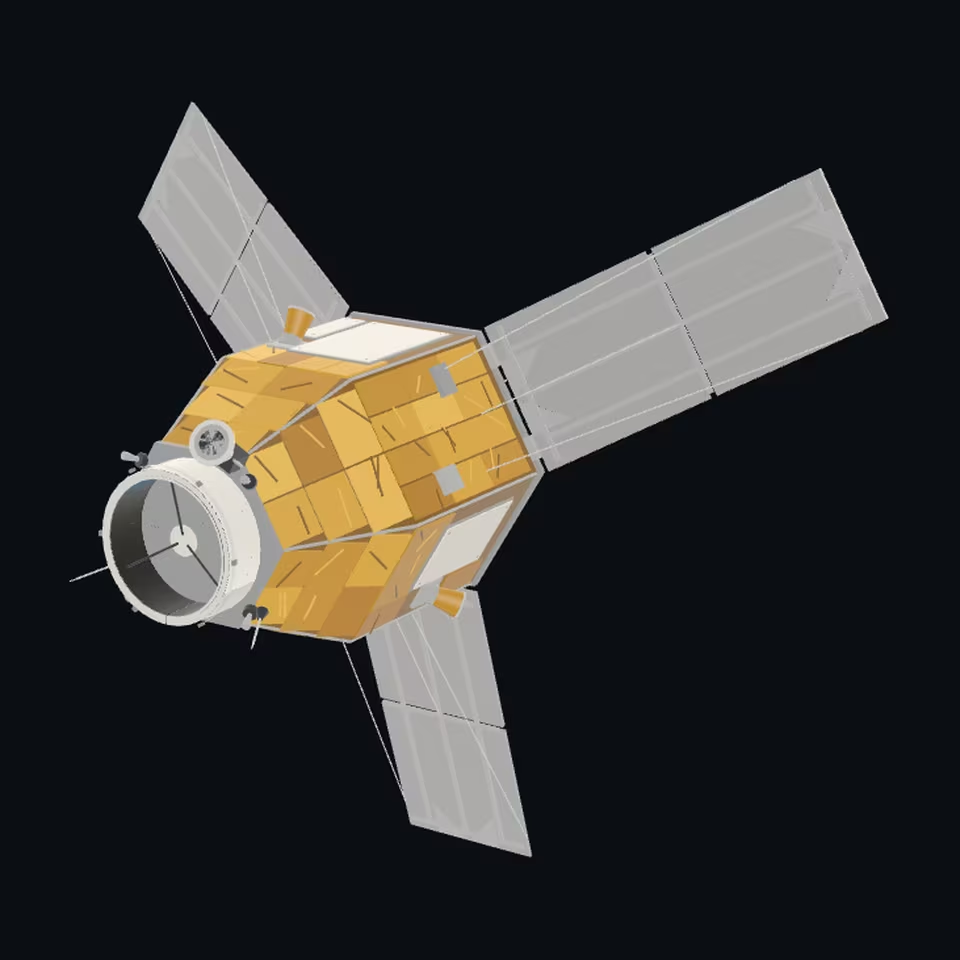
Open the 3D viewer (www.spaceradar.ai).
The viewer loads when you ask: about 700 kB the first time (three.js and the model), much less after.
Pictures 4
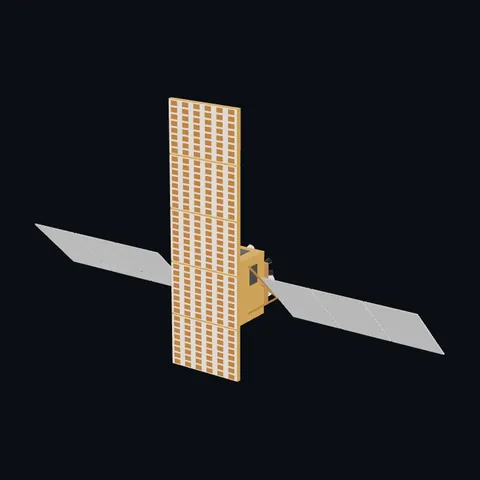
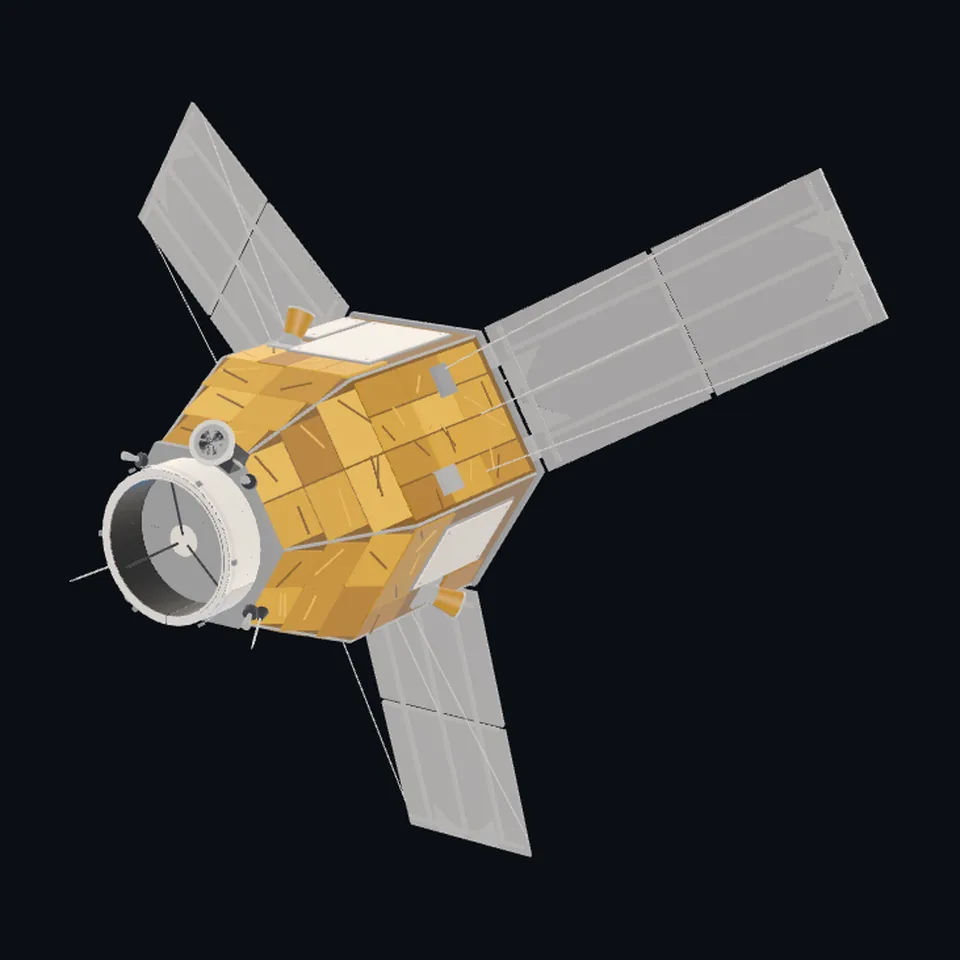 Three-quarter view
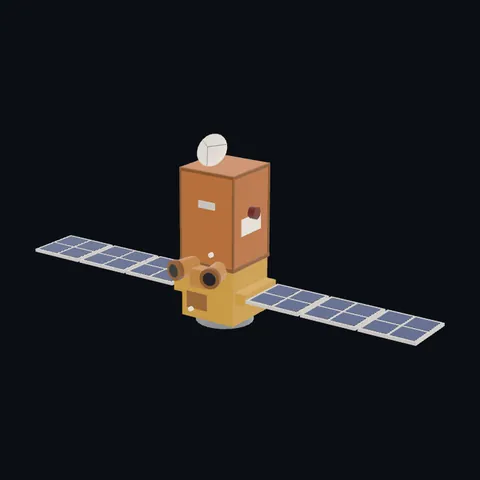
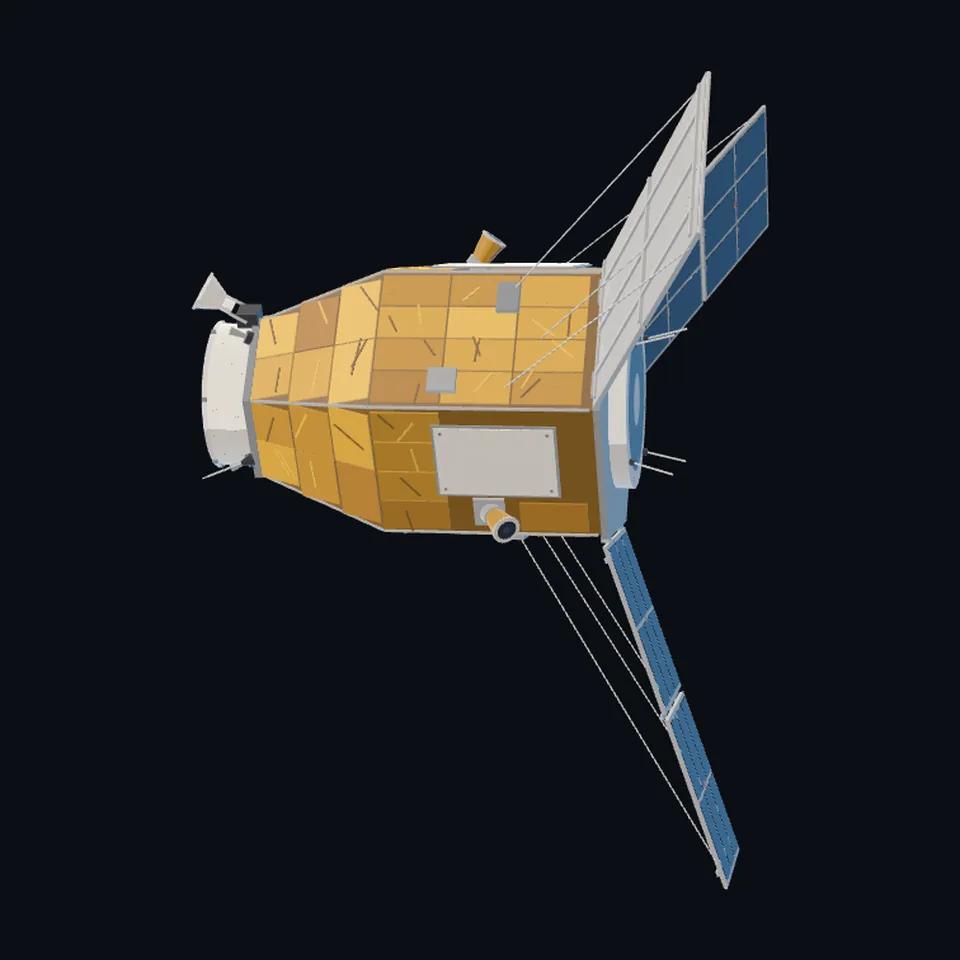 From the side
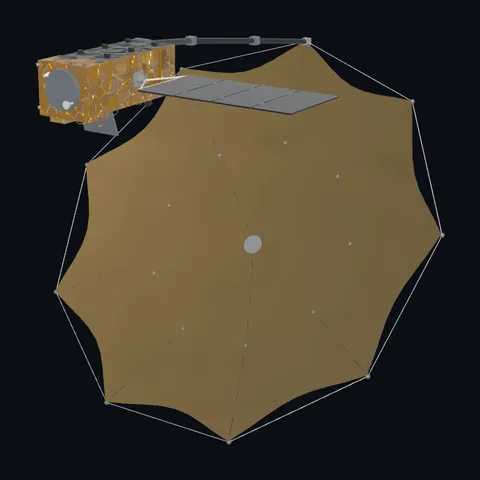
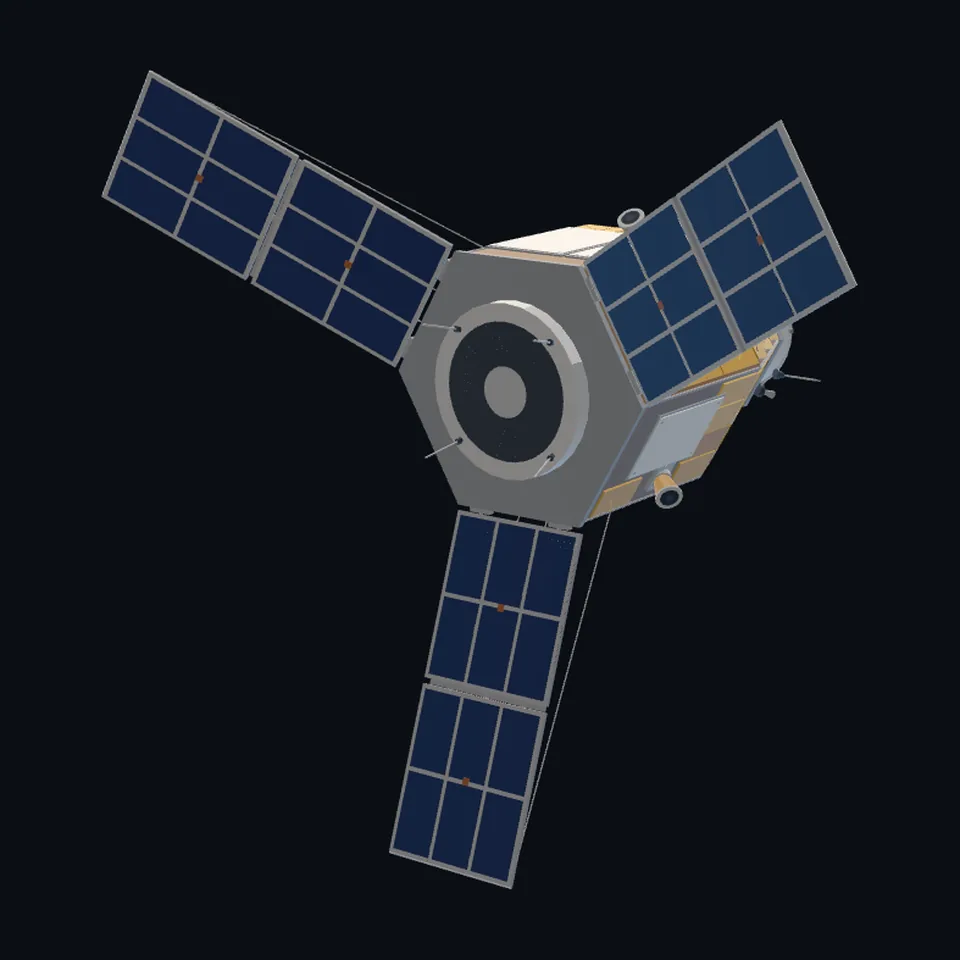 From behind
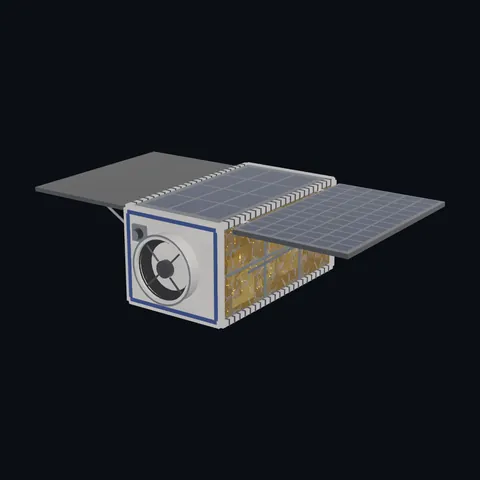
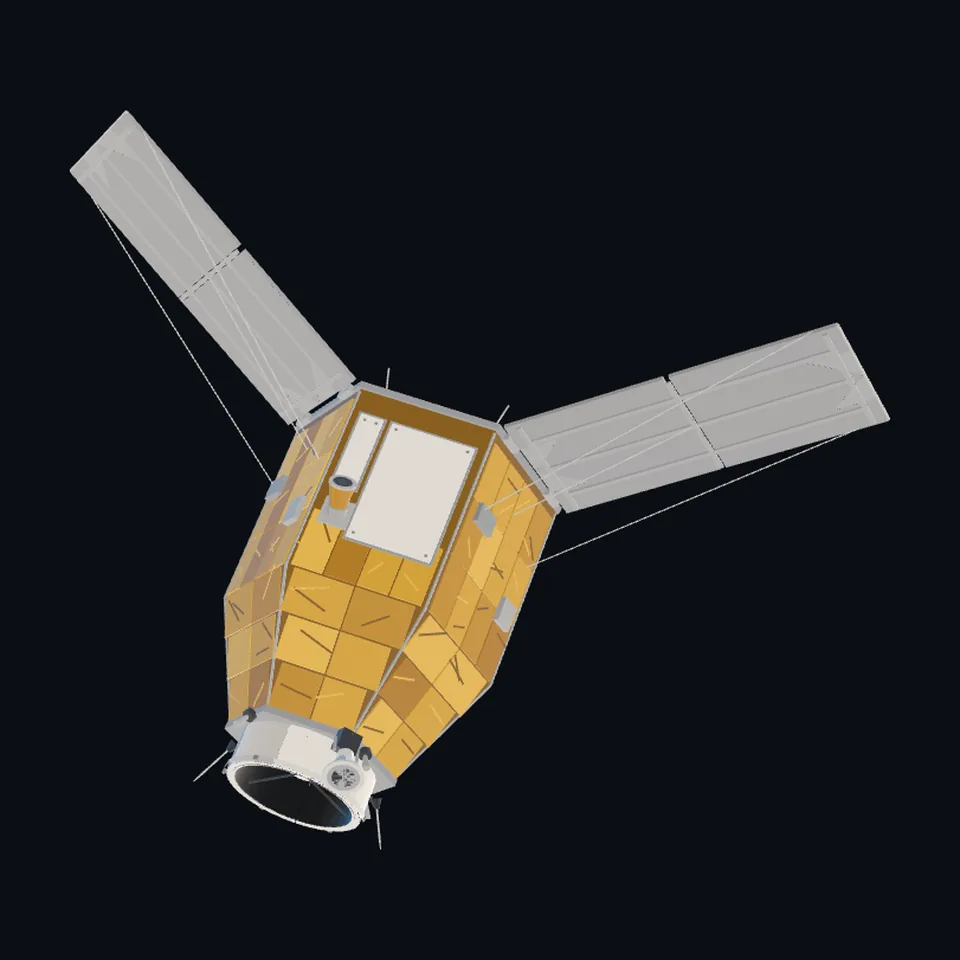 From above
About this model
Pléiades is one of the 203 3D models Space Radar made itself: a satellite, built in code from published dimensions and photographs, with no image-to-3D generator and no one else’s mesh.
Shape built from published dimensions and pictures; details simplified. It has 17,252 triangles in a 146 kB glTF file, and is 13 m across at full scale.
On Space Radar’s live map it is drawn for 3 catalogued objects, each where its published orbit puts it now. Open it on the map.
Dimensions and their sources
| Measure | Value |
|---|---|
| Mass | 940 kg |
| Orbit | 694 km |
| Solar panel | 2.3 × 1 m |
| Solar panels | 3 |
| Telescope aperture | 0.65 m |
| Telescope focal length | 12.905 m |
| Instrument envelope | 1.594 × 0.98 × 2.235 m |
| Star trackers | 3 |
eoPortal, 'Pleiades-HR (High-Resolution Optical Imaging Constellation of CNES)', eoportal.org/satellite-missions/pleiades, OPENED 2026-11-03: 'The bus structure is of hexagonal shape, with three solar arrays positioned at 120 degrees at the top of the platform.'; 'The solar array design (each panel size of 2.3 m x 1.0 m)'; 'a primary mirror size of 650 mm diameter' (a Korsch TMA, focal length 13 m in the text and 12.905 m in the table, f/20); the instrument 'L < 1594 mm, W < 980 mm, H < 2235 mm'; 'three high-accuracy star trackers (SED36) in a quasi tetrahedron configuration'; 'The X-band antenna employs a corrugated horn (omni-directional) with a 64 degree aperture' (on a 2-axis gimbal); 'The total dry mass of the S/C is 940 kg'; orbit 694 km. THE PAGE GIVES NO OVERALL HEIGHT, DIAMETER OR HEXAGON SIZE, no colours and no size for the S-band, X-band or DORIS antennas, and no second page was opened. The text and the table disagree on the focal length (13 m and 12.905 m: the table's was used for the record; the telescope's inside is not drawn to length) and the text names SiC-100 where the instrument section says Zerodur mirrors (not drawn). NOT CITED, READ OFF THE PICTURES AND ESTIMATED, scaled from the 2.3 x 1.0 m panels and the 0.65 m aperture: the hexagon (1.65 m flat to flat, 0.95 m a side), 1.40 m of prism and a 0.85 m taper to 1.0 m flat to flat, a baffle cylinder 0.94 m across and 0.35 m long, the top ring (1.16 m), the radiators and star trackers' sizes and places, the X-band horn and the S-band whips, the arrays' 20 degree tilt toward the zenith and their stays, and the choice of faces (30, 150 and 270 degrees) for the three arrays. (read 2026-11-03)
How it was made
Built in code from published dimensions and photographs, with no image-to-3D generator and no one else’s mesh. 3D model: built by Space Radar from eoPortal's published numbers for Pleiades and from pictures of it by CNES and a scale-model photograph by Tiraden (looked at, not used).
The full record
built by this project in code (the private tool model-from-images: assemble.py, from a yaml of primitives, object `optical-pleiades`), from the cited numbers and the pictures under `references`; no image-to-3D model was used, and no published mesh of the craft (NASA's 3D Resources on GitHub carry none; the pictures CNES publishes through eoPortal carry no free licence, so they were looked at only)
Where the map uses it. NORAD 38012 (PLEIADES 1A) and 39019 (PLEIADES 1B): CNES's two very-high-resolution optical imagers on Astrium's AstroSat-1000 platform, launched 17 December 2011 and 2 December 2012 on Soyuz from Kourou; public #973. NOT for Pleiades Neo 3 and 4 (48268, 49070): a different bus, not built here
Licence note. None of the pictures is in the file and none was fetched into it. LOOKED AT ONLY: six eoPortal figures credited CNES, EADS Astrium, TAS (the labelled outer-structure schematic, two artist's pictures of the craft in orbit, the interior and instrument-accommodation drawing, the HiRI camera drawing, the radiometric-test photograph), no licence stated; and a photograph of a scale model on the CNES stand at Le Bourget 2019 (CC BY-SA 4.0, Tiraden, Commons). The shape is this project's, under this repository's licence, built from published numbers (facts). NO LOGO AND NO LETTERING is on the mesh.
References 5
What the shape was compared with. None of these pictures is in the file.
- Pleiades-HR, eoPortal: 'Schematic layout of the Pleiades outer structure'CNES via eoPortalcredit CNES; no free licence stated on the page: looked at only
- Pleiades-HR, eoPortal: 'Artist's rendition of the deployed Pleiades spacecraft' and 'Artist's conception of the Pleiades spacecraft in orbit'CNES via eoPortalcredit CNES; no free licence stated on the page: looked at only
- Pleiades-HR, eoPortal: interior structure and instrument accommodation; illustration of the HiRI instrumentCNES, TAS via eoPortalcredit CNES, Thales Alenia Space; no free licence stated on the page: looked at only
- Pleiades-HR, eoPortal: 'Pleiades-HR1 undergoes radiometric testing'CNES via eoPortalcredit CNES; no free licence stated on the page: looked at only
- Pléiades (satellite).jpgTiradenCC BY-SA 4.0 (Tiraden; Commons, read 2026-11-03): looked at only

Use it
The model is under the MIT licence: use it, change it and share it, in any project, also a paid one. Keep the credit:
Pléiades 3D model by Space Radar (spaceradar.ai), MIT LicenseAny glTF 2.0 loader that reads meshopt compression (EXT_meshopt_compression) opens the file: three.js with its MeshoptDecoder, Babylon.js, model-viewer. Tools such as glTF-Transform can write an uncompressed copy.
Or embed the viewer in your page:
<iframe src="https://www.spaceradar.ai/model/?id=pleiades" title="Pléiades, 3D model by Space Radar" width="600" height="450" loading="lazy" style="border:0;max-width:100%"></iframe>Related models