Phoenix Mars lander
Shape built from published dimensions and pictures; details simplified.
Turn it in 3D
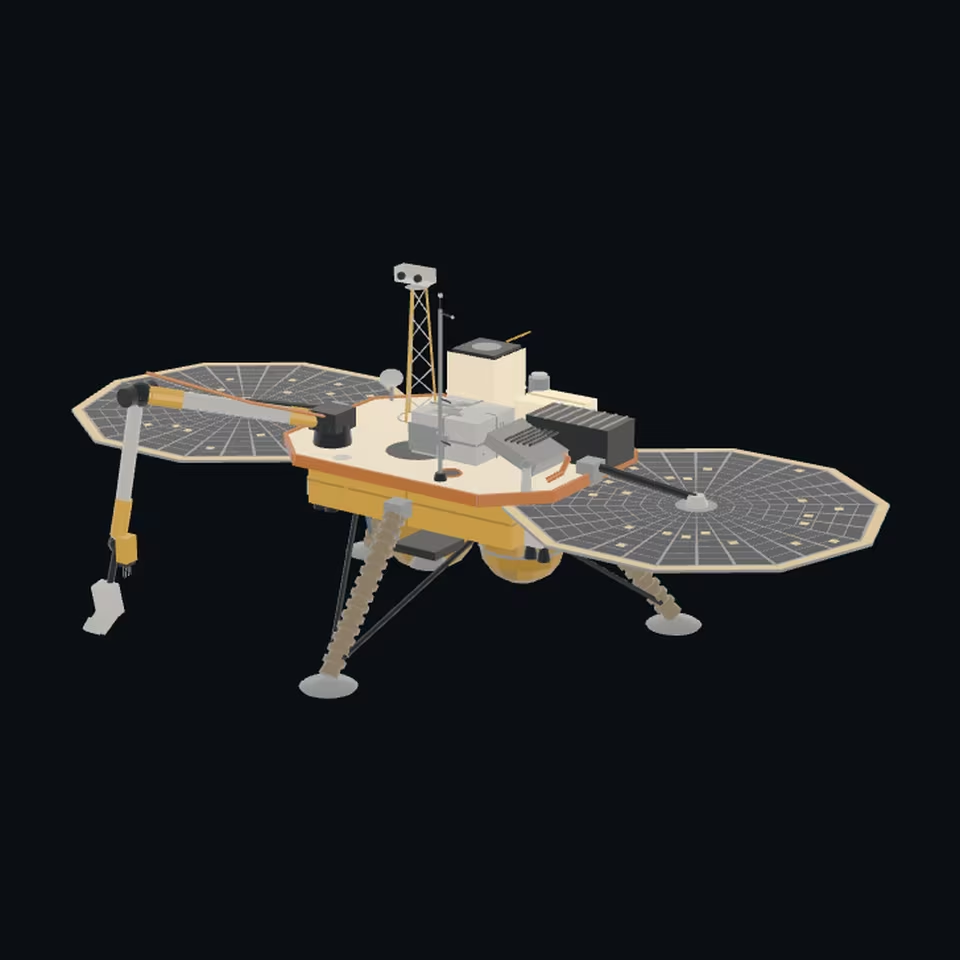
Open the 3D viewer (www.spaceradar.ai).
The viewer loads when you ask: about 700 kB the first time (three.js and the model), much less after.
Pictures 4
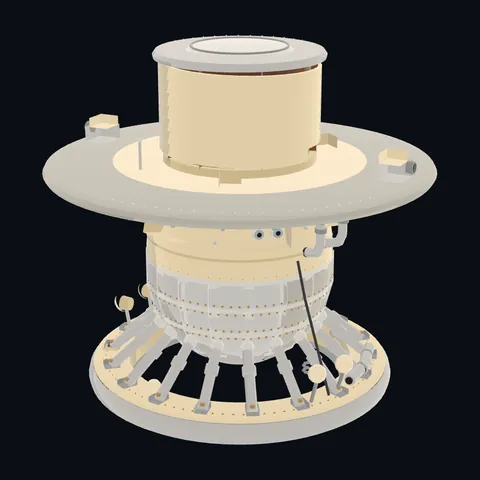
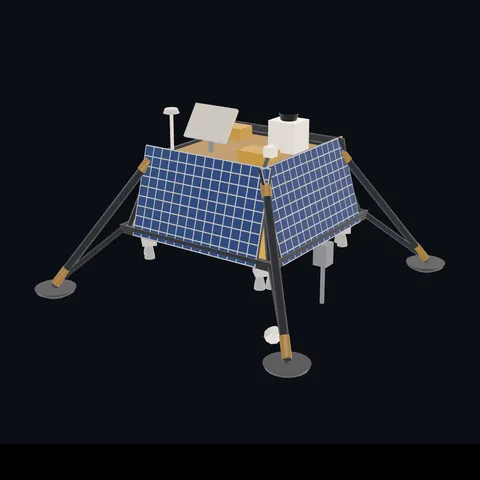
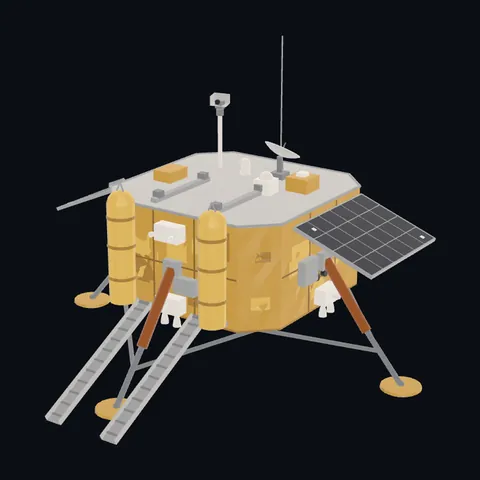
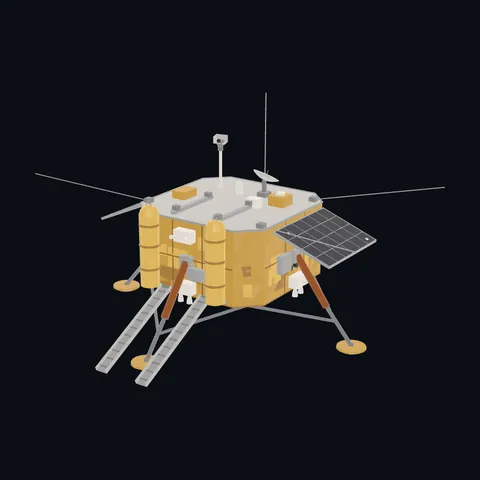
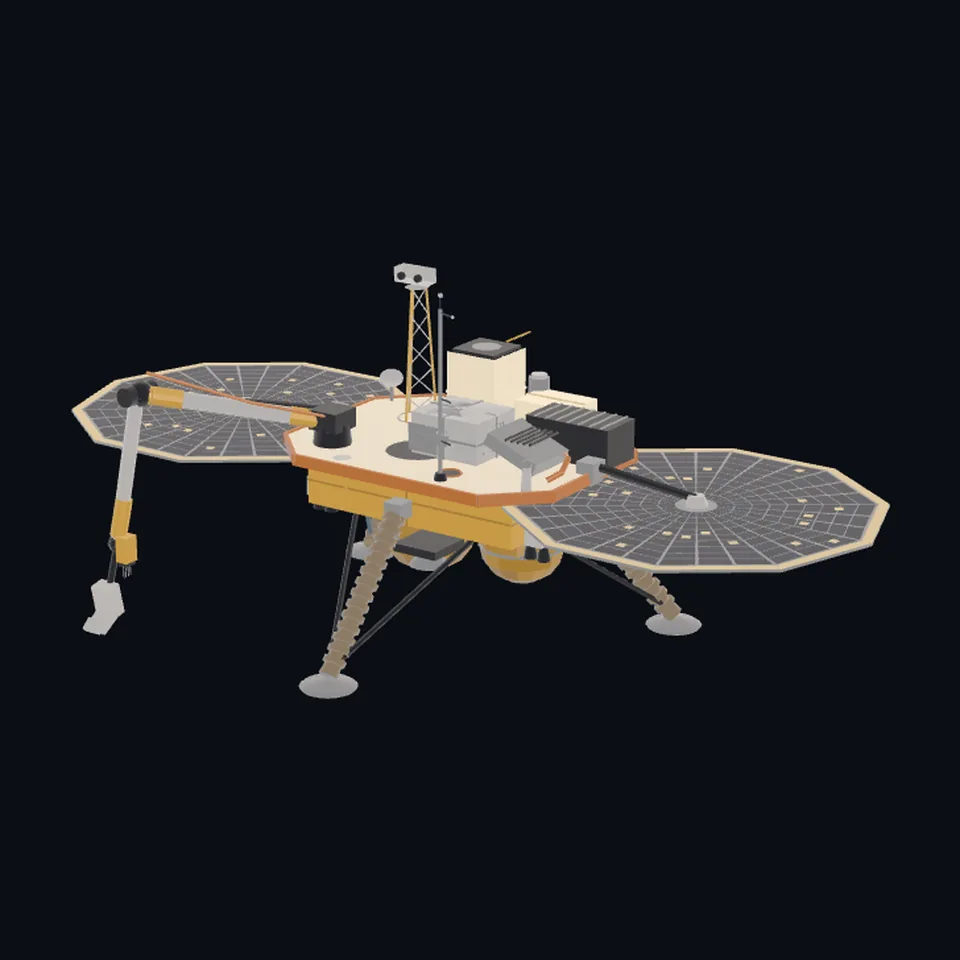 Three-quarter view
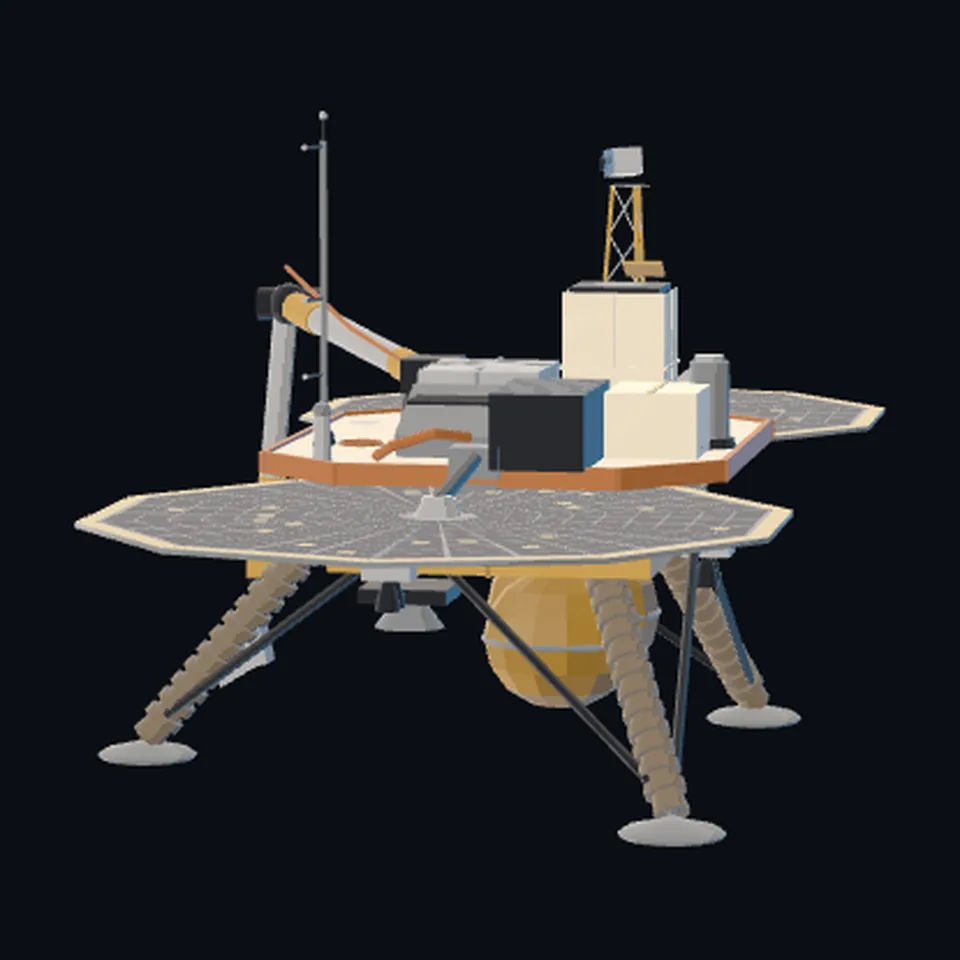 From the side
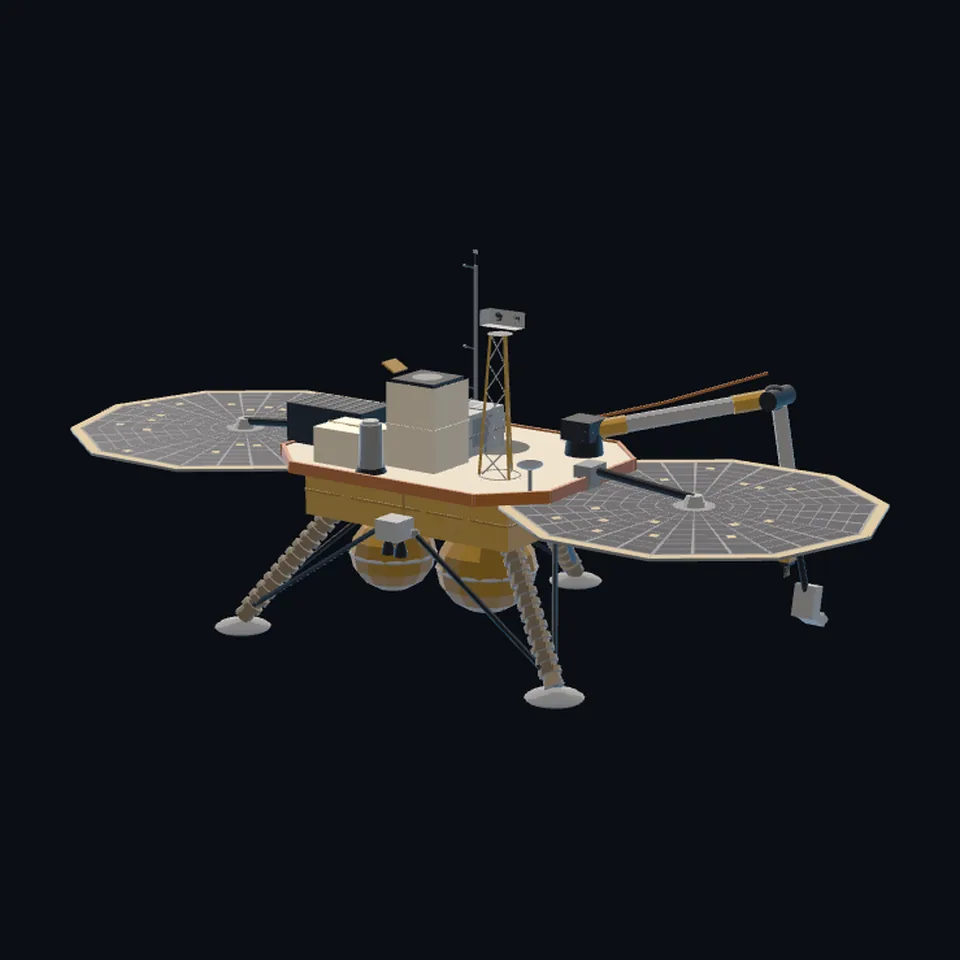 From behind
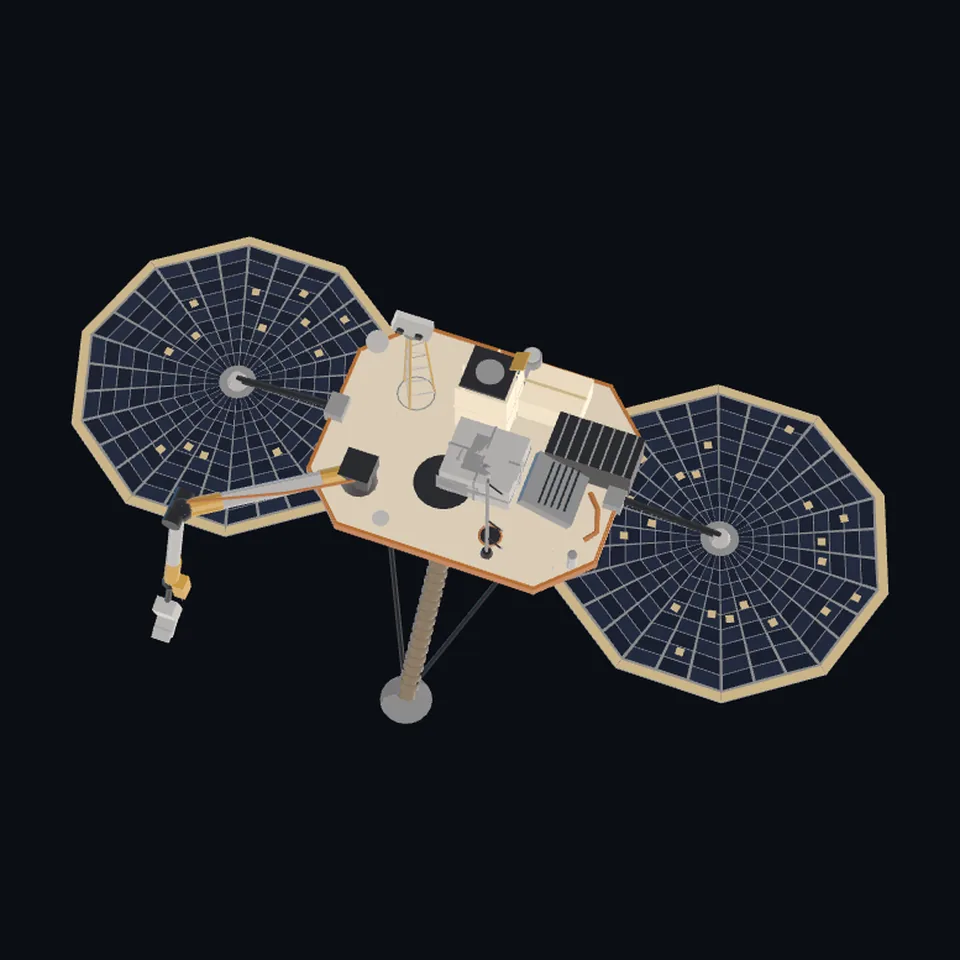 From above
About this model
Phoenix Mars lander is one of the 203 3D models Space Radar made itself: a lander or rover, built in code from published dimensions and photographs, with no image-to-3D generator and no one else’s mesh.
Shape built from published dimensions and pictures; details simplified. It has 14,424 triangles in a 124 kB glTF file, and is 5.5 m across at full scale.
It is part of the map’s library; no object on the live map is drawn with it today.
Dimensions and their sources
| Measure | Value |
|---|---|
| Span | 5.5 m |
| Deck | 1.5 m |
| Height to mast top | 2.2 m |
| Array area | 7 m² |
| Arm reach | 2.35 m |
CITED, 5.5 m: Wikipedia "Phoenix (spacecraft)" (read 2026-10-26) "About 5.5 m (18 ft) long with the solar panels deployed." Drawn 5.42 m tip to tip. CITED, 1.5 m: same page, "The science deck by itself is about 1.5 m (4.9 ft) in diameter." Drawn 1.5 m across the short way; OURS 1.9 m along the arrays (read off NASA's drawing against the 5.5 m). CITED, 2.2 m: same page, "From the ground to the top of the MET mast, the lander measures about 2.2 m (7.2 ft) tall." Drawn 2.23 m. OURS: the deck's top 1.10 m above the ground. CITED, 7.0 m2: same page, "two gallium arsenide solar array panels (total area 7.0 m2 (75 ft2)) deployed from the lander after touchdown". Drawn as two ten-sided arrays of 1.09 m circumradius = 2 x 3.49 m2 = 7.0 m2. NSSDCA 2007-034A (nssdc.gsfc.nasa.gov/nmc/spacecraft/display.action?id=2007-034A, read 2026-10-26) says "octagonal solar panel wings"; the photographs (refs 1 and 2) show ten sides, which is what is drawn and what makes the cited area. OURS: the sides and the 24-leaf fan seams. CITED: NSSDCA, "The spacecraft comprises an octagonal base supported on three landing legs." Drawn: an octagon deck (OURS: chamfers), three legs. CITED, 2.35 m: Wikipedia, "The robotic arm was designed to extend 2.35 m (7.7 ft) from its base on the lander". Drawn: upper arm 1.1 m, forearm 1.0 m, wrist and scoop 0.25 m. OURS: the deployed pose (where the arm ended is not published). CITED: MET mast "1 m (3.3 ft) vertical mast ... at heights of approximately 250, 500 and 1,000 mm above the lander deck". Drawn: three thermocouple booms at those heights. - OURS: footpad radius 1.3 m, leg barrel 0.14 m, tank, bay and pod sizes, every instrument box, the positions on the deck (read off refs 3, 4 and 8). (read 2026-10-26)
How it was made
Built in code from published dimensions and photographs, with no image-to-3D generator and no one else’s mesh. 3D model: built by Space Radar from published dimensions and NASA/JPL photographs (public domain).
The full record
built by this project in code (release 1.4.0 stage r14-m8's scripts, one a craft, on release 1.3.0's part library, kept with the stage's notes), from the cited dimensions and the pictures under `references`; no image-to-3D model was used, and no published mesh (NASA's 3D Resources on GitHub, 1 583 paths, science.nasa.gov/3d-resources, 377 entries, and NASA Science's 3D-type resources have none of these craft; Lavochkin publishes none; read 2026-10-26)
Where the map uses it. the phoenix landing site (registry/sites.yaml), Vastitas Borealis on Mars: Phoenix as it stands, both ten-sided fan arrays open, the arm down at the front left. It was the generic lander (scene/models.js `lander`), which is still what is drawn while this file is on its way; public #1131
Licence note. Public domain (NASA/JPL's photographs and drawings of the flight lander, read on Commons 2026-10-26): looked at, with credit; nothing of them is in the file. The shape is this project's, under this repository's licence, built from published numbers (facts). NO LOGO AND NO LETTERING is on the mesh.
References 11
What the shape was compared with. None of these pictures is in the file.
- Phoenix Mars Lander during assembly and testing (PIA09701)NASA/JPL/UA/Lockheed MartinPublic domain (NASA/JPL/UA/Lockheed Martin; Commons' LicenseShortName, read 2026-10-26)
- Phoenix Mars Lander in testing PIA01885NASA/JPLPublic domain (NASA/JPL; Commons' LicenseShortName, read 2026-10-26)
- Drawing-Phoenix-landerNASAPublic domain (NASA; Commons' LicenseShortName, read 2026-10-26)
- Phoenix spacecraft modelNASAPublic domain (NASA; Commons' LicenseShortName, read 2026-10-26)
- Phoenix Deck after Sample DeliveriesNASA/JPL-Caltech/University of Arizona/Texas A&M UniversityPublic domain (NASA/JPL-Caltech/University of Arizona/Texas A&M University; Commons' LicenseShortName, read 2026-10-26)
- Self-Portrait, Day 2NASA/JPL-Caltech/University of Arizona/Texas A&M UniversityPublic domain (NASA/JPL-Caltech/University of Arizona/Texas A&M University; Commons' LicenseShortName, read 2026-10-26)
- Phoenix Robotic Arm PIA09207NASA/JPLPublic domain (NASA/JPL; Commons' LicenseShortName, read 2026-10-26)
- Phoenix ScoopNASA/JPL-Caltech/University of Arizona/Texas A&M UniversityPublic domain (NASA/JPL-Caltech/University of Arizona/Texas A&M University; Commons' LicenseShortName, read 2026-10-26)
- Leg of Phoenix spacecraftNASA/JPL-Caltech/University of ArizonaPublic domain (NASA/JPL-Caltech/University of Arizona; Commons' LicenseShortName, read 2026-10-26)
- Phoenix Mars LanderNASAPublic domain (NASA; Commons' LicenseShortName, read 2026-10-26)
- Phoenix Mars Lander, side viewNASA/JPL/Corby WastePublic domain (NASA/JPL/Corby Waste; Commons' LicenseShortName, read 2026-10-26)


Use it
The model is under the MIT licence: use it, change it and share it, in any project, also a paid one. Keep the credit:
Phoenix Mars lander 3D model by Space Radar (spaceradar.ai), MIT LicenseAny glTF 2.0 loader that reads meshopt compression (EXT_meshopt_compression) opens the file: three.js with its MeshoptDecoder, Babylon.js, model-viewer. Tools such as glTF-Transform can write an uncompressed copy.
Or embed the viewer in your page:
<iframe src="https://www.spaceradar.ai/model/?id=phoenix" title="Phoenix Mars lander, 3D model by Space Radar" width="600" height="450" loading="lazy" style="border:0;max-width:100%"></iframe>Related models