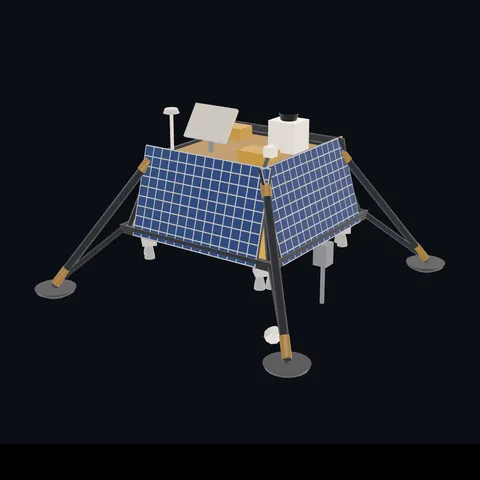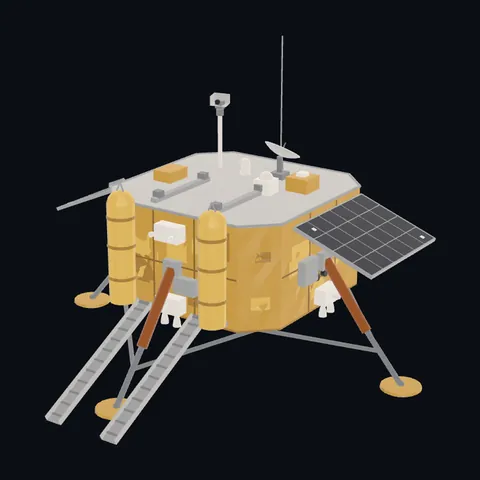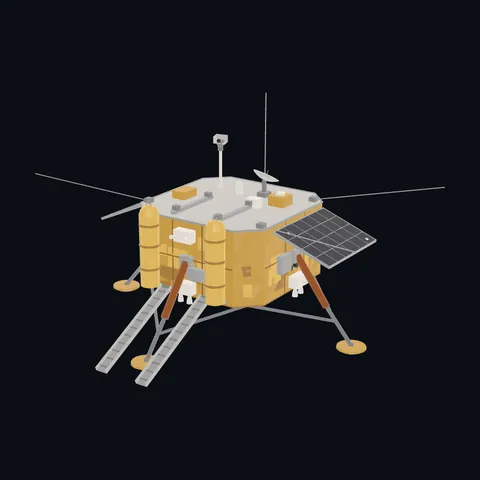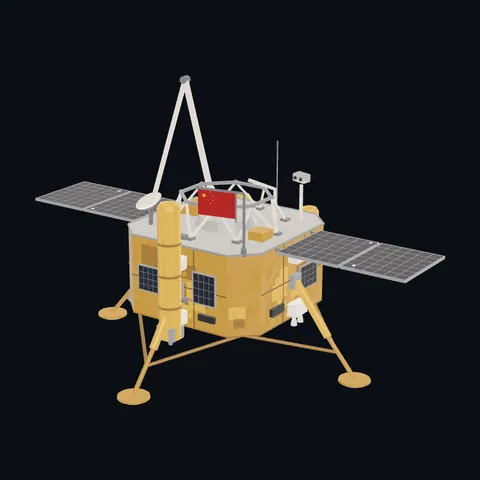
Venera 9
Shape built from published dimensions and pictures; details simplified.
Turn it in 3D
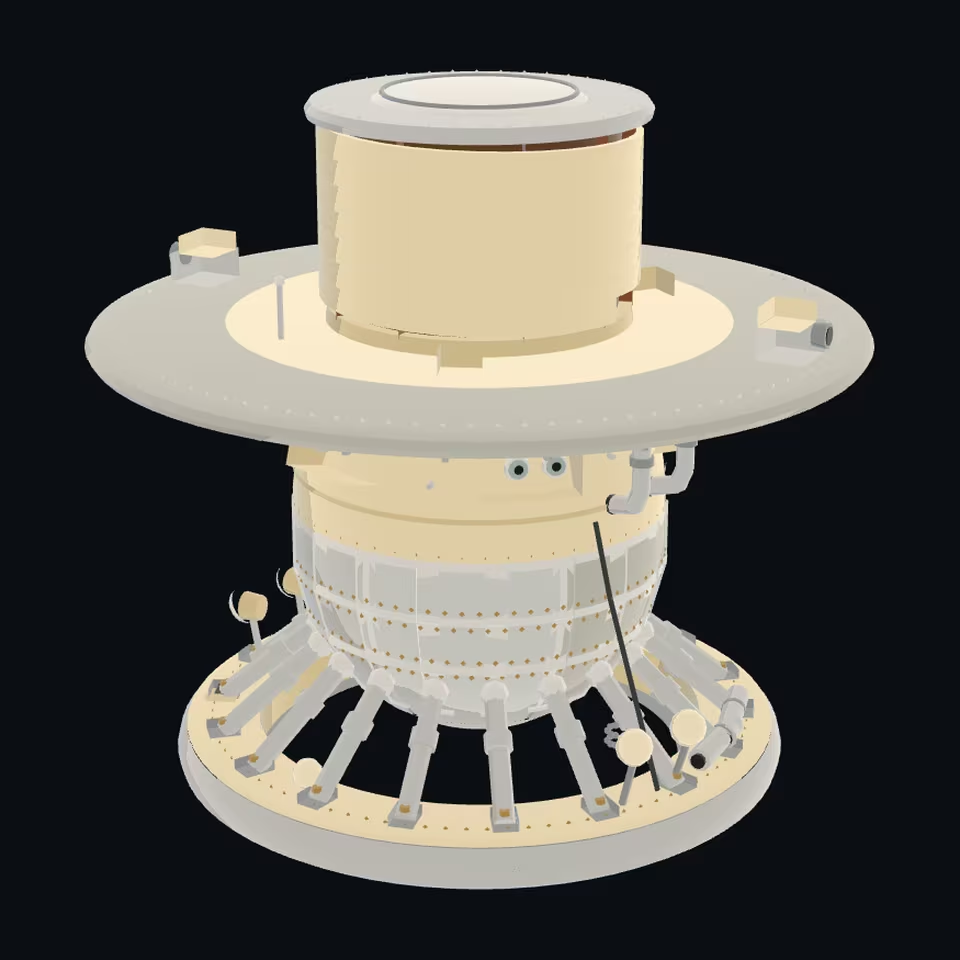
Open the 3D viewer (www.spaceradar.ai).
The viewer loads when you ask: about 700 kB the first time (three.js and the model), much less after.
Pictures 4
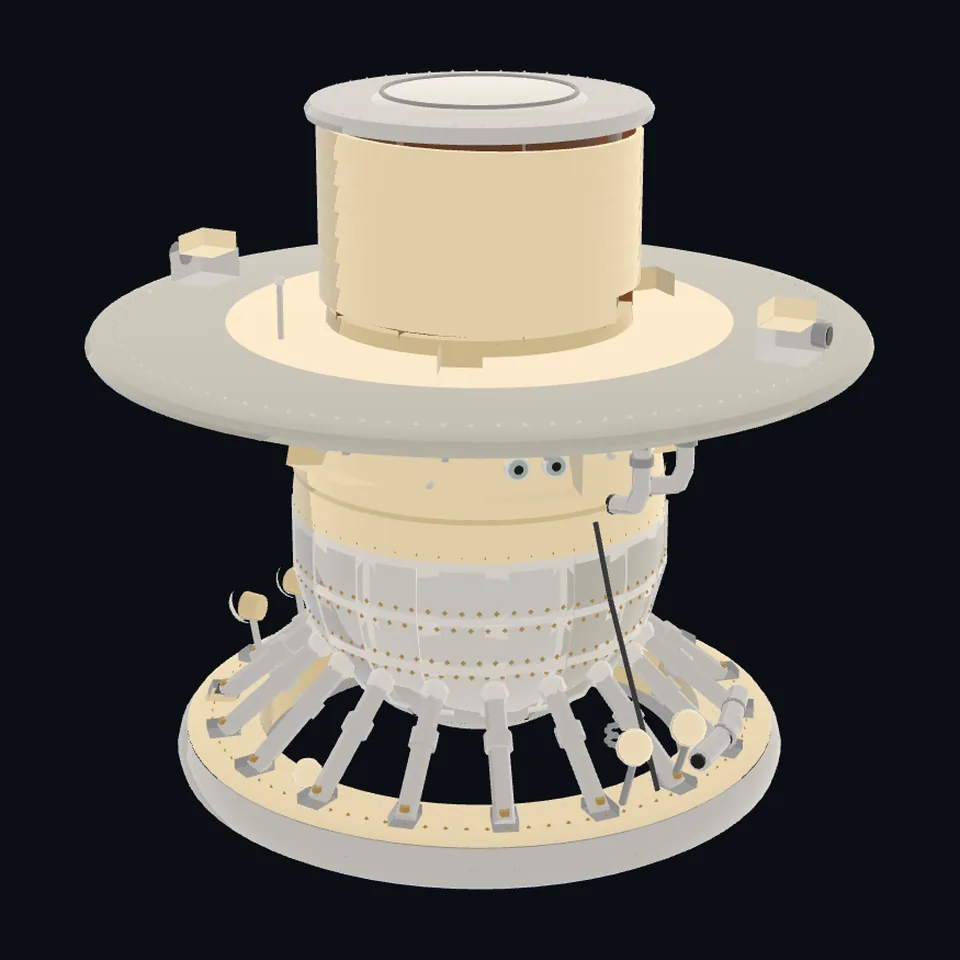 Three-quarter view
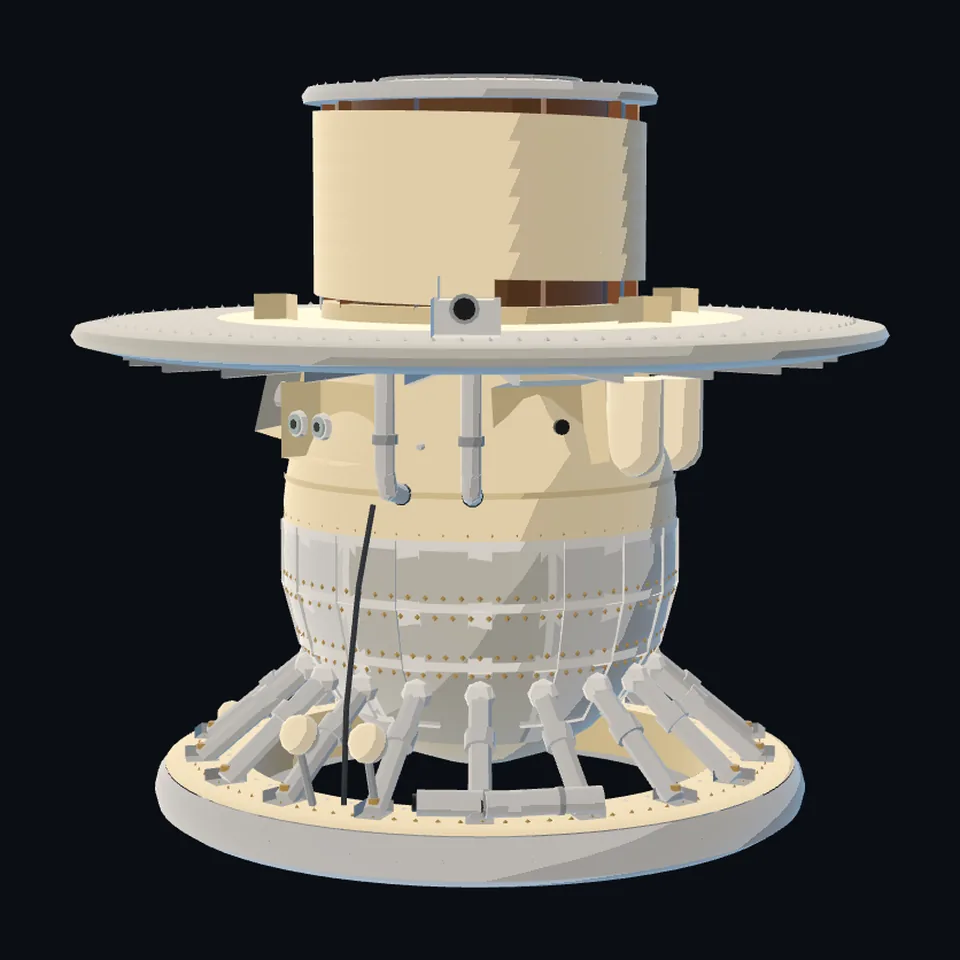 From the side
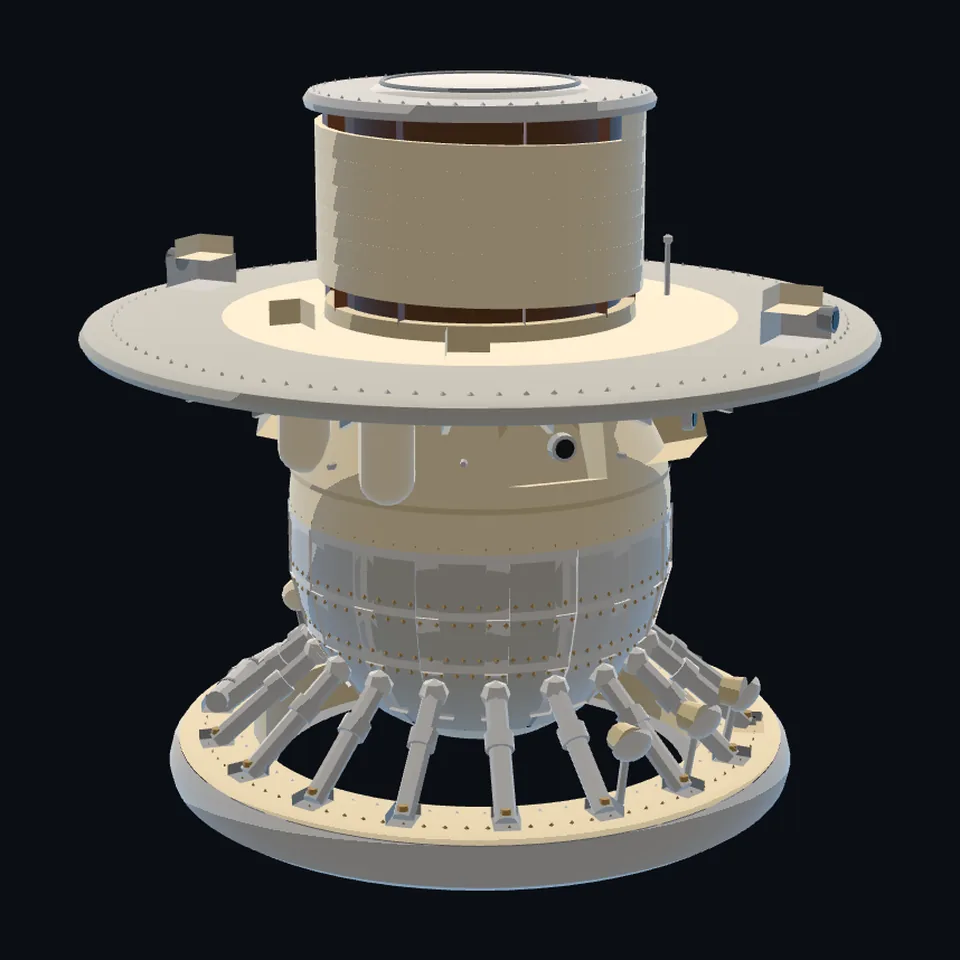 From behind
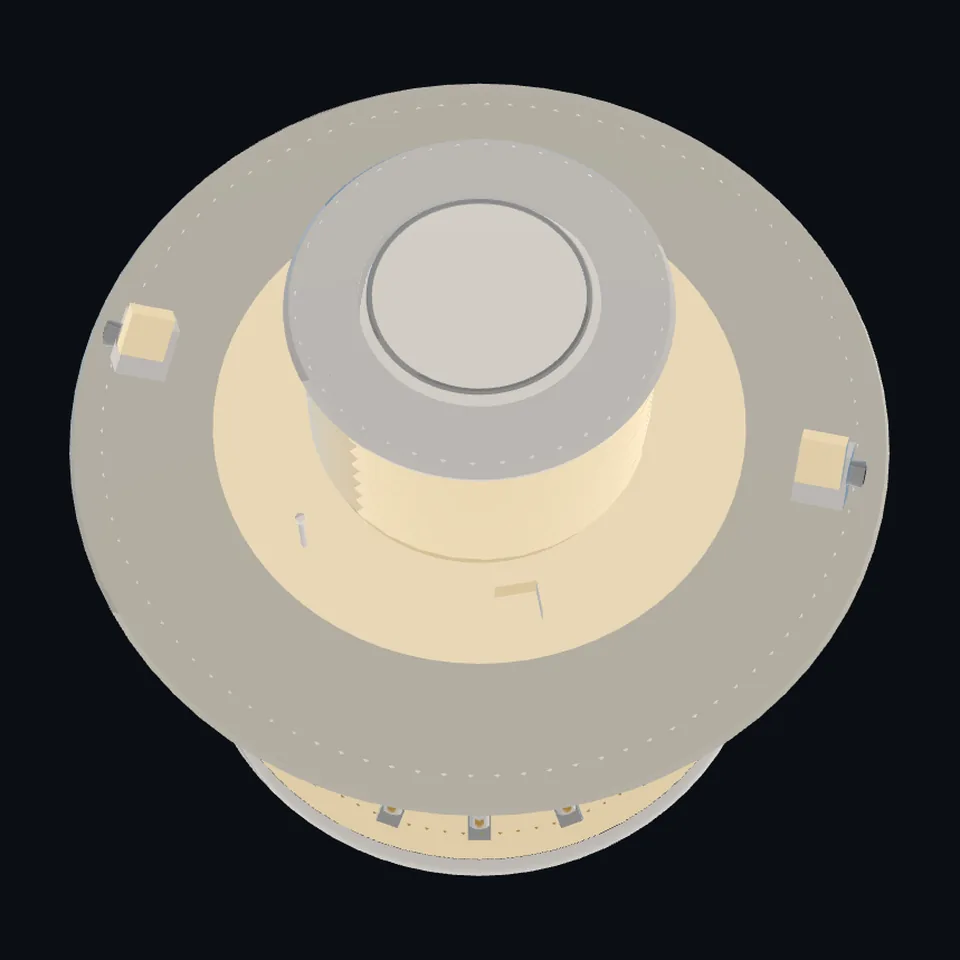 From above
About this model
Venera 9 is one of the 203 3D models Space Radar made itself: a lander or rover, built in code from published dimensions and photographs, with no image-to-3D generator and no one else’s mesh.
Shape built from published dimensions and pictures; details simplified. It has 24,936 triangles in a 214 kB glTF file, and is 2.4 m across at full scale.
It is part of the map’s library; no object on the live map is drawn with it today.
Dimensions and their sources
| Measure | Value |
|---|---|
| Ball | 1 m |
| Pressure vessel | 0.8 m |
| Ring | 1.8 m |
| Drag plate | 2.2 m |
| Cylinder | 0.84 m |
| Height | 2 m |
| Landing mass | 660 kg |
| Entry sphere | 2.4 m |
| Legs | 18 |
Schroeder, Bayandor and Samareh, 'Impact and crashworthiness characteristics of Venera type landers for future Venus missions' (AIAA; NASA NTRS 20170002533, ntrs.nasa.gov/citations/20170002533), OPENED 2026-11-05: the payload module was 'roughly one meter in diameter' with an '80 cm diameter pressure vessel'; there were '18 legs that connected the payload module to the impact ring'; the impact ring was 'a hollow metallic ring' (a torus) 'perforating' holes in its skin; the lander entered 'encapsulated in a 2.4 m spherical heat shield'; the paper's preliminary design has the ring's radius at 0.9 m and the payload 0.65 m above it; the four parts are the parachute capsule and drag plate, the payload module, the legs and the impact ring. Wikipedia, 'Venera 9', en.wikipedia.org/wiki/Venera_9, OPENED 2026-11-05: the surface payload 660 kg; 'the ring was partly crushed upon touchdown'; the ring-shaped aerodynamic shield; two lens covers; the instrument list. The pages give no height, no drag plate and no cylinder size, so OURS: every other size, read off the photographs of the 1:1 replica with the ball's one metre as the ruler and the 2.4 m shell as the check (the drag plate 2.2 m, which is what fits in the shell; the cylinder 0.84 m across and 0.6 m tall; the whole 2.0 m high), about ten per cent. The paper's 2.15 m drag plate radius is its own preliminary figure and does not fit the 2.4 m shell, so it is not used. THE CYLINDER IS DRAWN AS THE REPLICAS SHOW IT: what it was on the real craft (an antenna housing or the parachute capsule) is not given by the pages read (read 2026-11-05)
How it was made
Built in code from published dimensions and photographs, with no image-to-3D generator and no one else’s mesh. 3D model: built by Space Radar from published dimensions and photographs of the replica in Kaluga (Stolbovsky, CC BY 4.0; DonSimon, CC BY 4.0).
The full record
built by this project in code (tools/venera-builder/venera.py, on release 1.5.0's part library), from the cited dimensions and the pictures under `references`; no image-to-3D model was used, and no published mesh (NASA's 3D Resources, 1 199 files read 2026-11-05, has no Venera; NASA Science and Roscosmos publish none that was found; the agency pages were searched, and no agency model of it under usable terms was found)
Where the map uses it. the venera-9 and venera-10 landing sites (registry/landing-sites-1-5.yaml `model: venera-9`, the landing-sites layer), Venus: the lander of the Venera 9 and 10 twins (1975), as the 1:1 replica stands, its landing ring whole, on its legs under the drag plate and the cylinder. It was a mark and nothing else; the other Venus sites still are; internal #1076
Licence note. CC BY 4.0 (Stolbovsky's and DonSimon's photographs of the 1:1 replica in Kaluga) and Public domain (the U.S. Navy photograph of the Venera 12 cut-away; the Soviet picture from Venus): looked at, with credit; nothing of them is in the file. The Moscow replica's photograph under CC BY-SA was looked at only. The shape is this project's, under this repository's licence, built from published numbers (facts). NO LOGO AND NO LETTERING is on the mesh.
References 6
What the shape was compared with. None of these pictures is in the file.
- Venera 9 Space Probe 01StolbovskyCC BY 4.0 (Commons' LicenseShortName, read 2026-11-05)
- Venera 9 Space Probe 02StolbovskyCC BY 4.0 (Commons' LicenseShortName, read 2026-11-05)
- Kaluga Wikiexpedition (2016-06-11) 0139DonSimonCC BY 4.0 (Commons' LicenseShortName, read 2026-11-05)
- Moscow. VDNKh. Pavillion 32 Cosmos. Venera 9 Lander P5293259 2645Alexxx1979CC BY-SA 4.0 (Commons' LicenseShortName, read 2026-11-05)
- Cut-away model of a Soviet Venera 12 landerDon S. Montgomery, U.S. Navy (Ret.)Public domain (U.S. Navy; Commons' LicenseShortName, read 2026-11-05)
- Foto de Venera 9Ted StrykPublic domain (Commons' LicenseShortName, read 2026-11-05)


Use it
The model is under the MIT licence: use it, change it and share it, in any project, also a paid one. Keep the credit:
Venera 9 3D model by Space Radar (spaceradar.ai), MIT LicenseAny glTF 2.0 loader that reads meshopt compression (EXT_meshopt_compression) opens the file: three.js with its MeshoptDecoder, Babylon.js, model-viewer. Tools such as glTF-Transform can write an uncompressed copy.
Or embed the viewer in your page:
<iframe src="https://www.spaceradar.ai/model/?id=venera-9" title="Venera 9, 3D model by Space Radar" width="600" height="450" loading="lazy" style="border:0;max-width:100%"></iframe>Related models