CryoSat-2
Shape built from published dimensions and pictures; details simplified.
Turn it in 3D
Open the 3D viewer (www.spaceradar.ai).
The viewer loads when you ask: about 700 kB the first time (three.js and the model), much less after.
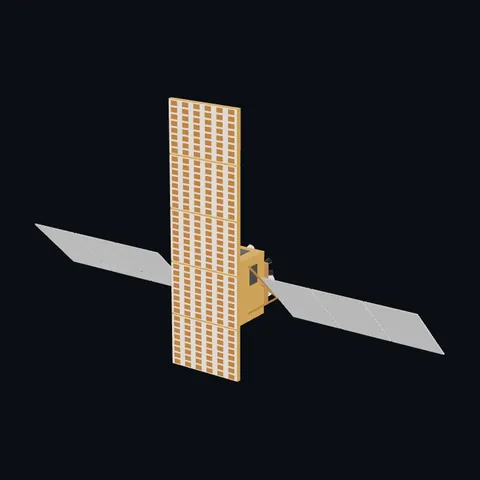
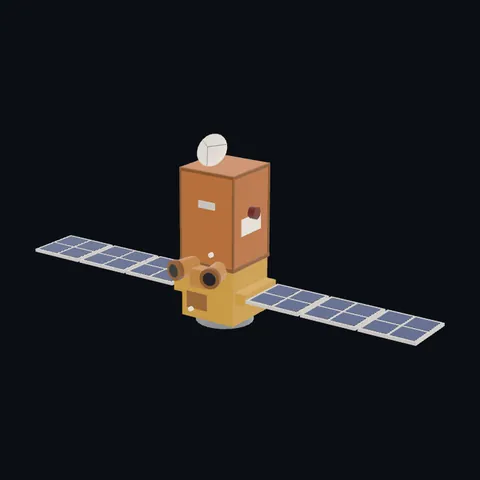
Pictures 4
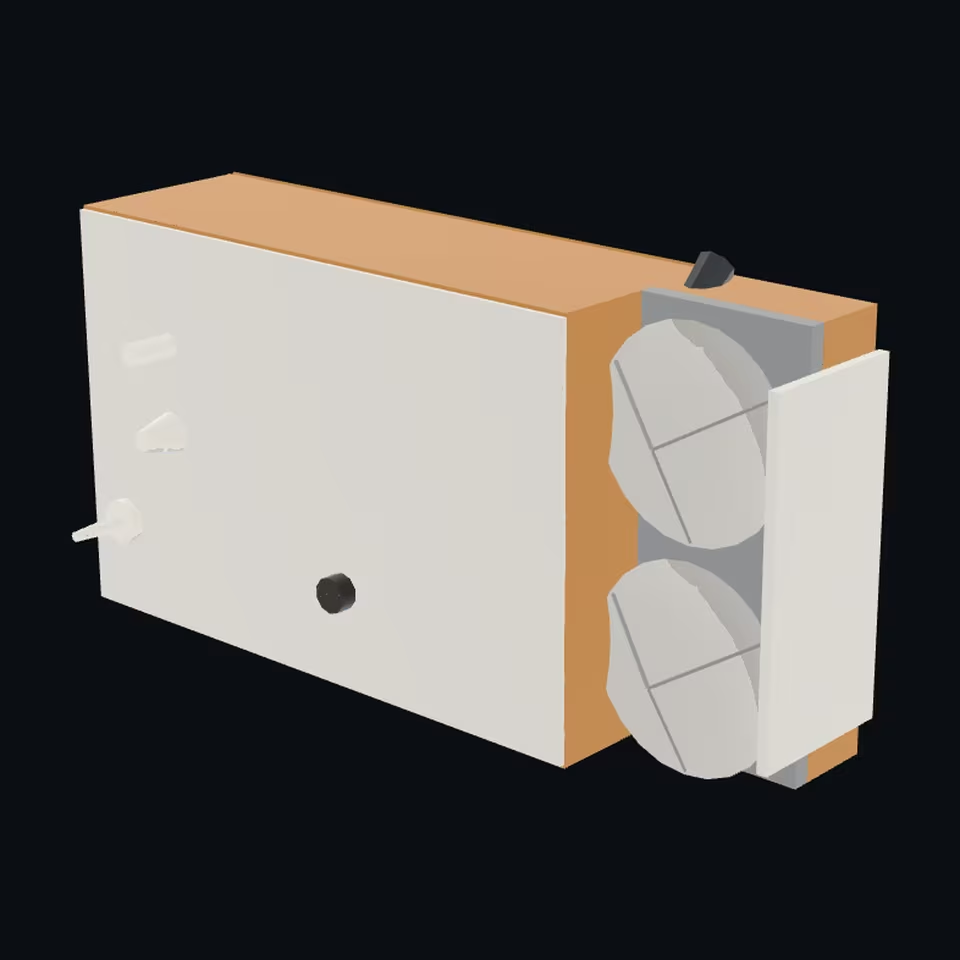
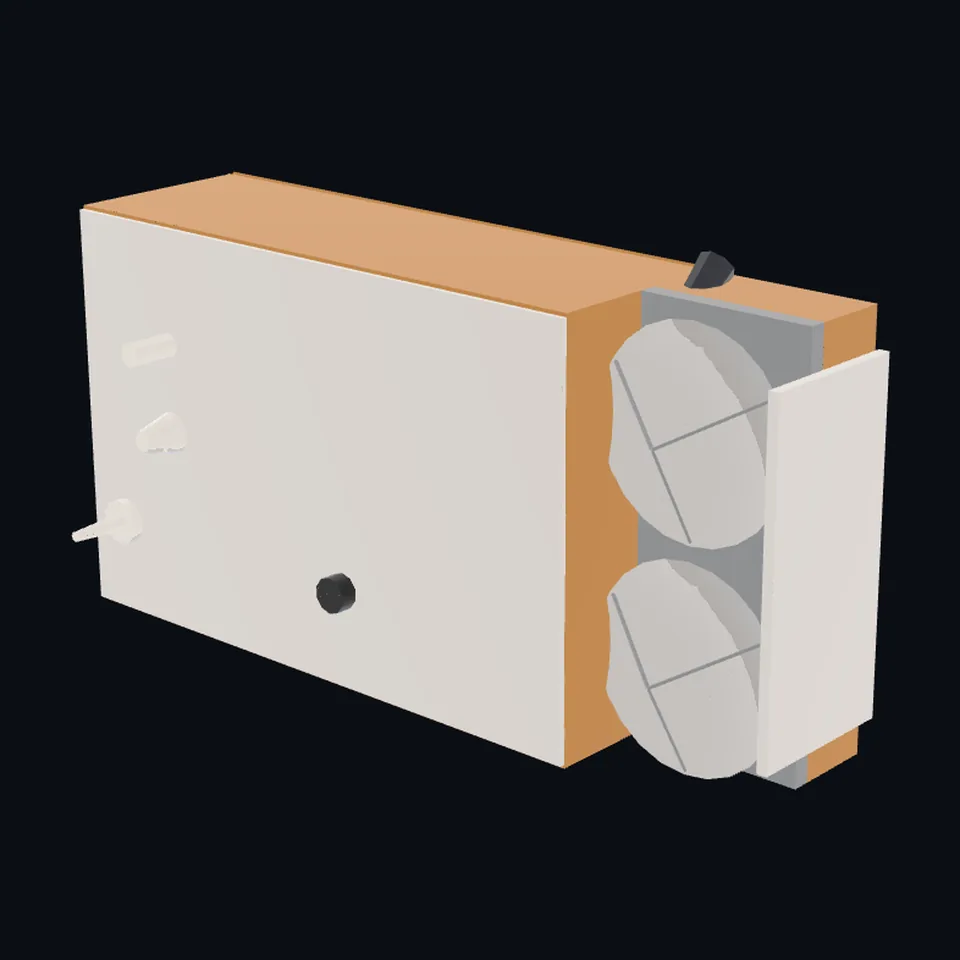 Three-quarter view
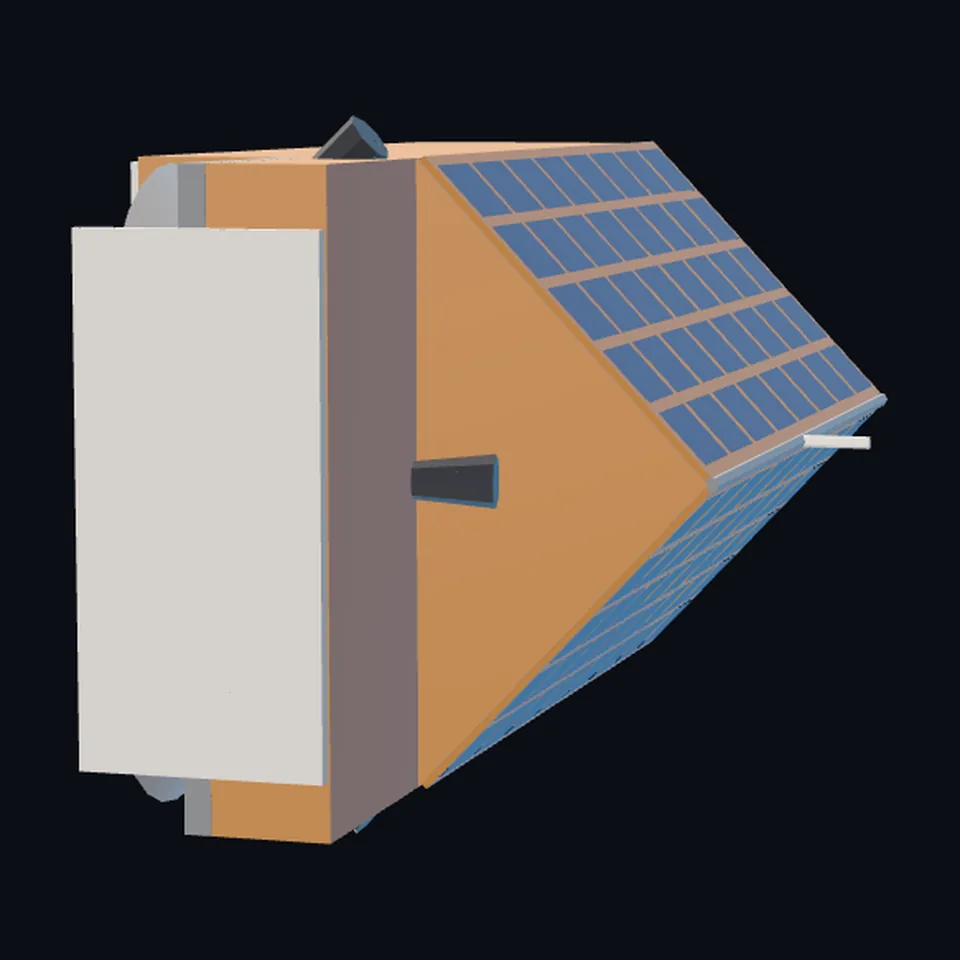 From the side
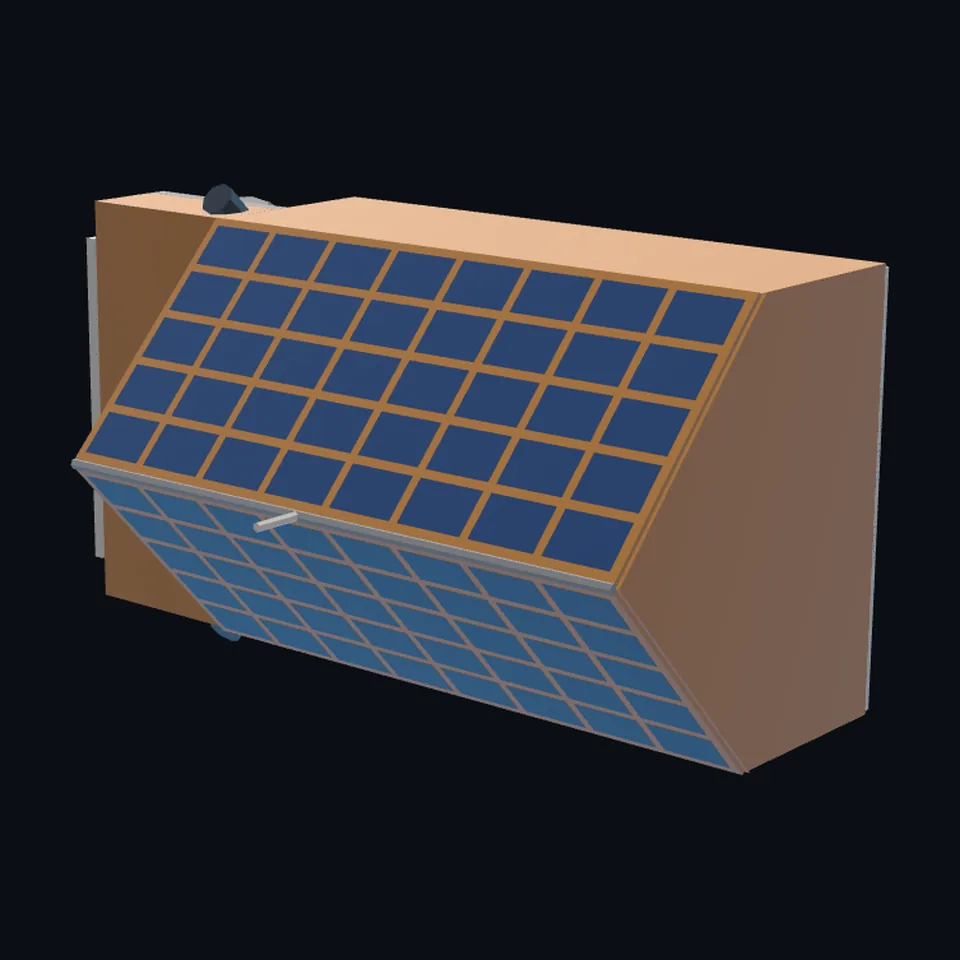 From behind
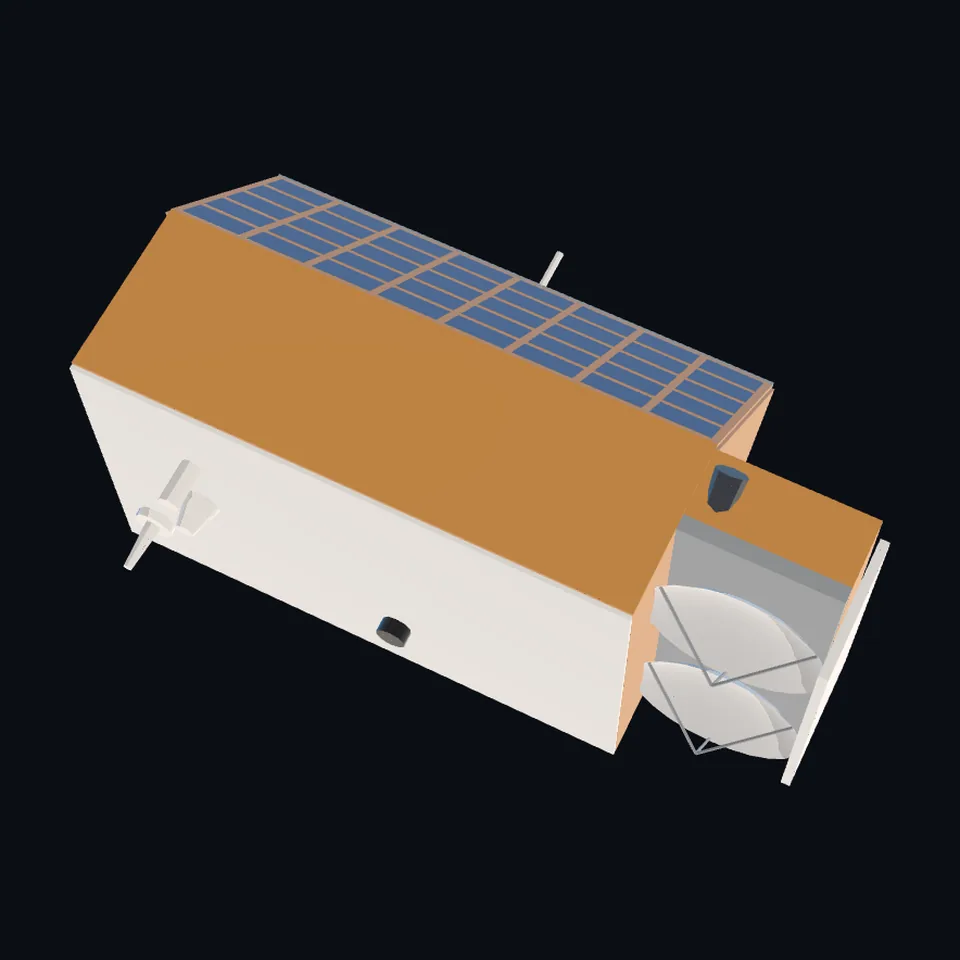 From above
About this model
CryoSat-2 is one of the 203 3D models Space Radar made itself: a satellite, built in code from published dimensions and photographs, with no image-to-3D generator and no one else’s mesh.
Shape built from published dimensions and pictures; details simplified. It has 7,902 triangles in a 53 kB glTF file, and is 4.6 m across at full scale.
On Space Radar’s live map it is drawn for the object with NORAD catalogue number 36508, where its published orbit puts it now. Open it on the map.
Dimensions and their sources
| Measure | Value |
|---|---|
| Craft | 4.6 × 2.34 × 2.2 m |
| Siral reflector | 1.2 × 1.1 m |
| Siral baseline | 1.2 m |
| Nose down | 6° |
eoPortal, eoportal.org/satellite-missions/cryosat-2, OPENED 2026-10-14: 'The spacecraft structure consists of a long rectangular main platform body, surmounted by fixed solar arrays in the form of a tent.'; 'The spacecraft has neither deployable appendages nor any other moving parts except for thruster valves.'; 'The lower surface of this structure is permanently earth facing.'; 'All electronics are mounted on the nadir plate acting as radiator.'; 'The antennas used for radio communication, and the Laser Retroreflector, are mounted on this surface; an emergency antenna for command and monitoring is also fitted on top of the satellite between the solar arrays.'; 'The two SIRAL instrument antenna dishes are mounted on a separate rigid bench in the forward section of the S/C.'; 'In addition, a dedicated SIRAL radiator is mounted at the nose tip.'; 'A slight nose-down attitude of the S/C (6º) is chosen'; 'The S/C has dimensions of 4.6 m x 2.34 m x 2.20 m.'; '2x GaAs body-mounted solar arrays, with 850 W each at normal solar incidence'; '3-axis stabilized local-normal pointing, with 6º nose-down attitude'; 'A set of three star tracker heads'; 'the star tracker accommodation on the antenna bench'; 'The SIRAL design features two receiving antennas forming an interferometer in the cross-track direction with a baseline of 1.2 m'; 'The antenna subsystem consists of two Cassegrain antennas, mounted side-by-side and forming the interferometric cross-track.'; 'The primary super-elliptic reflectors are about 1.1 m x 1.2 m in size.'; 'Figure 2: Illustration of the CryoSat-2 spacecraft with thermal covers on the SIRAL antennas'; 'LRR is accommodated in the nadir plate of the spacecraft'. ESA, 'Facts and figures', esa.int/Applications/Observing_the_Earth/FutureEO/CryoSat/Facts_…, OPENED 2026-10-14 (words and numbers only): 'Launch: 8 April 2010'; 'Power: 2 × GaAs body-mounted solar arrays, each delivering 850 W'; 'Orbit: Mean altitude of 719 km and inclination of 92°; low Earth, polar, non-Sun-synchronous'. ESA, 'Satellite', esa.int/Applications/Observing_the_Earth/FutureEO/CryoSat/Satell…, OPENED 2026-10-14: 'The solar panels are rigidly fixed to the satellite body. Forming a 'roof' with a carefully optimised angle'; 'An S-band helix antenna fixed to the satellite's underside'; 'Next to it, an X-band antenna'. OURS: how the 4.6 m divides (3.5 m of body and roof, 1.05 m of nose), the roof's ridge 1.1 m above the body's top (no angle is given), the reflectors drawn round, every place on the Earth face, the star trackers' places on the bench. (read 2026-10-14)
How it was made
Built in code from published dimensions and photographs, with no image-to-3D generator and no one else’s mesh. 3D model: built by Space Radar from published dimensions (no free picture of the craft).
The full record
built by this project in code (the private tool model-from-images: assemble.py, from a yaml of primitives), from the cited dimensions and the pictures under `references`; no image-to-3D model was used, and no published mesh (NASA's 3D Resources has none of this craft; the survey of 2026-10-13 found no agency model of it under usable terms); ESA's own pictures and models were NOT used: ESA's terms forbid derivative works
Where the map uses it. NORAD 36508 (CRYOSAT 2), the one record in the live saved data of 2026-10-12: ESA's ice altimeter, launched in 2010. It had no route: it wore the shape of its class, a box with two wings and a dish, where the craft has no wings at all; public #957
Licence note. This project's own shape, under this repository's licence, built from published numbers and sentences (facts). NO FREE PICTURE OF THE CRAFT WAS FOUND: the layout is the pages' own words; a visitor's share-alike photograph of the flight craft was looked at only (named under references) and nothing of it is in the file. NO ESA PICTURE WAS USED. NO LOGO AND NO LETTERING is on the mesh.
References 1
What the shape was compared with. None of these pictures is in the file.
- Cryosat2 test iabg ottobrunnAndreasSchepers (Wikimedia Commons)CC BY-SA 3.0 (AndreasSchepers, own work; read 2026-10-14): share-alike, LOOKED AT ONLY, never fetched by the tool and not on any sheet

Use it
The model is under the MIT licence: use it, change it and share it, in any project, also a paid one. Keep the credit:
CryoSat-2 3D model by Space Radar (spaceradar.ai), MIT LicenseAny glTF 2.0 loader that reads meshopt compression (EXT_meshopt_compression) opens the file: three.js with its MeshoptDecoder, Babylon.js, model-viewer. Tools such as glTF-Transform can write an uncompressed copy.
Or embed the viewer in your page:
<iframe src="https://www.spaceradar.ai/model/?id=cryosat-2" title="CryoSat-2, 3D model by Space Radar" width="600" height="450" loading="lazy" style="border:0;max-width:100%"></iframe>Related models