Space Shuttle robot arm
Shape built from published dimensions and pictures; details simplified.
Turn it in 3D
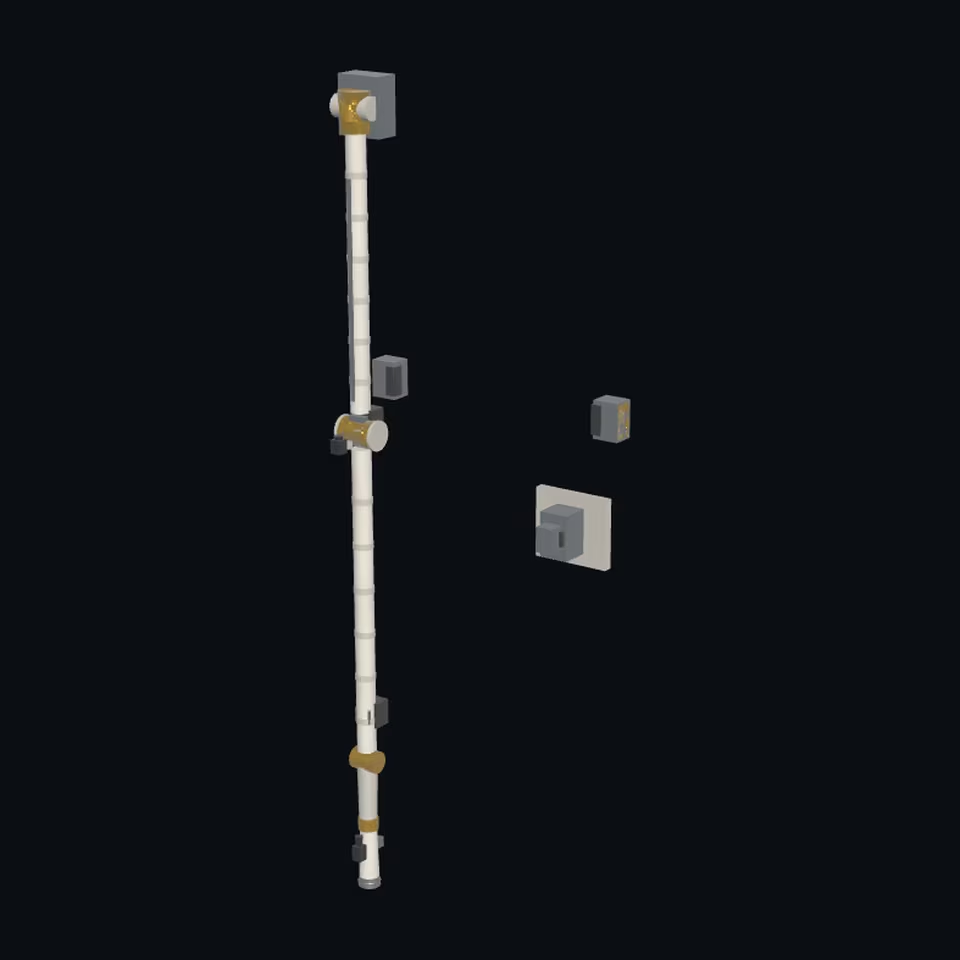
Open the 3D viewer (www.spaceradar.ai).
The viewer loads when you ask: about 700 kB the first time (three.js and the model), much less after.
Pictures 4
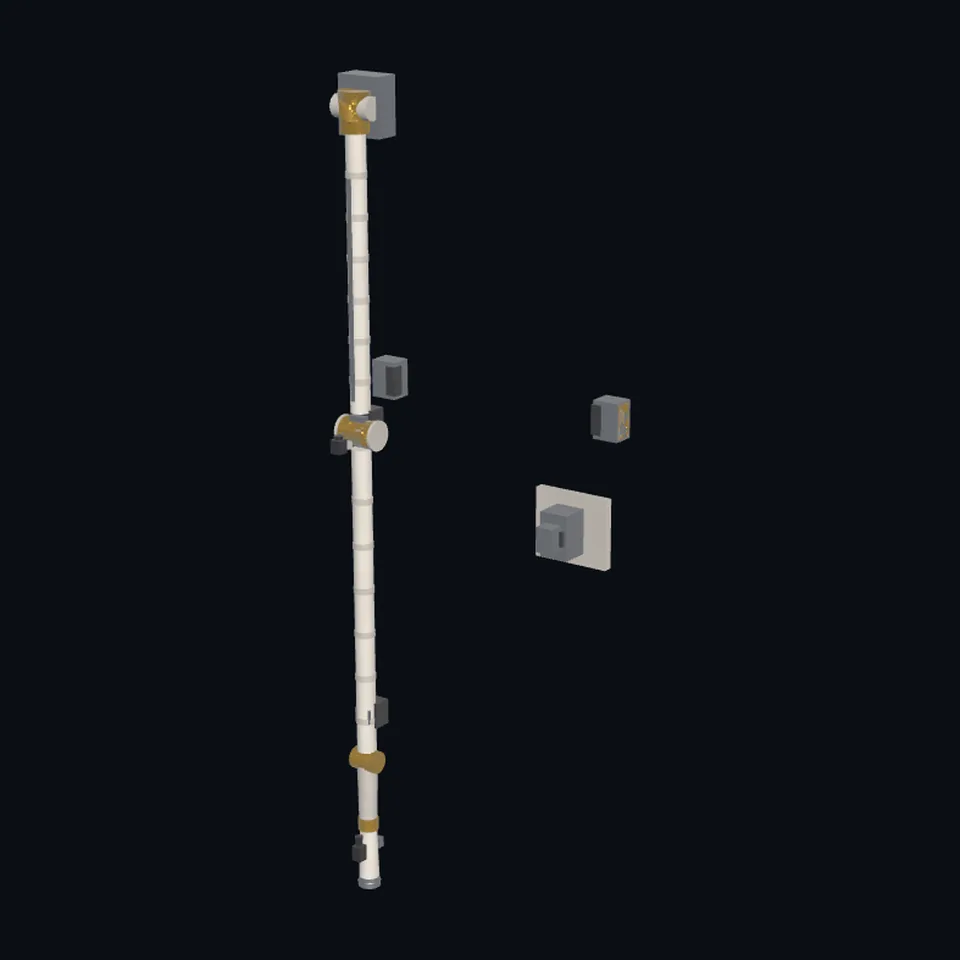 Three-quarter view
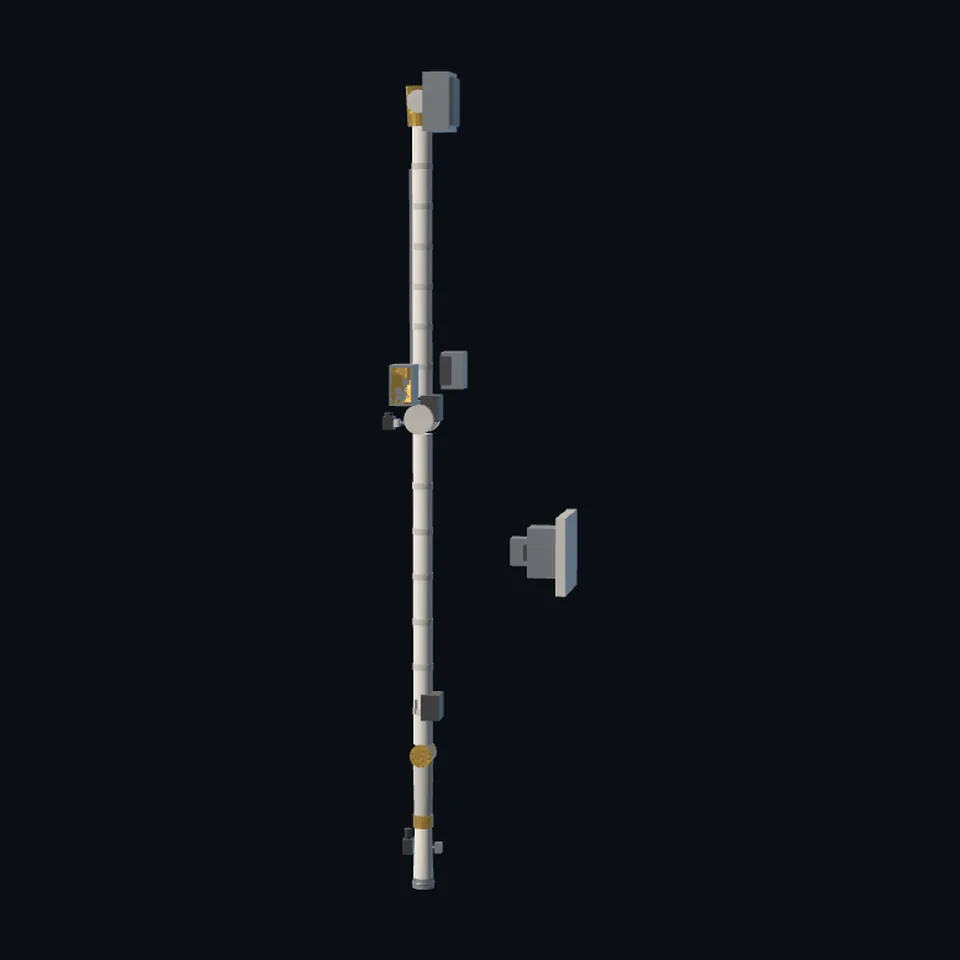 From the side
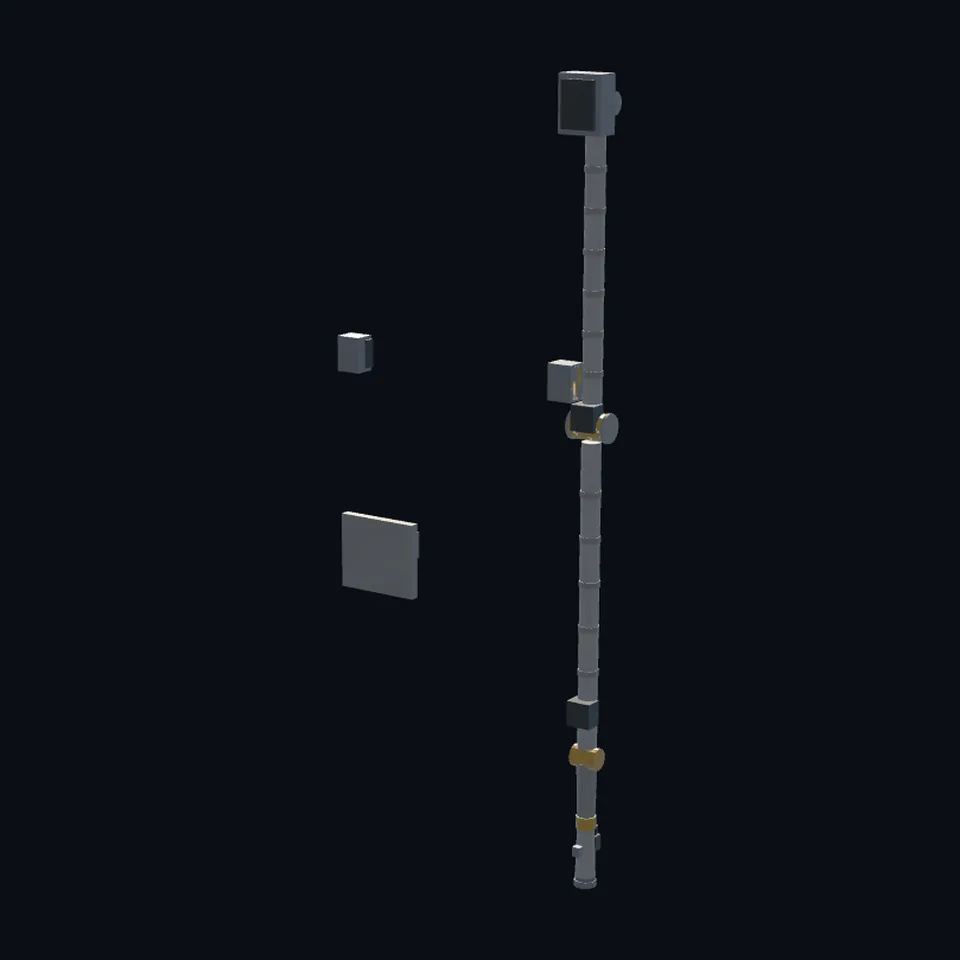 From behind
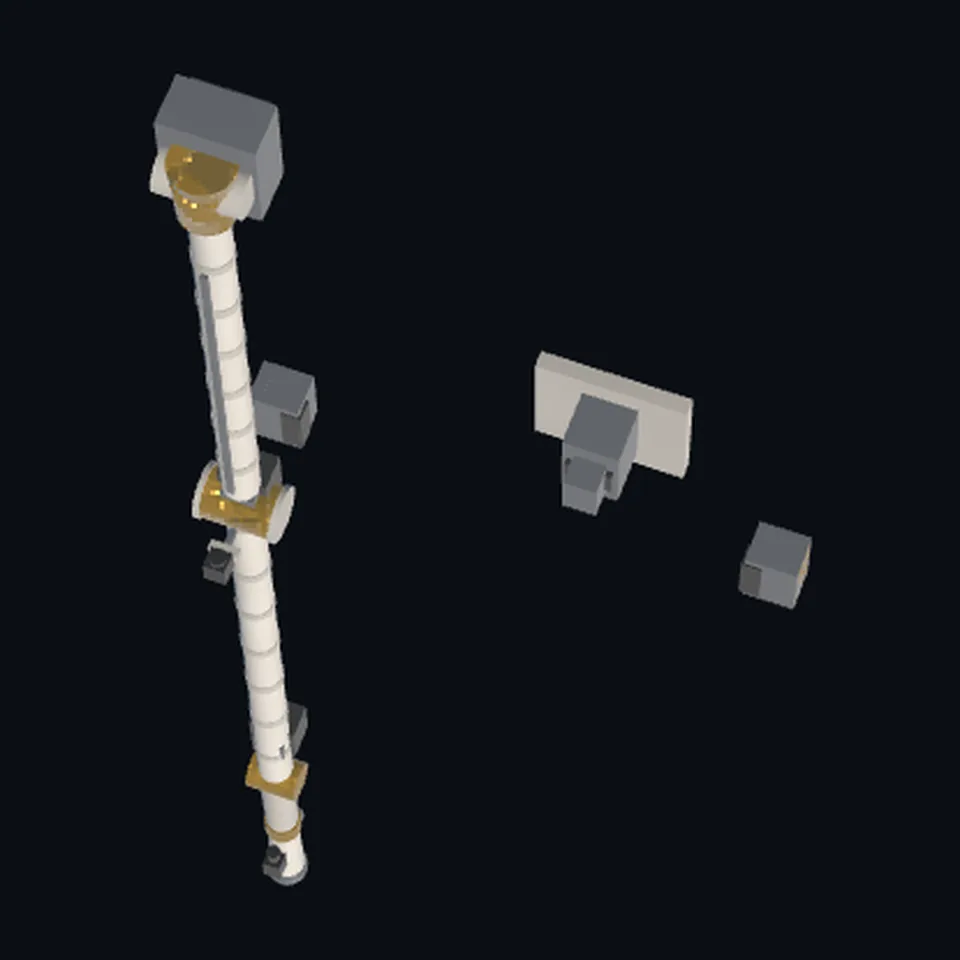 From above
About this model
Space Shuttle robot arm is one of the 203 3D models Space Radar made itself: a rocket stage, built in code from published dimensions and photographs, with no image-to-3D generator and no one else’s mesh.
Shape built from published dimensions and pictures; details simplified. It has 2,764 triangles in a 38 kB glTF file, and is 15 m across at full scale.
It is part of the map’s library; no object on the live map is drawn with it today.
Dimensions and their sources
| Measure | Value |
|---|---|
| Length | 15.2 m |
| Diameter | 0.38 m |
| Upper boom | 5 m |
| Lower boom | 5.8 m |
Wikipedia, 'Canadarm' (en.wikipedia.org/wiki/Canadarm), OPENED 2026-11-03: '15.2 metres (50 ft) long', '38 centimetres (15 in) diameter', 'six joints'; the IEEE Canadian Millennium Project's technical page on the arm (ewh.ieee.org/reg/7/millennium/canadarm/canadarm_technical.html), OPENED 2026-11-03: the upper arm boom 'approximately 5 m long by 33 cm in diameter', the lower 'approximately 5.8 m long by 33 cm in diameter', graphite-epoxy. OURS: the joint-to-joint lengths 6.0 m and 6.8 m (the booms and their joints' housings), 2.4 m from the wrist to the tip of the end effector, which make the 15.2 m, and every other size, read off the STS-31 photographs (read 2026-11-03)
How it was made
Built in code from published dimensions and photographs, with no image-to-3D generator and no one else’s mesh. 3D model: built by Space Radar from NASA's published dimensions of the arm; compared with NASA's STS-31 photographs (public domain).
The full record
built by this project in code (tools/hubble-builder/canadarm.py); no image-to-3D model was used, and no published mesh: NASA's 3D Resources has none of the arm (read 2026-11-03)
Where the map uses it. NOTHING YET, as a route on the map: the Space Shuttle's Remote Manipulator System (the Canadarm) on the port sill of Discovery's open bay, with the berth that held the Hubble, in the `hubble-deployment` Moment (release 1.7.7). It is laid on the orbiter file of `shuttle-orbiter` and is in THAT file's frame (metres, +Y toward the nose, +X starboard, +Z up out of the bay, y = 0 at the tail's tip), so stand it with keepXZ, lengthM its own height, and ride it on the orbiter with `at` [0, minY, 0] (the Moment's builder reads minY from the file). Stowed: straight along the port longeron, shoulder at the bay's forward end (y 27.0), the three parts turned about their joints by pose keyframes
Licence note. The shape is this project's, under this repository's licence, built from published numbers (facts); NASA's photographs of the arm (public domain) were looked at.
References 1
What the shape was compared with. None of these pictures is in the file.
- 1990 s31 IMAX view of HST in payload bayNASA (IMAX Cargo Bay Camera, STS-31)Public domain (NASA; Commons LicenseShortName, read 2026-11-03)

Use it
The model is under the MIT licence: use it, change it and share it, in any project, also a paid one. Keep the credit:
Space Shuttle robot arm 3D model by Space Radar (spaceradar.ai), MIT LicenseAny glTF 2.0 loader that reads meshopt compression (EXT_meshopt_compression) opens the file: three.js with its MeshoptDecoder, Babylon.js, model-viewer. Tools such as glTF-Transform can write an uncompressed copy.
Or embed the viewer in your page:
<iframe src="https://www.spaceradar.ai/model/?id=shuttle-rms" title="Space Shuttle robot arm, 3D model by Space Radar" width="600" height="450" loading="lazy" style="border:0;max-width:100%"></iframe>Related models
Falcon 9 first stage
Shape built from published dimensions and pictures; details simplified.
R-7 (8K72K) core and Blok E
Shape built from published dimensions and pictures; details simplified.