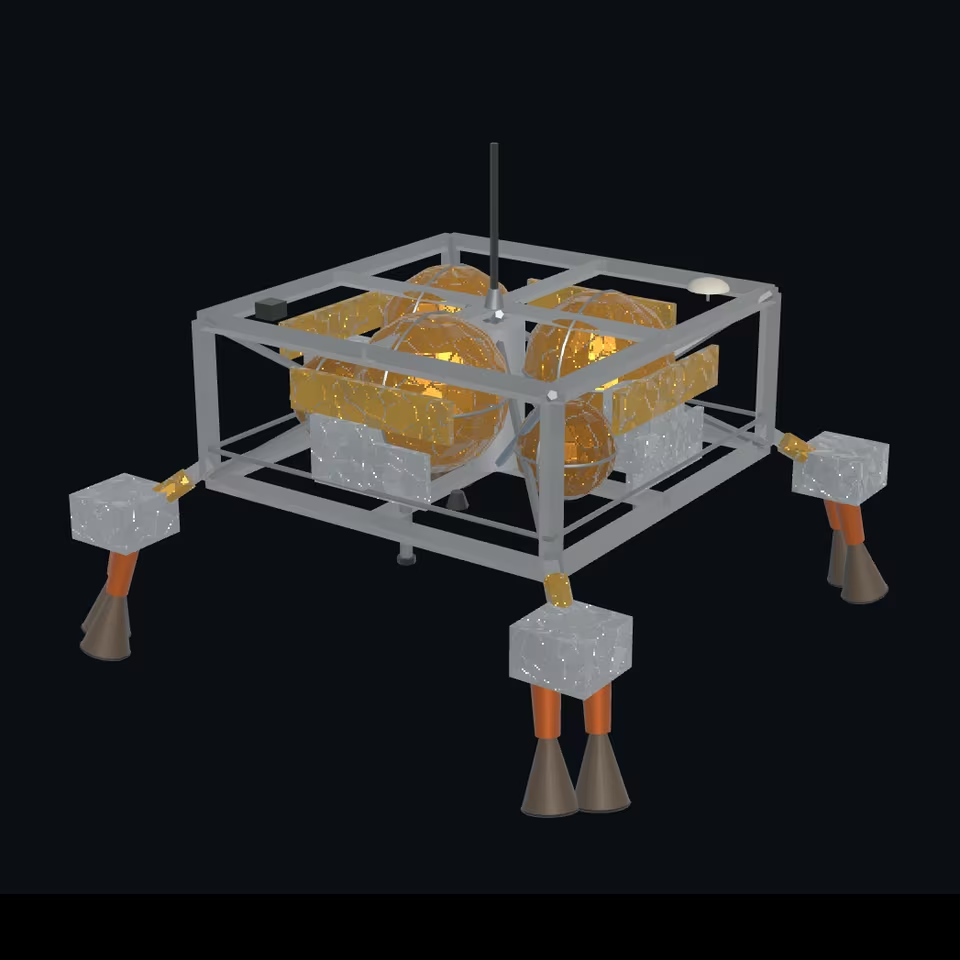
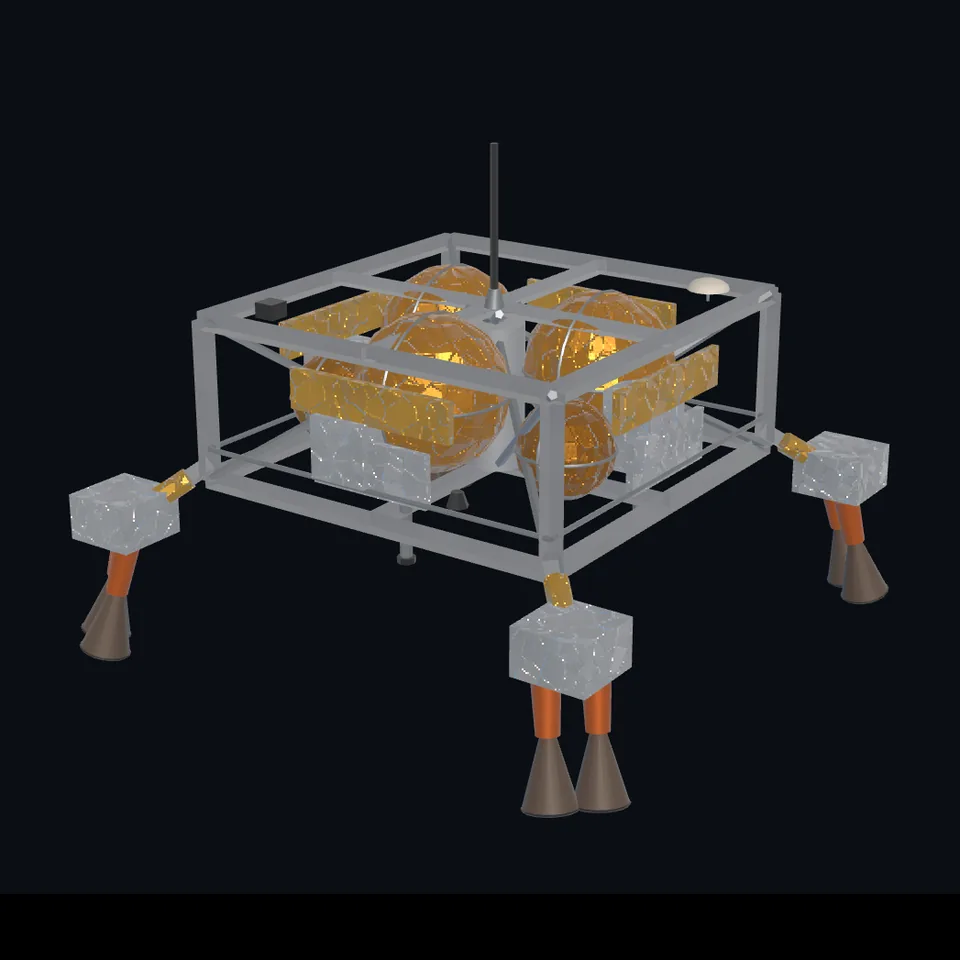
Curiosity's descent stage
Shape built from published dimensions and pictures; details simplified.
Turn it in 3D
Open the 3D viewer (www.spaceradar.ai).
The viewer loads when you ask: about 700 kB the first time (three.js and the model), much less after.
Pictures 4
 Three-quarter view
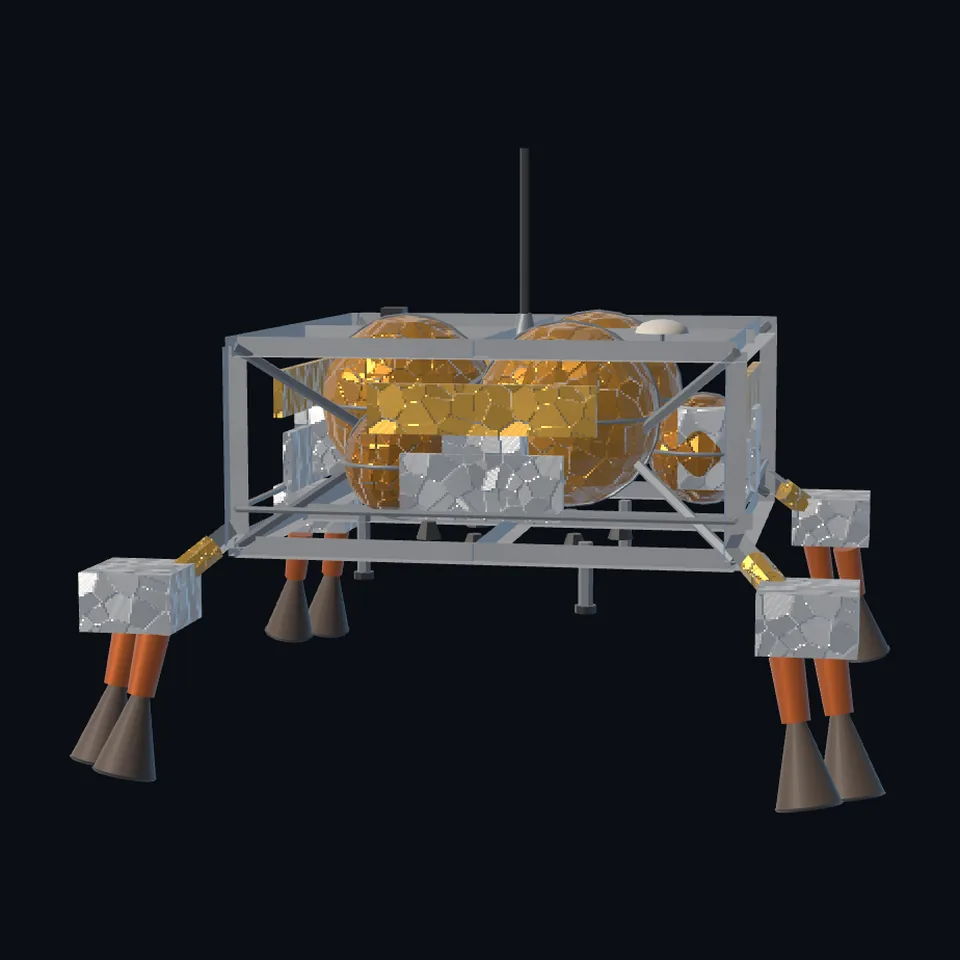 From the side
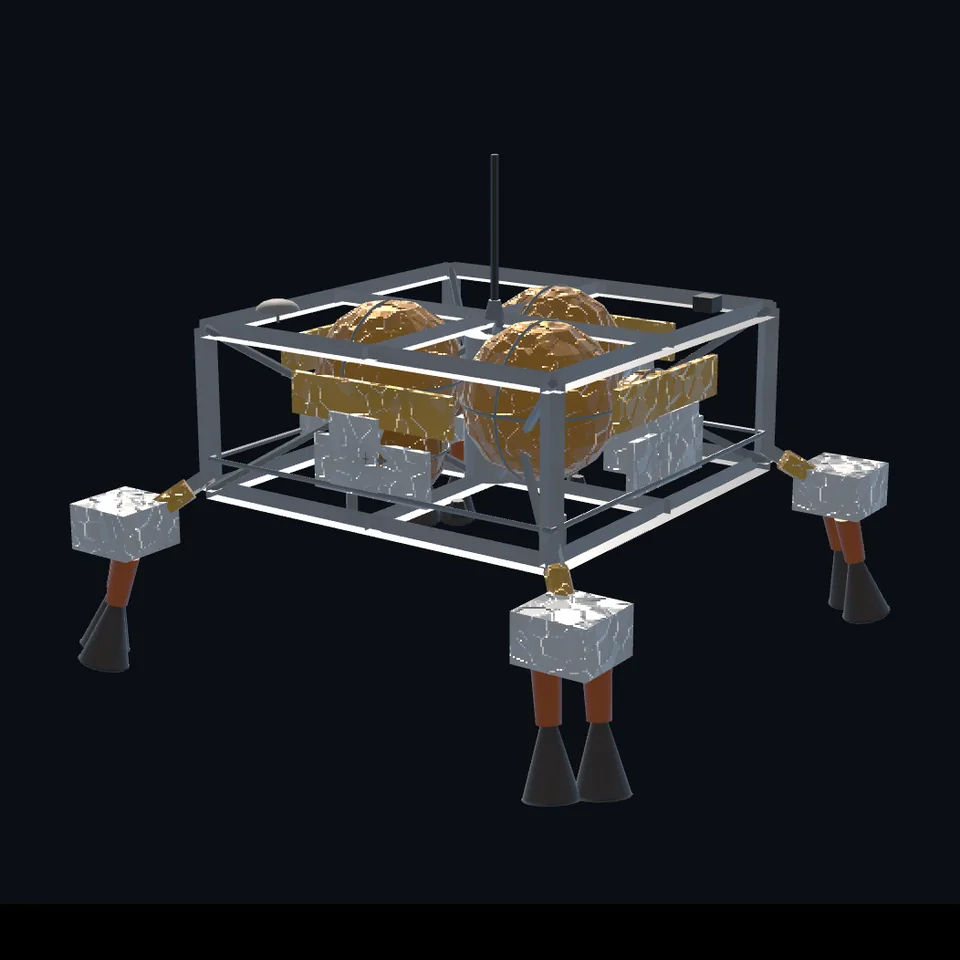 From behind
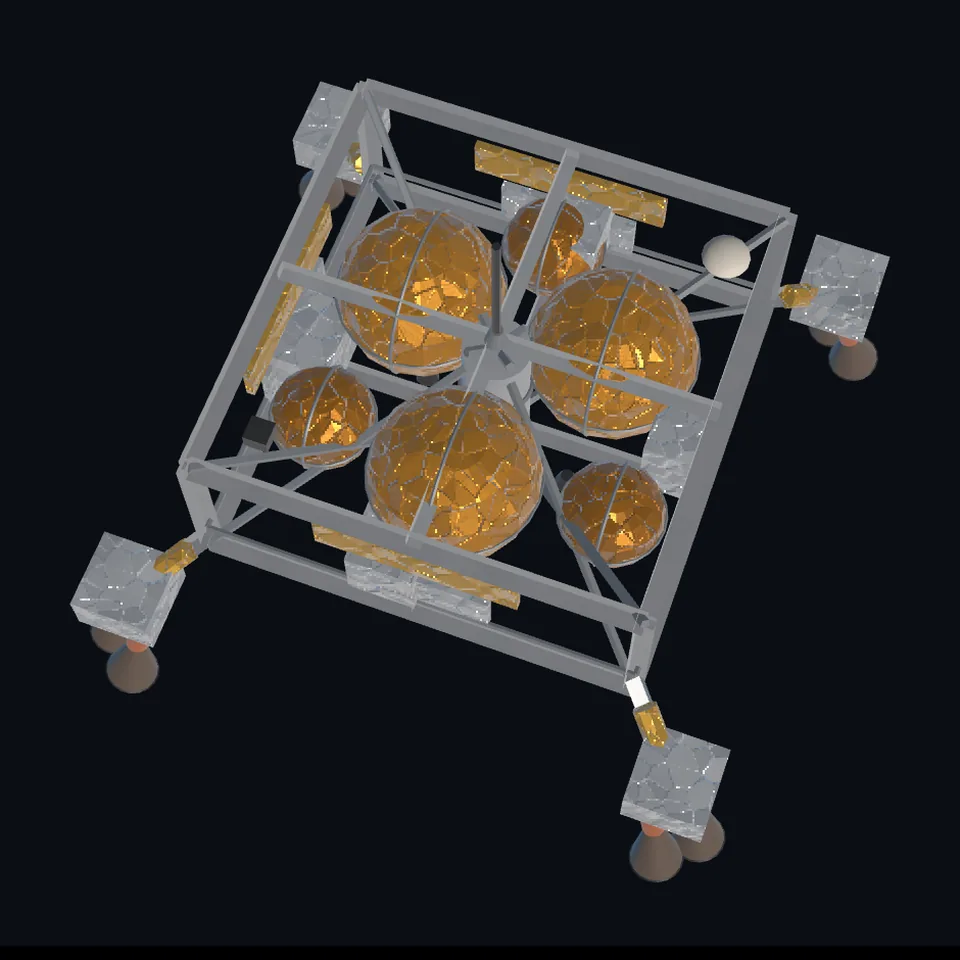 From above
About this model
Curiosity's descent stage is one of the 203 3D models Space Radar made itself: a crewed craft or station, built in code from published dimensions and photographs, with no image-to-3D generator and no one else’s mesh.
Shape built from published dimensions and pictures; details simplified. It has 7,798 triangles in a 78 kB glTF file, and is 4.1 m across at full scale.
It is part of the map’s library; no object on the live map is drawn with it today.
Dimensions and their sources
| Measure | Value |
|---|---|
| Width | 4.1 m |
| Height | 3.215 m |
NASA/JPL, Mars Science Laboratory Landing press kit, July 2012 (public domain; opened 2026-11-03): 'eight throttleable retrorockets on the descent stage, called Mars landing engines'; 'nylon cords begin to spool out to lower the rover'; the engines 400 to 3 100 N (Wikipedia, Mars Science Laboratory). NO DIMENSION OF THE DESCENT STAGE was found; READ OFF THE PHOTOGRAPHS, against the 4.5 m aeroshell it rides in and the 2.7 m rover: a frame 2.6 m square and 1.05 m high, six tanks (three of 0.50 m radius, three of 0.31 m), a central column of 0.2 m radius, four pods on booms reaching 2.07 m from the axis, nozzles of 0.16 m exit radius turned 14 degrees outward, a mast of 1.05 m. The engines' places (two at each of four corners) are from NASA's labelled drawing. ILLUSTRATIVE to about ten per cent. (read 2026-11-03)
How it was made
Built in code from published dimensions and photographs, with no image-to-3D generator and no one else’s mesh. 3D model: built by Space Radar from NASA's published numbers and NASA/JPL pictures (public domain).
The full record
built by this project in code (tools/msl-builder/, release 1.7.9: msl.py); no published 3D model of the descent stage under a free licence was found (see msl-entry)
Where the map uses it. NOTHING YET, as a route on the map: no object of the map is the Mars Science Laboratory's descent stage, which crashed beside Gale crater in 2012. It is the rocket backpack of the Curiosity Moment (release 1.7.9, internal #1058): the frame of beams and struts with its six tanks in gold blanket, the central column, four boom-mounted pods with two Mars landing engines each (the eight engine mouths are `engines`, in the order the moment lights them), the antenna mast and the rover's three struts. Origin: the engines' lips, so the model stands on them; +Y up the frame (the deck up, the rover below it), the frame's underside 1.115 m up
Licence note. The shape is this project's, under this repository's licence, built from published numbers (facts) and read off NASA photographs. Every picture it was compared with is listed under references; each is a NASA/JPL work in the public domain (Commons' LicenseShortName, read 2026-11-03), was only looked at, none was traced, copied or projected. NO LOGO, FLAG OR LETTERING is on the mesh.
References 2
What the shape was compared with. None of these pictures is in the file.
- MSL DescentStage.jpgNASA/JPL-CaltechPublic domain (NASA/JPL-Caltech; Commons' LicenseShortName, read 2026-11-03)
- MSL-descent-stage-with-labe.pngNASAPublic domain (NASA, from NTRS; Commons' LicenseShortName, read 2026-11-03)


Use it
The model is under the MIT licence: use it, change it and share it, in any project, also a paid one. Keep the credit:
Curiosity's descent stage 3D model by Space Radar (spaceradar.ai), MIT LicenseAny glTF 2.0 loader that reads meshopt compression (EXT_meshopt_compression) opens the file: three.js with its MeshoptDecoder, Babylon.js, model-viewer. Tools such as glTF-Transform can write an uncompressed copy.
Or embed the viewer in your page:
<iframe src="https://www.spaceradar.ai/model/?id=msl-descent-stage" title="Curiosity's descent stage, 3D model by Space Radar" width="600" height="450" loading="lazy" style="border:0;max-width:100%"></iframe>Related models
Falcon 9 first stage
Shape built from published dimensions and pictures; details simplified.
R-7 (8K72K) core and Blok E
Shape built from published dimensions and pictures; details simplified.